



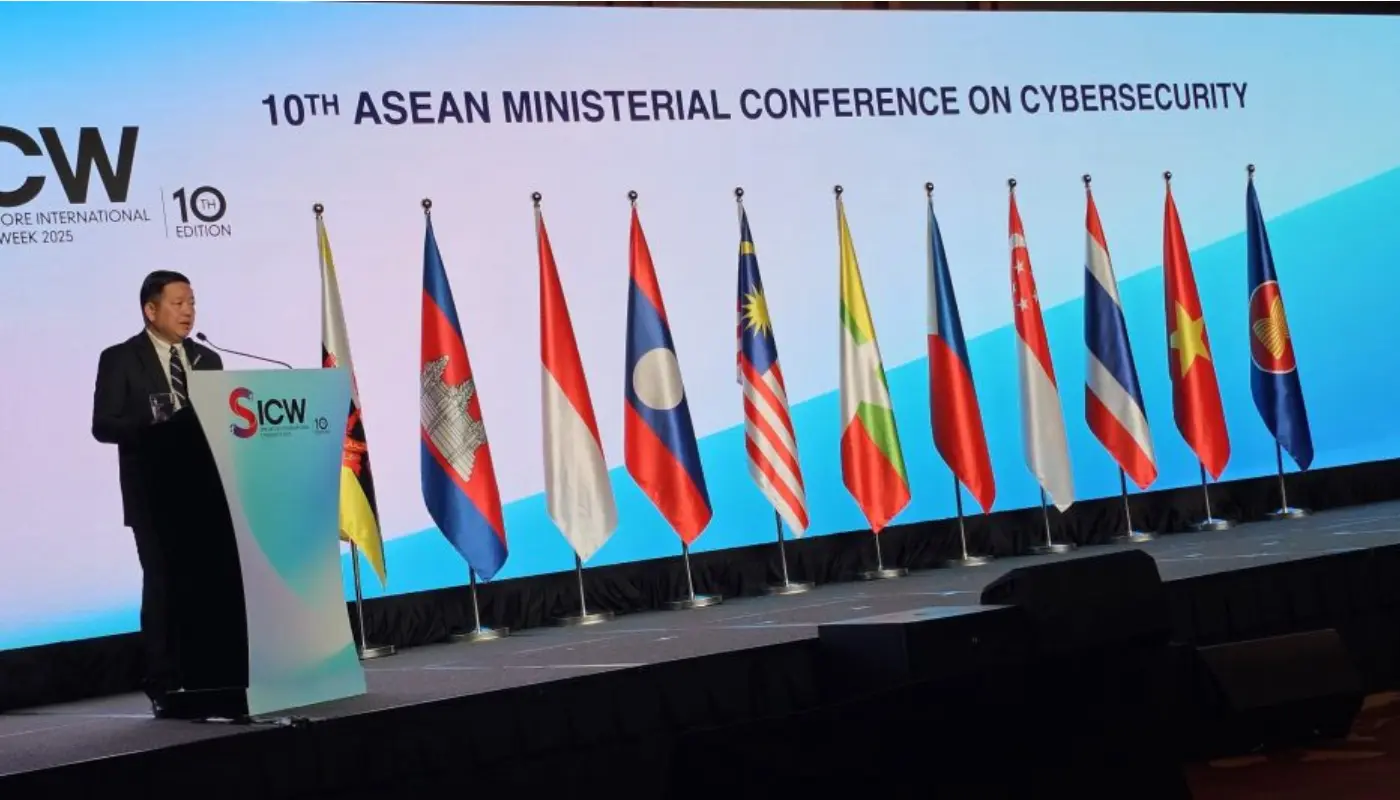
SINGAPORE – The Secretary-General of the Association of Southeast Asian Nations has called for a unified regional approach to confront escalating cyber threats, highlighting the critical intersection of digital economic growth and security.

Dr. Kao Kim Hourn delivered the address at the opening of the 10th ASEAN Ministerial Conference on Cybersecurity, an event forming part of the Singapore International Cyber Week.
He emphasised that as the region’s digital economy expands rapidly, so too does its vulnerability to malicious online activity.
The digital economy for the region witnessed a significant surge, reaching a gross merchandise value of $263 billion in 2024.
This represents a notable 15% increase from the previous year, with projections suggesting it could double to a staggering $2 trillion by the end of the decade.
This promising economic trajectory, however, is shadowed by a parallel rise in cybercrime. Recent studies indicate that businesses in Southeast Asia faced an average of 400 ransomware attempts every single day in 2024.
The financial impact is severe, with the average cost of a data breach for an ASEAN business potentially reaching $3.67 million.
Furthermore, online scams have become a pervasive issue, affecting a majority of the adult population across eight member states.
Dr. Kao outlined three central pillars for a robust regional response. The first priority involves constructing a more resilient ASEAN cybersecurity architecture.
This entails better policy coordination, enhancing human capacity, and improving readiness for incident response.
The full operationalisation of the ASEAN Regional Computer Emergency Response Team (CERT) is seen as a vital step for managing cross-border cyber incidents effectively.
The second area of focus addresses threats originating from emerging technologies. Dr. Kao specifically pointed to the dangers posed by artificial intelligence, such as AI-driven deepfakes and sophisticated scams, which reportedly cost victims an estimated $23.6 billion in 2024 alone.
He advocated for a “whole-of-ASEAN” approach, cutting across various sectors, to manage these systemic risks.
Finally, he stressed the necessity of sustaining and expanding collaboration with external partners. This international cooperation should be guided by the United Nations Norms of Responsible State Behaviour in Cyberspace.
Dr. Kao noted that partnerships, such as those through the ASEAN-Singapore Cybersecurity Centre of Excellence, are crucial for building technical and policy expertise across the region.
The impending conclusion of the ASEAN Digital Economy Framework Agreement (DEFA) was also highlighted as a key development.
It is anticipated that this agreement will include substantial provisions designed to reinforce trust and security as foundational elements of the region’s digital transformation.
The AEC Council is expected to announce a substantial conclusion of the DEFA negotiations later this week.
