



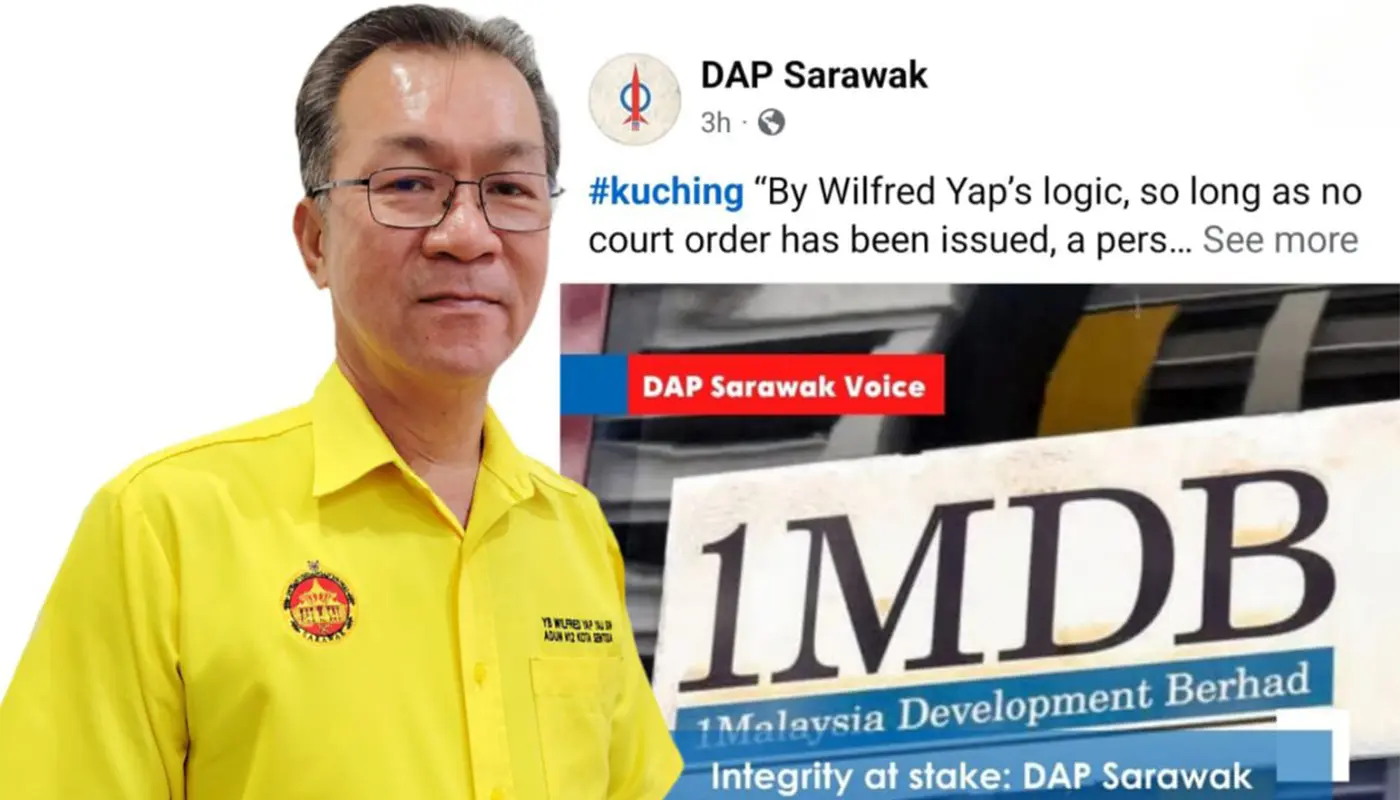
KUCHING – Kota Sentosa assemblyman Wilfred Yap has reiterated his position that accountability must be pursued through the rule of law, due process and independent institutions, rather than political pressure or public opinion.

In a statement, Yap rejected what he described as attempts by the DAP Sarawak Stampin Branch to divert public attention through emotive rhetoric and selective moral posturing. He argued that respect for the law is not a weakness but a moral obligation in any democratic society.
“No political party, including DAP, has the authority to appoint itself as judge, jury and executioner,” he said, adding that comparisons made by DAP Stampin equating the matter to an individual knowingly retaining stolen money were misleading.
Yap stressed that political parties are legal entities governed by statutory and judicial processes, and decisions involving them must be grounded in law rather than populist analogies designed to inflame sentiment.
He emphasised that defending due process does not equate to defending wrongdoing, but rather to protecting the integrity of institutions and ensuring justice is carried out properly and independently.
Turning his attention to governance, Yap said that if DAP Stampin is genuinely concerned about morality, integrity and accountability, it should reflect on its own record.
He pointed out that Pakatan Harapan, of which DAP is a major component, made explicit reform promises when forming the federal government in 2018 and again in 2022.
These promises included separating the roles of Attorney-General and Public Prosecutor, strengthening the independence of the Malaysian Anti-Corruption Commission (MACC), introducing political financing laws, enforcing mandatory asset declarations, implementing Freedom of Information legislation, recognising the Unified Examination Certificate (UEC), and enhancing constitutional checks and balances.
Yap noted that many of these reforms remain unimplemented despite DAP holding key Cabinet positions and having legislative authority.
“Moral lectures cannot substitute for legislative delivery. Selective outrage cannot replace institutional reform,” he said.
He concluded by reaffirming his commitment to governance anchored in institutions, stating that he will continue to stand firmly for the rule of law, due process and principled governance, rather than politics driven by rhetoric.
