



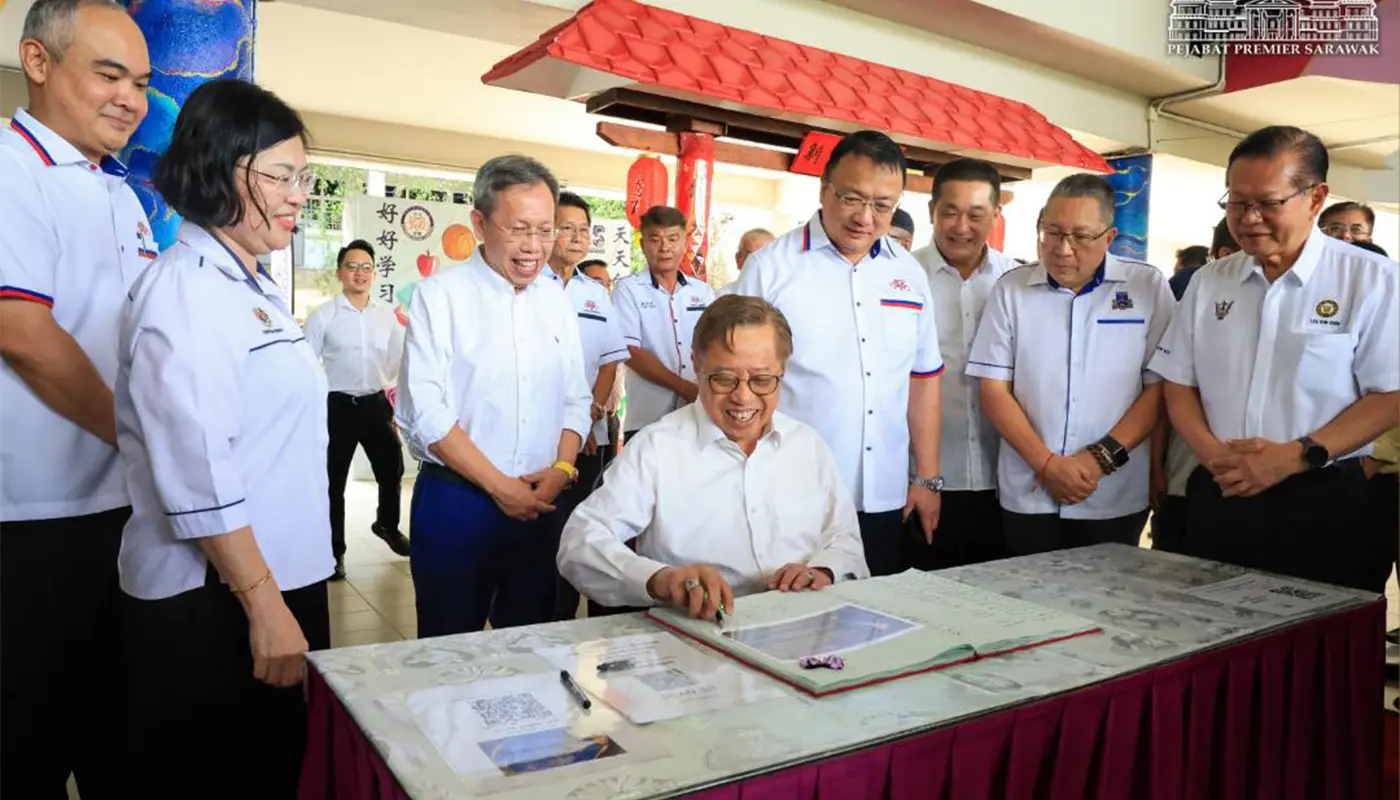
KUCHING – The Premier of Sarawak, Datuk Patinggi Tan Sri (Dr) Abang Haji Abdul Rahman Zohari bin Tun Datuk Abang Haji Openg, launched a pilot free school bus service on Monday, 12 January 2026, at SJK Chung Hua No. 6. The initiative aims to ease peak-hour traffic congestion while promoting sustainable urban living in the capital.

In his address, the Premier described the programme as a significant step towards building a smart city. He noted that while the concept is promising, its success depends on effective management and efficient service delivery.
“I applaud the effort to solve traffic congestion, but the success depends on how you actually run the service,” he said.
The free bus service is expected to provide direct financial relief to families by reducing household transport costs.
At the same time, it will help cut the number of private vehicles on school routes, thereby easing congestion during peak hours.
A key feature of the pilot is the integration of digital technology to enhance safety. All buses are equipped with closed-circuit television (CCTV) systems, enabling parents to monitor their children’s journeys in real time. “In this digital age, we use technology to enhance communication and security,” the Premier explained.
The pilot project will serve as a model for expansion to other high-traffic school zones across Kuching. With early results showing promise, the government intends to extend the service to more schools, particularly in areas prone to congestion.
The Premier emphasised that cooperation with communities and Parent-Teacher Associations (PIBGs) will be crucial, with the government covering the cost of buses and operations.
He further highlighted the importance of well-planned infrastructure to support Sarawak’s growth. “Our infrastructure must be carefully planned and properly built for us to be on the right track,” he said, expressing confidence that such initiatives position Sarawak as a regional leader in sustainable development.
The Premier also reaffirmed that Sarawak’s strong fiscal management underpins these social investments. He noted that consistent revenue growth allows the state to allocate resources to welfare programmes, including free bus services and free tertiary education. Dedicated budgets have been set aside to ensure the long-term sustainability of these initiatives.
The pilot project reflects Sarawak’s broader vision of combining smart city planning with social welfare, ensuring that development benefits both families and the wider community.
