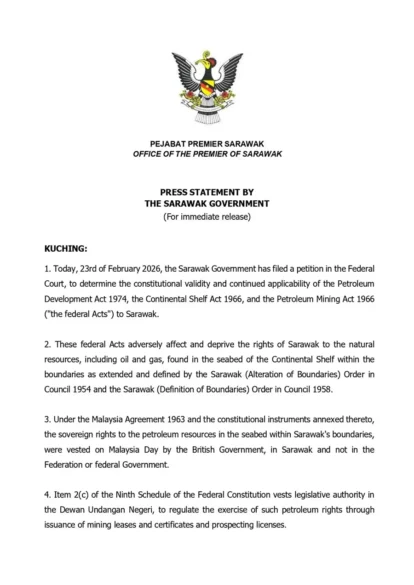
KUCHING – The Sarawak Government has submitted a petition to the Federal Court seeking a ruling on the constitutional validity and continued applicability of three federal laws relating to oil and gas resources.

Filed on 23 February 2026, the petition challenges the Petroleum Development Act 1974, the Continental Shelf Act 1966, and the Petroleum Mining Act 1966. The state administration argues that these laws undermine Sarawak’s rights to natural resources located within its boundaries, particularly petroleum deposits in the seabed of the continental shelf.
According to the government, Sarawak’s boundaries were defined by the Sarawak (Alteration of Boundaries) Order in Council 1954 and the Sarawak (Definition of Boundaries) Order in Council 1958. Under the Malaysia Agreement 1963 (MA63), sovereign rights over petroleum resources within these boundaries were vested in Sarawak by the British Government on Malaysia Day, not in the Federation.
The petition highlights that legislative authority over petroleum rights is vested in the Dewan Undangan Negeri under Item 2(c) of the Ninth Schedule of the Federal Constitution. This includes the issuance of mining leases, prospecting licences, and certificates.
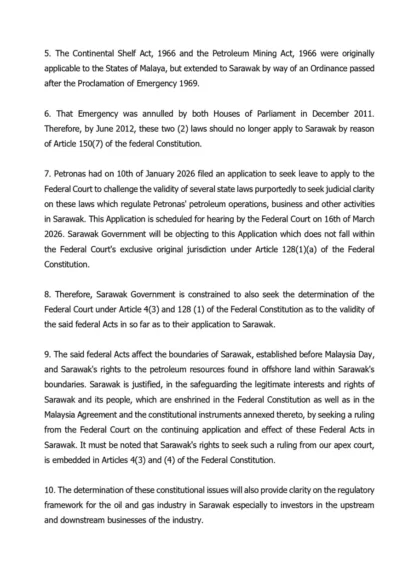
The Continental Shelf Act and Petroleum Mining Act were initially enacted for Malaya but extended to Sarawak during the Emergency declared in 1969. That emergency was annulled in December 2011, and by June 2012, Sarawak contends, the laws should have ceased to apply under Article 150(7) of the Constitution.
The filing comes after Petronas submitted an application on 10 January 2026 to challenge the validity of several Sarawak state laws regulating its operations. The Federal Court is scheduled to hear Petronas’ application on 16 March 2026. Sarawak has stated it will object, arguing that the matter does not fall within the Federal Court’s exclusive jurisdiction under Article 128(1)(a).
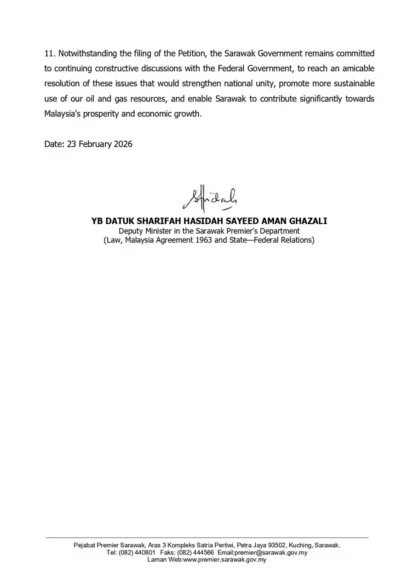
Deputy Minister in the Sarawak Premier’s Department, YB Datuk Sharifah Hasidah Sayeed Aman Ghazali, explained that the state is compelled to seek clarity from the Federal Court under Articles 4(3) and 128(1). She noted that the federal laws in question affect Sarawak’s boundaries and its rights to offshore petroleum resources, which must be safeguarded for the benefit of the people.
The government believes that resolving these constitutional issues will provide certainty for investors in Sarawak’s oil and gas industry, particularly those involved in upstream and downstream operations.
Despite pursuing legal action, the Sarawak Government reaffirmed its commitment to constructive engagement with the Federal Government. It expressed hope that an amicable resolution could be achieved, one that strengthens national unity, ensures sustainable resource management, and enhances Malaysia’s economic growth.