



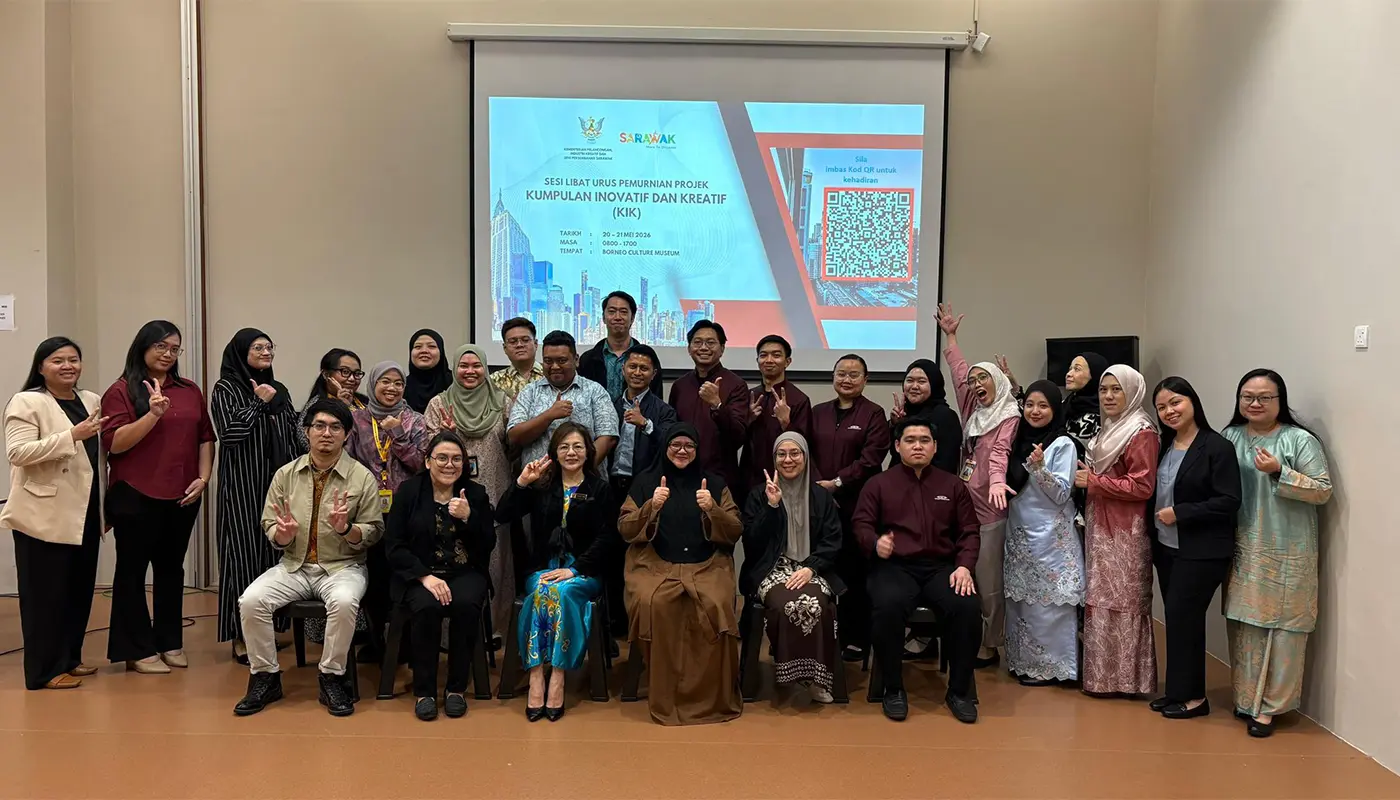
KUCHING – The culture of innovation and creativity within Sarawak’s public service continues to be strengthened through the Innovative and Creative Group (KIK) Project Refinement Session, held from 20 to 21 May 2026 at the Borneo Cultures Museum.
The session brought together 31 participants from the Sarawak Museum Department, the Sarawak Tourism Board, and the Ministry of Tourism, Creative Industries and Performing Arts.
The programme was designed to refine the KIK project documentation while also enhancing the quality of delivery and presentation techniques to meet professional standards and established assessment criteria.
KIK initiatives have long been recognised as a platform for public sector employees to develop creative solutions that improve efficiency and service delivery.
By refining project documentation and presentation methods, participants are better equipped to showcase their work in ways that highlight impact and sustainability.
Throughout the two-day engagement, participants exchanged ideas, shared experiences, and discussed best practices in producing high-impact innovation projects.
The collaborative environment encouraged cross-agency learning, ensuring that projects developed under the KIK framework are not only innovative but also practical and beneficial to the wider community.
Officials noted that the refinement session is part of a broader effort to embed innovation into the daily operations of government agencies.
By encouraging creativity and problem-solving, Sarawak aims to build a public service culture that is responsive to challenges and capable of delivering improved outcomes for citizens.
The Borneo Cultures Museum provided a fitting backdrop for the session, symbolising Sarawak’s commitment to preserving heritage while embracing modern innovation.
Participants highlighted that the venue itself served as inspiration, reinforcing the importance of balancing tradition with forward-looking development.
The KIK programme has been instrumental in driving improvements across various government departments, from streamlining administrative processes to enhancing tourism promotion strategies.
By focusing on refinement, the latest session ensured that projects are aligned with state priorities and capable of delivering measurable results.
As Sarawak continues to invest in innovation, sessions like these demonstrate the government’s commitment to nurturing talent and fostering collaboration across agencies.
The emphasis on documentation and presentation reflects the importance of accountability and professionalism in ensuring that creative ideas translate into effective solutions.
