



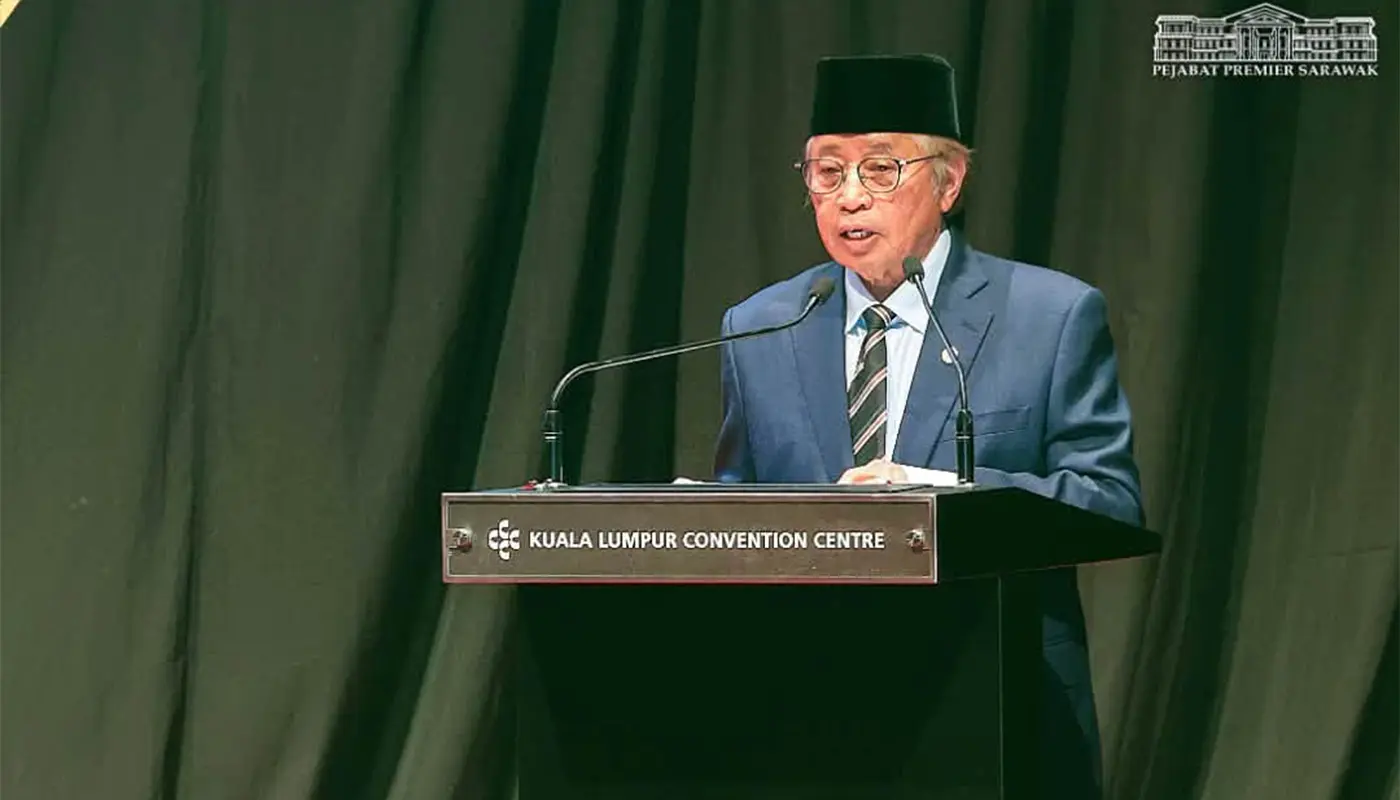
KUALA LUMPUR – The Premier of Sarawak, Datuk Patinggi Tan Sri (Dr) Abang Haji Abdul Rahman Zohari bin Tun Datuk Abang Haji Openg, has called for a paradigm shift in how charitable endowments are viewed in the modern era.
Speaking at the Opening Ceremony of the International Waqf Da’wah Convention 2026, he argued that knowledge must be recognised as a critical form of waqf, equal in value to traditional physical assets such as land and property.
The event, held at the Plenary Hall of the Kuala Lumpur Convention Center (KLCC), brought together scholars, policymakers, and community leaders to discuss the evolving landscape of Islamic philanthropy.
In his address, the Premier highlighted that the global economy is increasingly driven by intellectual capital rather than natural resources alone. Consequently, the mechanisms for preserving and sharing wealth must adapt to this reality.
He posited that the concept of Knowledge Waqf is essential for ensuring that expertise, innovation, and scientific discoveries continue to benefit society long after their initial creation.
Unlike physical assets that may depreciate or require significant maintenance, knowledge grows when shared. By treating intellectual contributions as endowments, individuals and institutions can create a lasting legacy that supports future generations.
“In the era of rapid technological advancement, science, technology, innovation, artificial intelligence (AI) and advanced research must become integral components of the waqf ecosystem,” the Premier stated.
This assertion underscores the need to integrate modern technological fields into the traditional framework of Islamic charity. It suggests that funding for AI research, digital literacy programmes, and scientific breakthroughs should be considered acts of enduring charity.
Historically, Islamic civilisation flourished due to its emphasis on learning and the preservation of knowledge. The Premier drew parallels to great centres of learning from the past, noting that they thrived because knowledge was valued, protected, and disseminated for the common good.
He urged contemporary society to revive this spirit, ensuring that expertise is not hoarded within exclusive institutions but is made accessible as a public asset.
The Premier outlined specific ways in which different members of society can contribute to this new model of waqf. Scholars are encouraged to dedicate their teaching and writings, scientists to share their discoveries, and professionals to mentor the next generation.
Educational institutions, meanwhile, play a pivotal role by expanding access to quality education and conducting research that addresses societal challenges.
“A scholar who shares knowledge, a researcher who contributes new discoveries, a professional who mentors young minds, and an institution that invests in education are all contributing to a form of waqf that has the power to transform generations,” he explained.
This broad definition allows for a more inclusive approach to philanthropy, where time and expertise are valued alongside monetary donations.
The ultimate goal of promoting Knowledge Waqf, according to the Premier, is to strengthen the resilience and competitiveness of the Muslim Ummah. In a world where economic power is increasingly tied to innovation and skills, relying solely on natural resources is no longer sufficient.
By investing in human capital through sustainable endowment models, communities can ensure they remain relevant and robust in a globalised economy.
This initiative also aligns with broader national goals of enhancing educational outcomes and driving technological adoption.
For Sarawak, which has been actively pursuing digital transformation and high-income economy status, the promotion of Knowledge Waqf offers a culturally resonant pathway to achieve these objectives. It bridges the gap between religious values and modern economic demands.
The convention served as a platform to explore practical implementations of this concept. Discussions likely covered legal frameworks for protecting intellectual property within waqf structures, funding models for research initiatives, and strategies for encouraging corporate participation.
The engagement of international participants indicates a growing recognition of this issue beyond Malaysia’s borders.
As the digital age accelerates, the ability to adapt traditional practices to new contexts becomes crucial. The Premier’s advocacy for Knowledge Waqf represents a forward-thinking approach to community development.
It challenges stakeholders to rethink the nature of contribution and legacy, moving beyond tangible assets to embrace the intangible power of ideas and expertise.
The success of such initiatives will depend on widespread adoption and institutional support. By positioning knowledge as a sacred trust and a communal resource, the Muslim community can harness its collective intellectual potential.
This approach not only preserves heritage but also drives progress, ensuring that the benefits of innovation are shared equitably across society.
