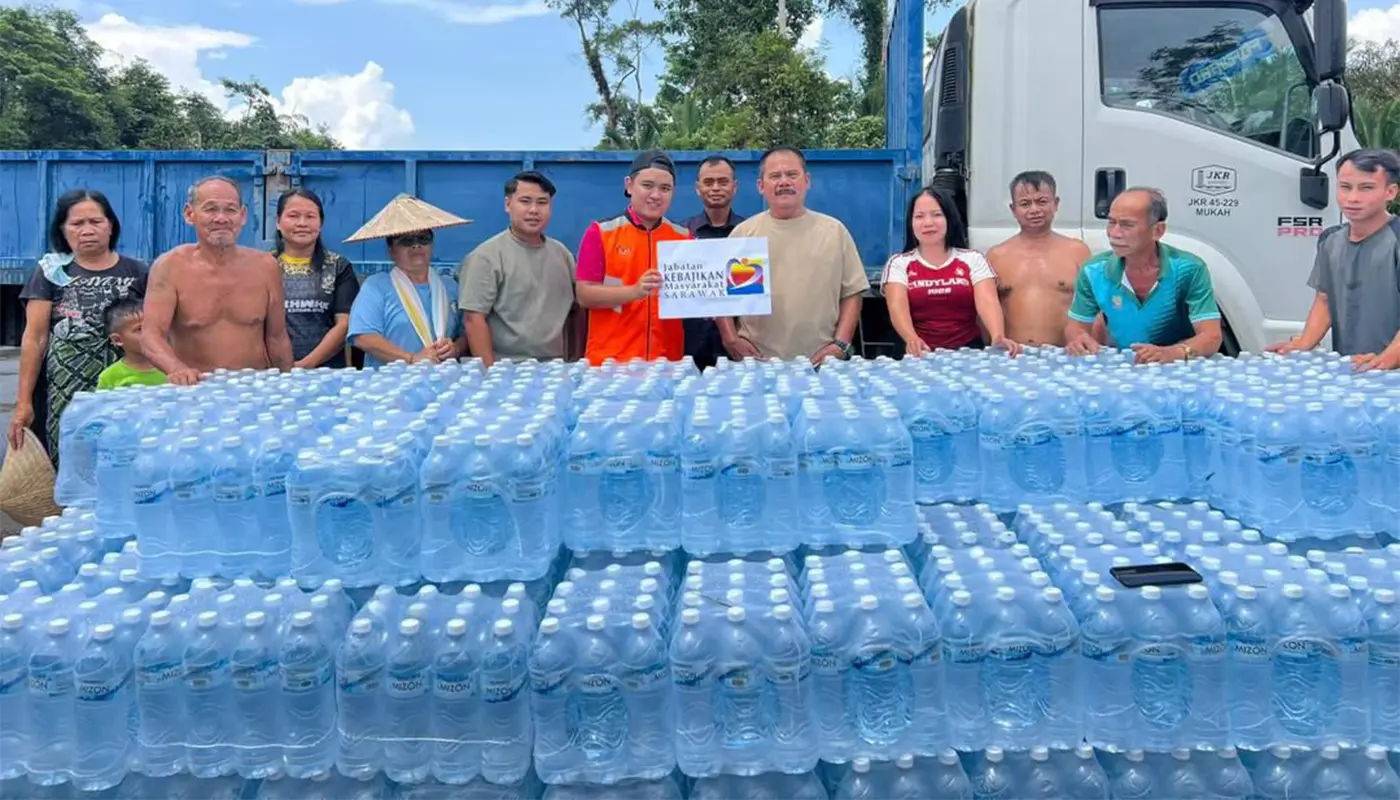
DALAT – The Mukah Division Public Works Department (JKR) has successfully concluded a multi-day relief operation to provide essential drinking water to remote communities in the Ulu Baoh region.
The initiative was launched in response to an extended period of dry weather which has significantly depleted local water reserves.
Operating under the strategic direction of the Dalat District Disaster Management Committee, the distribution exercise was carried out in phases on 28 and 30 March.

The mission targeted high-priority areas where natural water sources had reached critical lows due to the unrelenting heatwave affecting the central region of Sarawak.
Logistical teams managed to reach fifteen longhouses and one educational institution during the two-day window.

These rural settlements, which often rely on gravity-fed systems or rainwater harvesting, have been hit particularly hard by the current climatic conditions, making the delivery of bottled or tanked clean water a necessity for daily survival.
A spokesperson from JKR Sarawak Media highlighted that the department’s participation in this programme is a core component of its commitment to public welfare.
By integrating with local disaster committees, the department aims to provide a rapid response to emergencies that threaten the stability and health of interior communities.
The distribution of clean water is seen as a vital stop-gap measure to ensure that hygiene standards and hydration levels are maintained in schools and residential longhouses.
Officials noted that the “integrated effort” between various government agencies is essential for pooling resources and navigating the challenging terrain of the Dalat district.
Beyond the immediate relief, the programme serves as a reminder of the ongoing challenges posed by seasonal weather shifts in East Malaysia.
The collaboration between JKR and the District Disaster Management Committee is expected to continue as long as the dry spell persists, ensuring that the burden on rural residents is mitigated.
Authorities have reiterated that ensuring the security of the water supply remains a top priority. They hope that these proactive measures will safeguard the well-being of the Ulu Baoh populace until the weather patterns return to normal and local reservoirs are replenished.