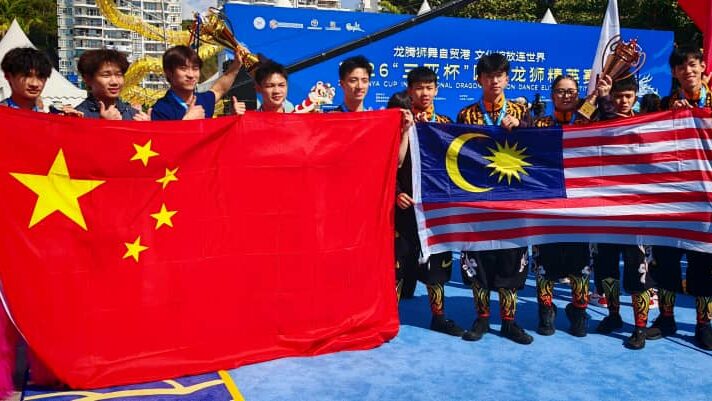
SANYA, Hainan, 19 January 2026 — Malaysia’s Northern Lion Dance team delivered a respectable performance on the international stage after finishing sixth at the 2026 Sanya Cup International Dragon and Lion Dance Elite Competition in China. The event, organised by the Hainan Tourism and Cultural Bureau and sanctioned by the International Dragon and Lion Dance Federation, gathered elite teams from across Asia and showcased some of the highest standards in the sport.
Malaysia was represented by the Chinese Martial Art Association (CMAA) Northern Lion Dance Team, which entered the competition as newcomers. Despite their limited experience at this level, the team managed to place ahead of several established competitors, including teams from Indonesia and South Korea. Indonesia had previously claimed the Sarawak Open title in 2024, making Malaysia’s result all the more encouraging.
The competition was firmly dominated by teams from China, who secured the top five positions. Their routines reflected years of refinement, strong technical control, and a deep understanding of traditional Northern Lion Dance characteristics. Hunan emerged as the overall champion, followed by Guizhou in second place. Fujian, Shanghai, and host province Hainan completed the top five rankings.
Team manager Ivan Lee Teo Heng described the result as a pleasant surprise. He noted that the Malaysian squad is largely made up of young performers, with an average age just above 17. Among them were 16-year-old Kong Wen Ying from St Joseph’s Private School, Kuching, as well as Lee Kian Cheng, Jonas Chu Ting Hai, and Vincent Wong Hung Jing, all aged 16 from SMK DPHA Gapor, Kuching. The oldest member, Phang Yi Quan, aged 26, is also from Kuching. According to Ivan, the youthfulness of the team points to strong long-term potential, provided they continue training with discipline and focus.
Coach Calvin Kong Ngon Chung shared a similar view, stressing that time is on the team’s side. He acknowledged that Chinese teams currently operate at a much higher level in terms of technical mastery and artistic expression. However, he believes the exposure gained in Sanya will be invaluable for Malaysia’s future progress. The lessons learned from competing against world-class opponents, he said, will help speed up the team’s development.
The sixth-place finish may not come with a trophy, but it represents an important step forward. For a young Malaysian team competing against the best in the world, the result reflects solid groundwork, cultural pride, and a promising road ahead for Northern Lion Dance in Malaysia.