
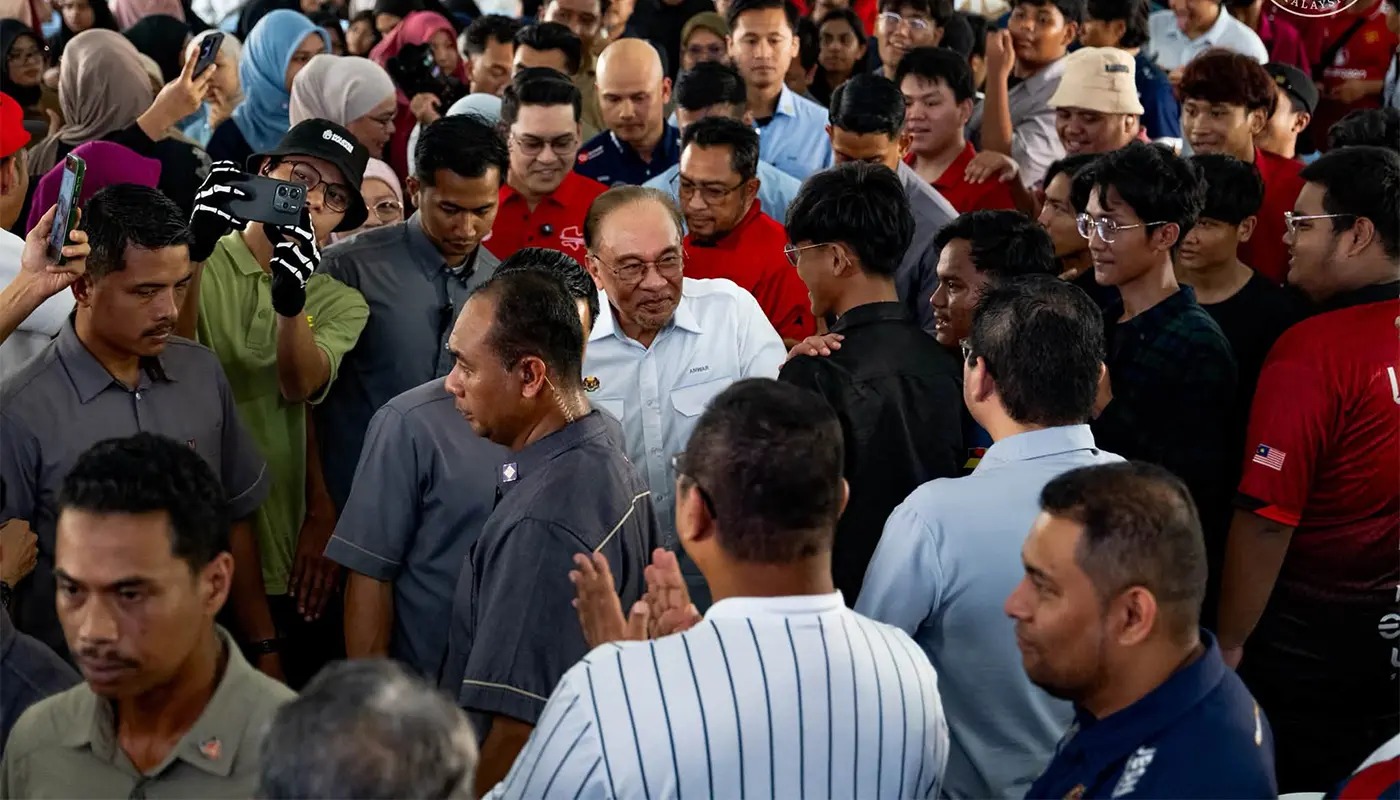


PASIR PANJANG – Prime Minister Anwar Ibrahim has issued a strong call to the nation’s youth to safeguard Malaysia’s social harmony and reject divisive racial politics.
Speaking at the Kembara Inspirasi Belia Akar Umbi (KIBAR) Negeri Sembilan event, the Prime Minister emphasised that peace and stability are fragile assets that must be actively defended against the corrosive effects of hateful rhetoric.
The engagement took place in Pasir Panjang, where Mr Ibrahim met with young community leaders and activists ahead of the country’s independence celebrations.
He used the platform to articulate a vision of national unity that transcends ethnic boundaries, urging the younger generation to prioritise collective progress over sectarian interests.
Mr Ibrahim stressed that Malaysia belongs to all its citizens. He argued that the development of Malays and Bumiputeras should not come at the expense of other communities.
Instead, he advocated for an inclusive approach where the Chinese, Indians, Orang Asli, and the peoples of Sabah and Sarawak can equally thrive. The goal, he stated, is a society where every demographic group succeeds without fear of suppression or denial of rights.
Addressing the root causes of societal friction, the Prime Minister noted that the nation’s challenges are not inherent to any specific race. Rather, he attributed many issues to a crisis of leadership and trust.
He warned against handing power to individuals who lack qualification, integrity, or moral compass. According to Mr Ibrahim, intelligence alone is insufficient; it must be paired with strong ethical values.
“Evaluate leaders based on their records, service and honesty, not racial sentiments or incitement to hatred,” he urged the audience. This message serves as a direct counter to political narratives that rely on ethnic polarisation to gain support.
The Prime Minister called for a meritocratic assessment of public officials, focusing on their tangible contributions and adherence to principles of good governance.
Since assuming office, Mr Ibrahim highlighted his administration’s efforts to address inherited shortcomings and improve the lives of all Malaysians. He reiterated his dual responsibility: to protect the special position of Malays and Bumiputeras while ensuring that the rights and welfare of non-Bumiputera communities are fully respected.
He described this balanced approach as a fundamental requirement of patriotism, stating that love for the country demands fairness and the embrace of all people as one family.
The Prime Minister also outlined expectations for the youth in navigating the modern world. He encouraged young Malaysians to be bold in pursuing advancements in technology, artificial intelligence, and the digital economy.
However, he cautioned that technological prowess must be grounded in strong spiritual and cultural foundations. Religion, morality, culture, and human values were identified as essential anchors that prevent societal disintegration amidst rapid modernisation.
“This spirit must be inherited and continued by the younger generation,” Mr Ibrahim said. He envisioned a future where independence is defined not just by historical sovereignty but by the quality of its citizenry.
A developed, united, and dignified Malaysia, he argued, requires a generation that is knowledgeable, courageous, and trustworthy.
The KIBAR programme, which focuses on grassroots youth inspiration, aligns with the government’s broader strategy to engage young people in nation-building.
By fostering dialogue and providing platforms for interaction, such initiatives aim to build resilience against extremist ideologies and promote a shared national identity.
As Malaysia approaches its independence milestones, the emphasis on unity remains critical. Political analysts note that maintaining social cohesion in a multi-ethnic society requires constant vigilance and proactive leadership.
The Prime Minister’s remarks reflect an ongoing effort to reshape the national discourse towards inclusivity and mutual respect.
The integration of traditional values with modern competencies was presented as the key to sustainable progress. Young leaders were encouraged to view their diverse heritage as a strength rather than a division.
By embracing this multifaceted identity, the next generation can drive economic innovation while preserving the social fabric that holds the nation together.
Mr Ibrahim concluded by reaffirming that the true meaning of independence lies in the ability of the people to live together in dignity and harmony.
It is a collective responsibility that requires every citizen, regardless of background, to contribute to the common good. The path forward, he suggested, is paved with integrity, competence, and an unwavering commitment to unity.


