KUCHING – Sarawak is moving quickly to establish itself in the space sector by leveraging CubeSat technology, aiming to become a key player in the regional aerospace and new space economy.
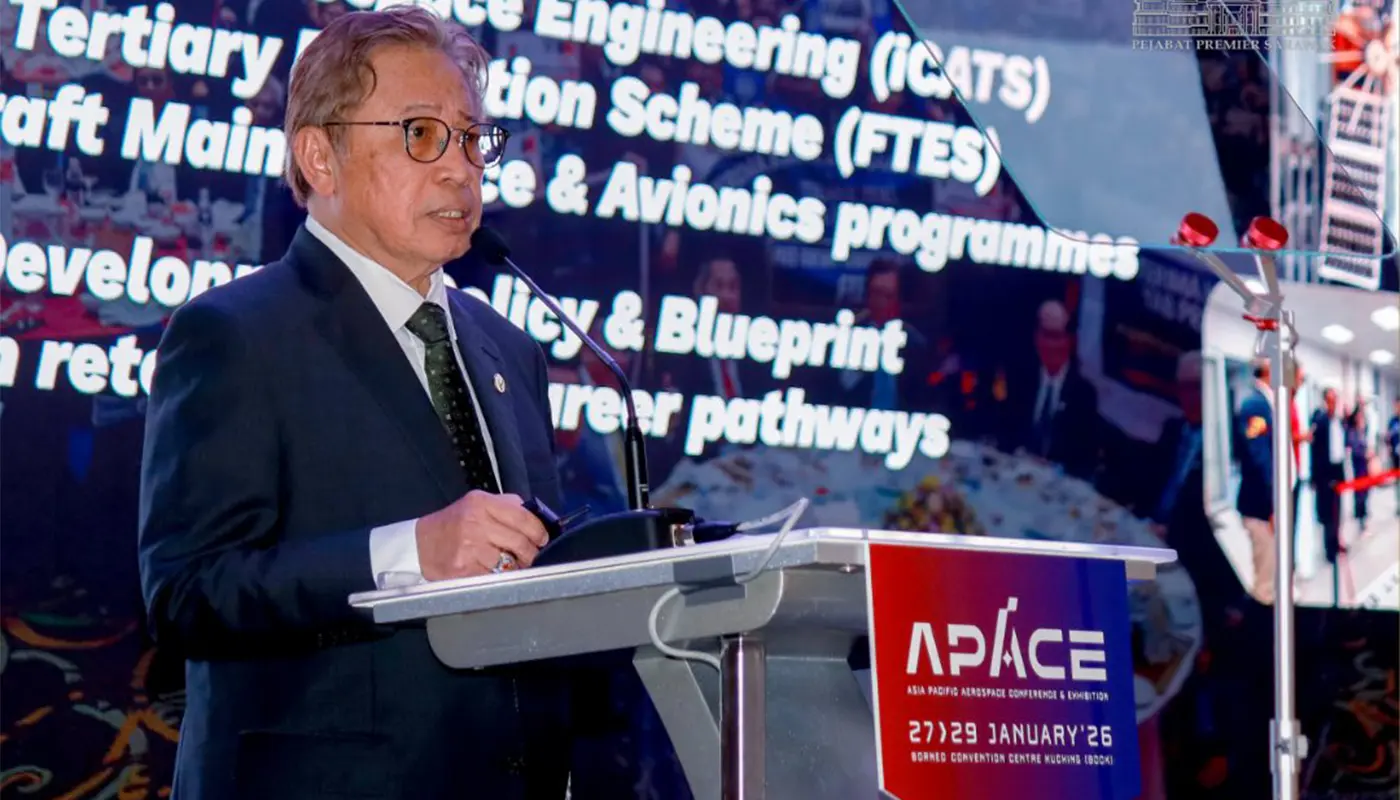
The announcement was made by the Premier of Sarawak, Datuk Patinggi Tan Sri (Dr) Abang Haji Abdul Rahman Zohari bin Tun Datuk Haji Openg, during his keynote at the Asia Pacific Aerospace Conference and Exhibition (APACE) 2026 at the Borneo Convention Centre Kuching.
Highlighting aerospace as a strategic sector, the Premier stressed that space technology is crucial for economic competitiveness, technological independence, and environmental monitoring in the modern era.

At the core of Sarawak’s approach are CubeSats, small, modular, and low-cost satellites. While traditional satellites cost between 100 and 300 million euros and take 5 to 15 years to develop, CubeSats can be built for less than 500,000 euros and launched within a year, offering both financial and operational advantages.
The Premier noted that CubeSats democratize access to space, allowing rapid deployment and minimizing financial risk. Operating in Low Earth Orbit, they provide low-latency, high-bandwidth communication and are ideal for Earth observation, vital for monitoring Sarawak’s extensive rainforests, rivers, and coastline.

Sarawak has already applied CubeSats in areas such as forest and natural resource management, agriculture, land-use planning, disaster preparedness, and maritime monitoring.
Looking ahead, the state plans to expand satellite systems, ground operations, and AI-driven data analytics. “It means building ground stations and supporting start-ups to turn this data into actionable intelligence for farmers, foresters, and first responders,” the Premier explained.
The CubeSat initiative is part of Sarawak’s broader aerospace development under the Post-COVID-19 Development Strategy 2030 (PCDS 2030), which focuses on building local capability through education, governance, and industry partnerships.
Key programs include the Faculty of Aerospace Engineering at i-CATS University College, specialised Aircraft Maintenance, Repair, and Overhaul (MRO) programmes, and the Sarawak Talent Development Policy.
New educational facilities, such as the Sarawak Science Centre and the Borneo Astronomy Centre in Santubong, were also announced to inspire the next generation of STEM professionals.
“In doing so, we are building our capacity to secure our future and contribute meaningfully to a collaborative and competitive aerospace landscape for all of ASEAN,” the Premier concluded, signalling Sarawak’s ambition to transition from a consumer of aerospace technology to an active developer, with CubeSats as a cornerstone.
APACE 2026 highlighted Sarawak’s pragmatic yet ambitious approach to the space economy, showcasing CubeSats as a practical, high-impact entry point for the state’s emerging role in aerospace innovation.