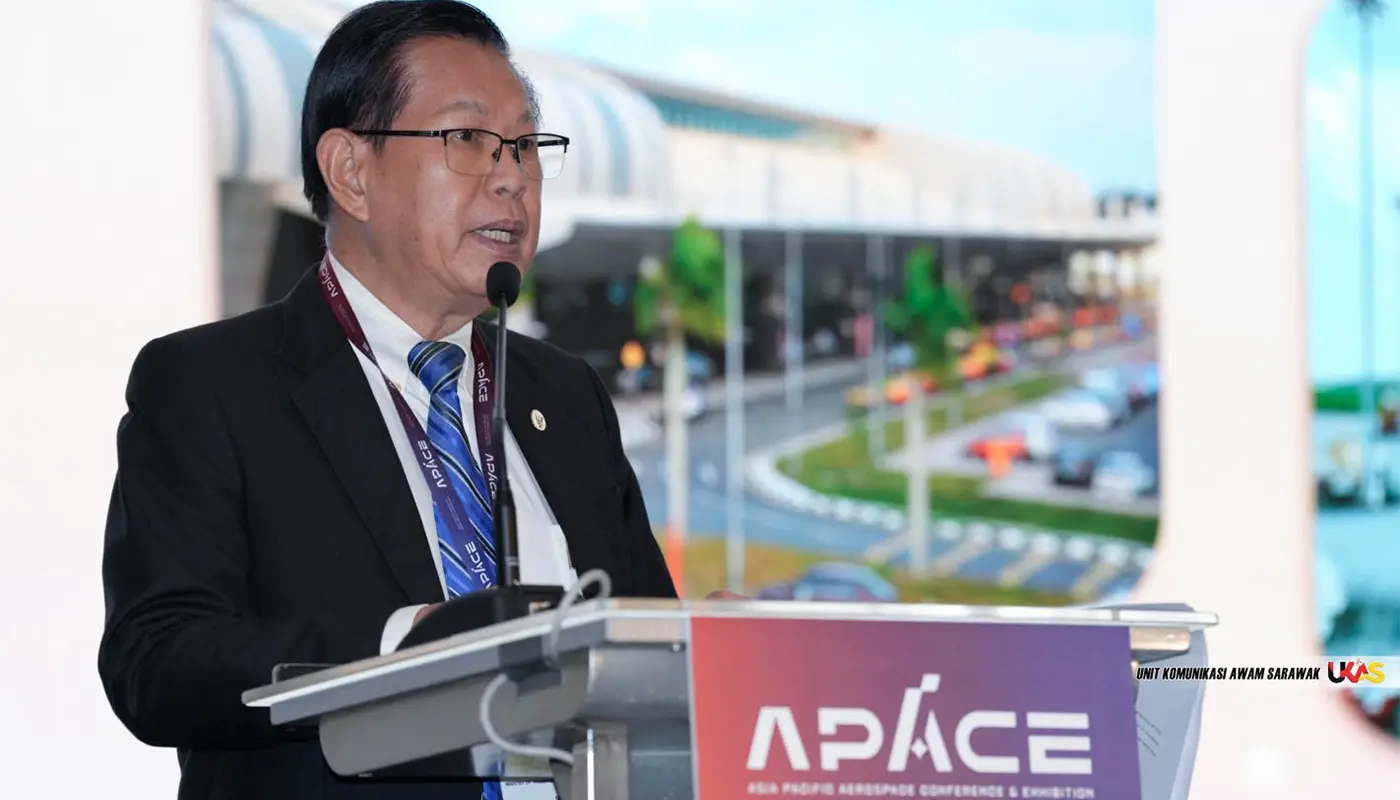
KUCHING – Sarawak has revealed plans to build a future-ready aviation ecosystem, prioritising safety, sustainability, talent development, and governance aligned with international standards.
Transport Minister Dato Sri Lee Kim Shin explained that aviation is not just an economic driver but a vital necessity for Sarawak, given its vast geography and scattered communities across coastal, inland, and highland areas.
“For Sarawak, flying is not a luxury, but a necessity. It connects rural communities to health and education services, supports tourism and trade, and strengthens emergency and disaster response capabilities,” he said at the Asia Pacific Aerospace Conference and Exhibition 2026 at the Borneo Convention Centre Kuching (BCCK).

Before the pandemic, Sarawak’s airports handled over 10 million passengers annually, underlining the sector’s importance for daily life and economic development.
A feasibility study is underway for a new Kuching International Airport, aimed at meeting long-term needs over the next 30 to 50 years. Lee stressed that the project goes beyond expanding the airport—it focuses on resilience against climate risks, readiness for future aircraft technologies, and integrating sustainability from the start.

The new airport will form part of an integrated aerotropolis, incorporating aviation-linked industries such as maintenance, repair and overhaul (MRO), aerospace component manufacturing, logistics, training, and industrial support services.
Lee also highlighted Sarawak’s network of Short Take-Off and Landing (STOL) airports, essential for connecting rural areas and supporting medical evacuations and humanitarian aid. He described STOLPORTs as strategic assets, increasingly relevant with the rise of hybrid aircraft and decentralised air mobility.
The Sarawak Government’s acquisition and rebranding of MASwings was noted as a strategic move to strengthen connectivity, especially for underserved rural routes.
Talent development is another key focus, with Sarawak partnering with local and international institutions to train professionals in engineering, airport operations, safety compliance, digitalisation, and green aviation. “Our goal is clear: Sarawak must build its own capacity, not rely on others,” Lee emphasised.
He also expressed Sarawak’s readiness to collaborate with regional and international partners in aviation networks, aerospace services, training, and green aviation initiatives, reinforcing its strategic role within BIMP-EAGA cooperation.
“The future of aviation will favour those who plan ahead, invest wisely, and cooperate openly. Sarawak chooses to prepare and build for the long term,” he concluded.