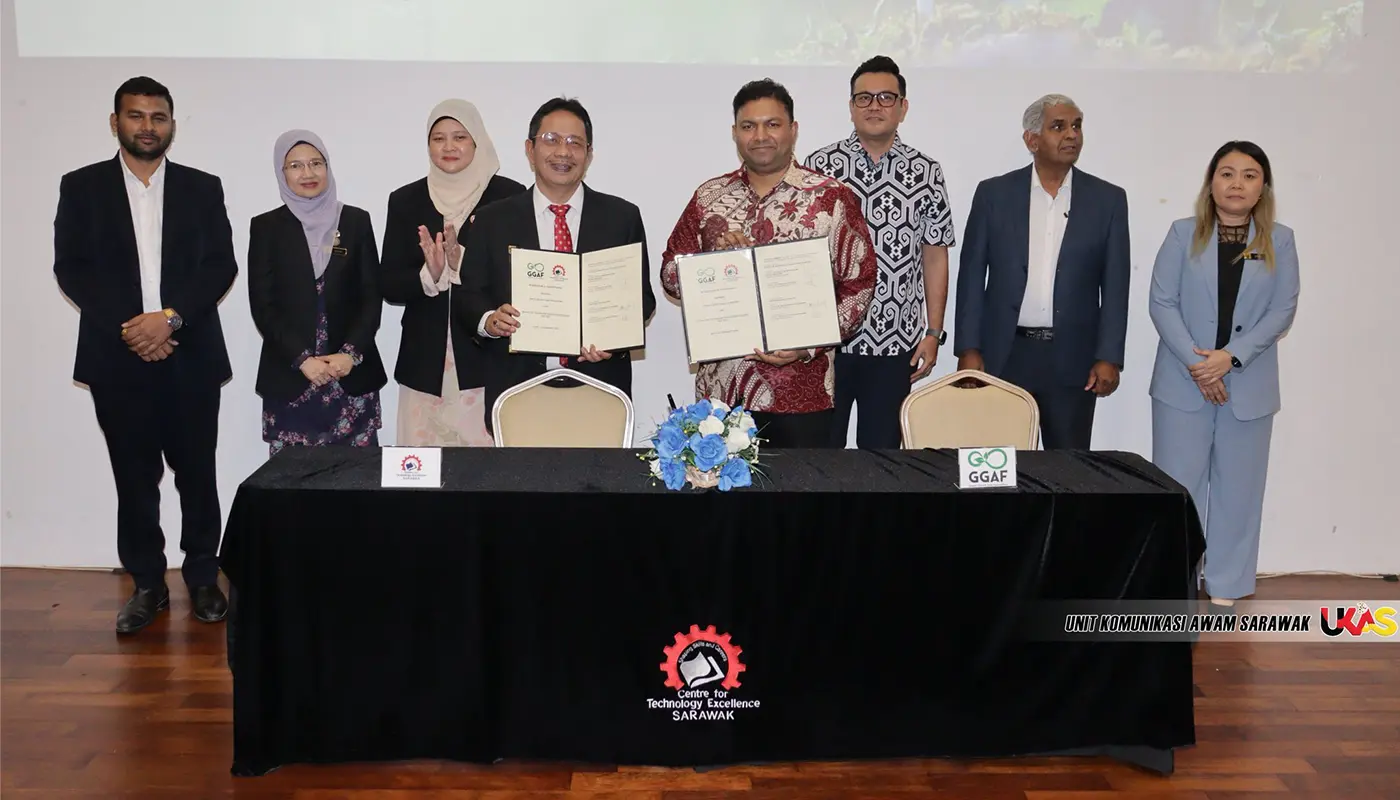
KUCHING – The Sarawak Centre for Technical Excellence (CENTEXS) has formalised a partnership with the Green Growth Asia Foundation (GGAF) through a Memorandum of Understanding (MoU) aimed at strengthening green talent development and advancing the low carbon city agenda in the state.
The agreement was signed by Dato Syeed Mohd Hussien Wan Abd Rahman, Chief Executive Officer of CENTEXS, and Dr Balamurugan Ratha Krishnan, Chief Executive Officer of GGAF, during a ceremony held on Wednesday.
The collaboration is designed to enhance Education for Sustainable Development (ESD) within the technical and vocational education and training (TVET) ecosystem. It will also provide capacity-building opportunities for city implementers and expand career pathways in the growing green economy.
The MoU coincided with the “GreenGov 360: Building Future-Ready Cities through GCAP – ESG Strategies to City Action” programme, which ran for two days beginning 24 February at CENTEXS.
The initiative brought together city implementers and stakeholders to strengthen the translation of Environmental, Social and Governance (ESG) strategies into practical, high-impact actions.
Speaking at the event, the CENTEXS CEO highlighted that the partnership represents a shift from planning to implementation, particularly in building grassroots capacity for sustainable development.
He noted that earlier collaborations with GGAF, including the Green City Action Plan and Eco-Campus programme, had laid a strong foundation for trust and alignment.
Meanwhile, the GGAF CEO stressed that the success of the green economy depends on the availability of skilled human capital aligned with global ESG standards. He emphasised that the partnership would help nurture talent capable of meeting these demands.
Under the agreement, both organisations will jointly develop ESD-based TVET programmes ranging from certificate to diploma levels. These will include train-the-trainer initiatives and micro-credential pathways to ensure flexibility and scalability.
Capacity-building training linked to the Green City Action Plan will be rolled out in phases through technical clinics, enabling local authorities to systematically operationalise green priorities.
The collaboration also seeks to strengthen digital capabilities in green city planning by leveraging Geographic Information Systems (GIS), Internet of Things (IoT), and data analytics. A pilot project based on the ‘sandbox’ concept will be introduced to test innovative solutions.
Another key element of the partnership is the creation of a sustainability certificate, designed to equip participants with practical skills that match job market requirements while aligning with ESG principles.
City councils, government agencies, industry players, higher learning institutions and community organisations are expected to join the training and outreach programmes during the initial phase.
This strategic initiative is anticipated to reinforce Sarawak’s green workforce ecosystem, support sustainable development goals, and enhance the competitiveness of the state’s cities at both national and regional levels.