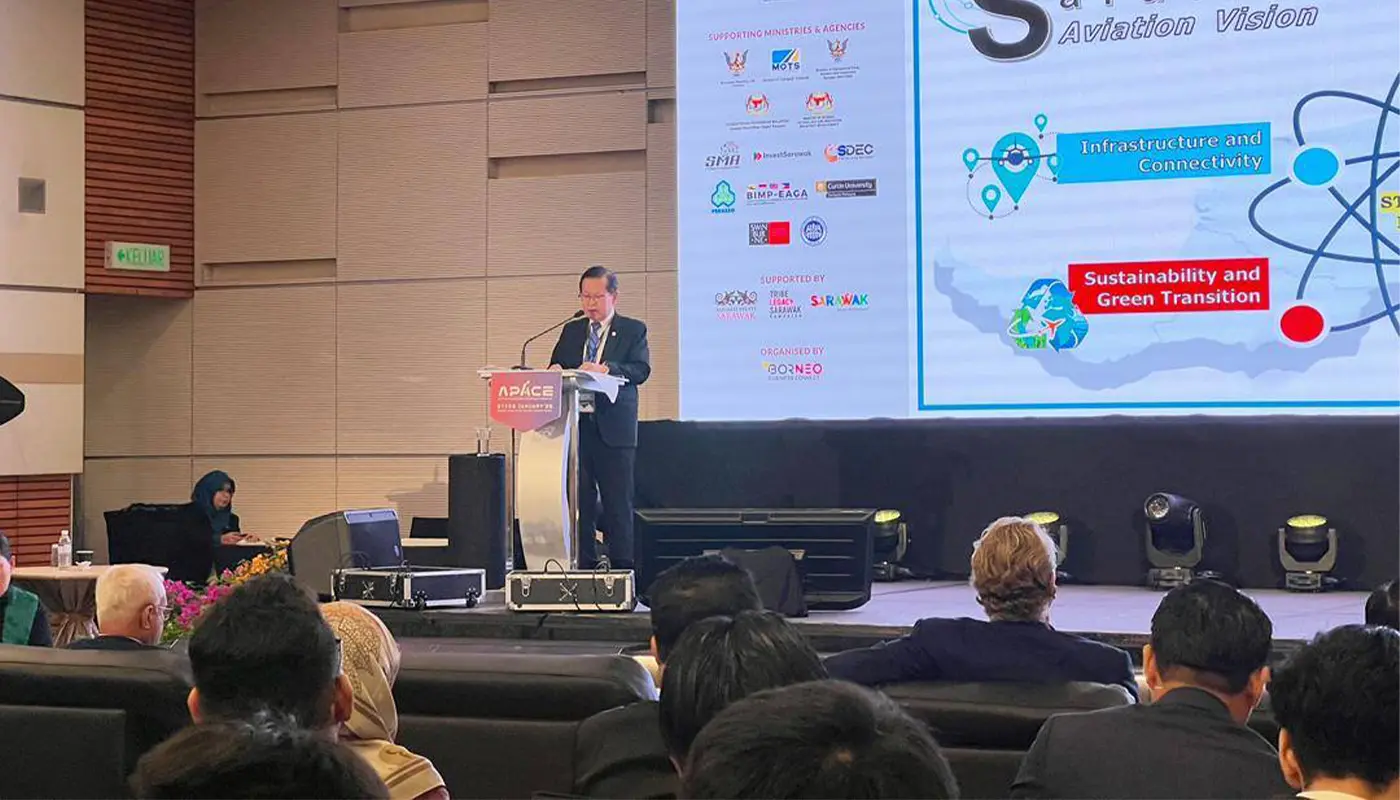
KUCHING – Sarawak is preparing for the long term in its aviation development with plans for a New Kuching International Airport (NKIA), aimed at ensuring the state remains competitive over the next three to five decades.
Transport Minister Dato Sri Lee Kim Shin said a feasibility study is currently underway, stressing that the initiative is not merely about building a bigger airport, but about developing a future-ready aviation ecosystem.
Speaking in his keynote address at the Asia Pacific Aerospace Conference and Exhibition (APACE) 2026 at the Borneo Convention Centre Kuching, Lee said the state must plan ahead to meet future capacity demands, advances in aircraft technology and sustainability requirements. “We need to ask what capacity Sarawak will require over the next 50 years, how we design for future aircraft technologies, and how sustainability and resilience are built in from the very beginning,” he said.

Aviation plays a critical role in connecting Sarawak’s vast territory and dispersed population. Before the pandemic, the state’s airports handled more than 10 million passengers annually, highlighting their importance to trade, tourism and investment.
The proposed NKIA is envisioned as part of an integrated aerotropolis, incorporating aviation-related industries such as maintenance, repair and overhaul (MRO), aerospace manufacturing, logistics, training and certification services. Lee noted that global experience shows successful airports evolve into aviation-centred economic ecosystems, rather than operating solely as transport terminals.

Sustainability forms a core pillar of the plan. Lee pointed to Sarawak’s potential in sustainable aviation fuel, energy-efficient airport design and low-emission operations, emphasising that sustainability must be embedded from the outset to ensure long-term competitiveness.
Sarawak also enjoys strategic advantages, including its network of Short Take-Off and Landing (STOL) airstrips and the establishment of AirBorneo following the acquisition of MASwings. These assets are expected to strengthen regional and rural connectivity, ensuring communities have access to healthcare, education and essential services.
Lee further highlighted Sarawak’s strategic location within the Brunei-Indonesia-Malaysia-Philippines East ASEAN Growth Area (BIMP-EAGA), making aviation a key driver of regional integration. He said aviation supports not only tourism and trade, but also disaster resilience and emergency response.
“The future of aviation will favour those who plan early, invest wisely and collaborate openly. Sarawak chooses to build for the long term,” he said.
If realised, the NKIA project is expected to significantly transform Sarawak’s aviation landscape, creating new opportunities for economic growth, sustainable development and stronger regional connectivity.