



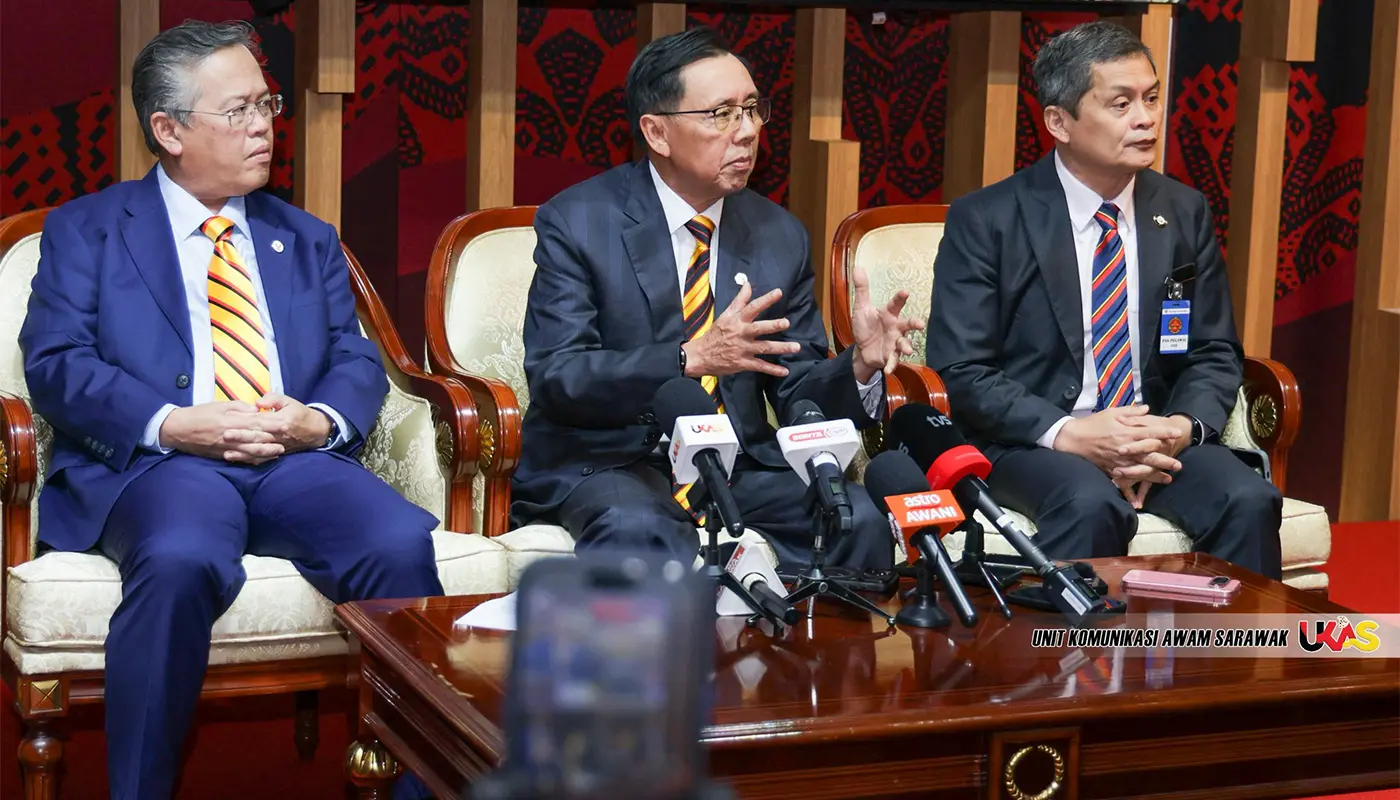
KUCHING – The Sarawak State Legislative Assembly has approved the Sarawak Paddy and Rice Board Bill 2026, a move widely regarded as a strategic measure to strengthen food security and stabilise rice supply in the state.

Minister of Food Industry, Commodities and Regional Development, Dato Sri Dr Stephen Rundi Utom, explained that the government’s immediate priority is to increase local rice production and build a sustainable, modern and organised paddy ecosystem.
He noted that strengthening the supply chain and boosting domestic production capacity are essential before effective price control mechanisms can be introduced.
“When Sarawak succeeds in producing sufficient rice supplies and controlling its own downstream chain, then we will be in a stronger position to stabilise rice prices.
For now, the main focus is to ensure that the state’s food supply continues to be secured and local production is enhanced,” he said during a press conference held in conjunction with the Assembly sitting.
Dr Rundi highlighted that rice price regulation remains under the jurisdiction of the Federal Government through Padiberas Nasional Berhad (BERNAS) and related ministries.
However, Sarawak is working to strengthen its own industry to reduce reliance on external supply chains.
He revealed that Sarawak’s current rice storage capacity can only sustain demand for two to three months, compared to Peninsular Malaysia which has reserves lasting up to six months.
This disparity underscores the urgency of accelerating local industry development to mitigate risks posed by geopolitical tensions, logistical challenges and global supply chain disruptions.
The state government has set a target of achieving 60 percent rice self-sufficiency by 2030. To reach this goal, large-scale rice cultivation areas are being prioritised.
Of the 14,000 hectares identified for development, around 6,000 hectares are government-owned land that can be developed more quickly.
Dr Rundi explained that the Large Scale Rice (LSR) approach will be central to the strategy, enabling greater use of mechanisation, automation and efficient irrigation systems.
These measures are expected to enhance productivity and ensure Sarawak’s rice sector is more resilient against external shocks.
The Bill also provides a legal framework for the establishment of the Sarawak Paddy and Rice Board, which will coordinate industry development, regulate operations and advise the government on policy matters.
By integrating modern technology and systematic management, the Board is expected to play a pivotal role in transforming Sarawak’s rice industry into a more competitive and sustainable sector.
Observers believe the initiative will not only strengthen food security but also create opportunities for rural communities, farmers and entrepreneurs.
With improved infrastructure, mechanisation and storage capacity, Sarawak aims to position itself as a key food production hub in the region.
