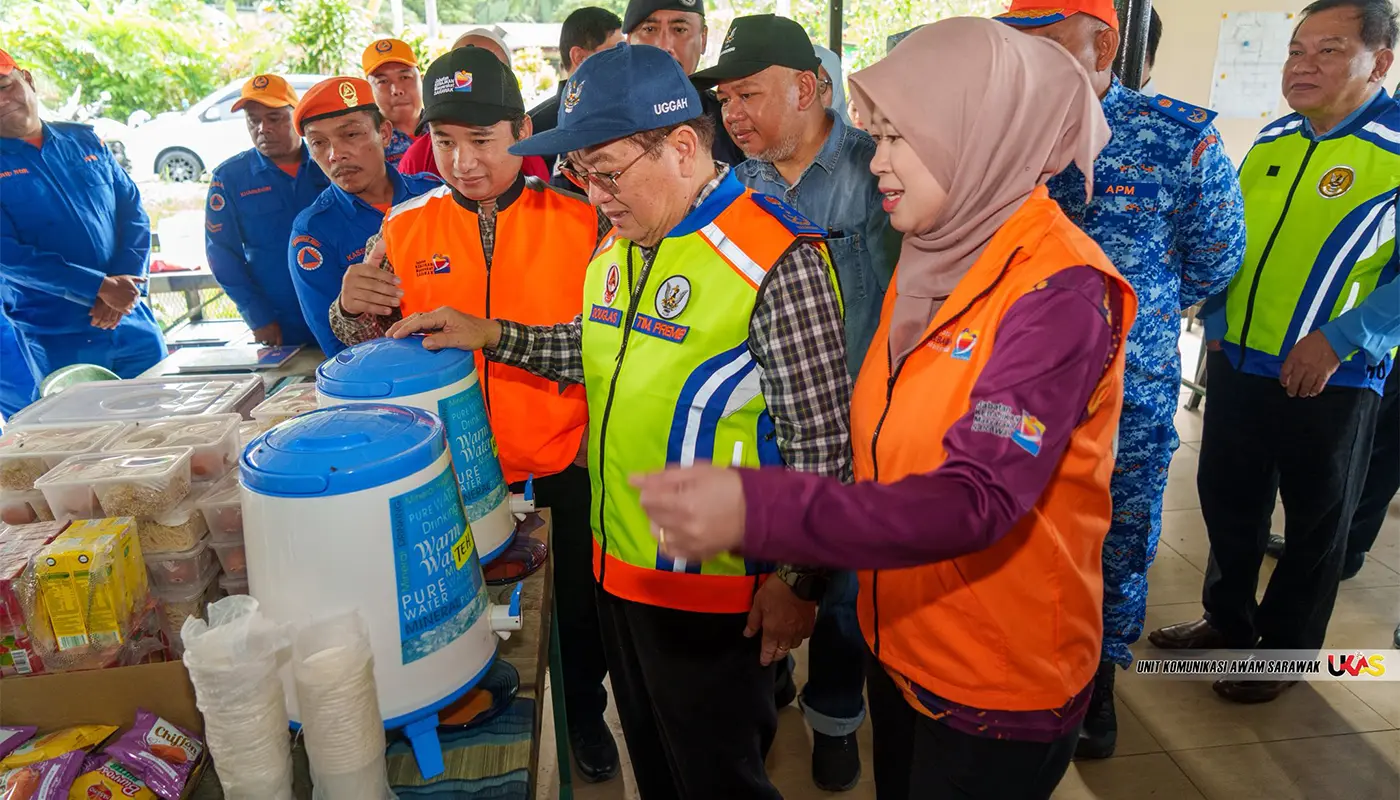
KUCHING – The Sarawak government has reaffirmed its commitment to ensuring that Temporary Evacuation Centres (PPS) across the state operate in full compliance with established standard operating procedures (SOPs), with the welfare and safety of flood victims placed at the forefront.
Deputy Premier and Chairman of the Sarawak State Disaster Management Committee (JPBNS), Datuk Amar Douglas Uggah Embas, said the management of PPS facilities remains under control, with adequate provisions such as mattresses, food, clean drinking water, hot water supply and medical services available to evacuees.
Speaking after inspecting the Sekolah Jenis Kebangsaan Cina (SJKC) Chung Hua Sungai Tengah PPS on Saturday, he acknowledged that some challenges were encountered during the initial opening of the centres. However, he stressed that these issues were swiftly resolved through coordinated efforts among the relevant agencies.
“Our main goal is to ensure that PPS functions as safe, clean and conducive shelters to ease the burden faced by flood victims,” he said.
According to Datuk Amar Douglas Uggah, a total of 12 PPS have been activated across Sarawak, accommodating 343 families and 1,347 individuals. The centres are located in Kuching, Lawas and Kota Samarahan, reflecting the widespread impact of recent floods.
Earlier, he visited the PPS Surau Ar-Rahman Kampung Sungai Batu, which was opened on 1 January 2026 and currently shelters 52 victims from 12 families. He also inspected the PPS Masjid Darul Istiqlaal Kampung Sungai Maong, where 128 evacuees from 26 families are being housed.
The Deputy Premier highlighted the importance of maintaining high standards in PPS management, noting that the centres are not only places of refuge but also vital facilities for safeguarding health and wellbeing during emergencies.
He reiterated that the state government’s disaster response strategy is centred on integrated coordination, ensuring that victims receive timely assistance and that facilities remain conducive throughout the evacuation period.
The inspections underline Sarawak’s proactive approach to disaster management, with authorities working to minimise hardship for affected communities while reinforcing public confidence in the state’s preparedness.