



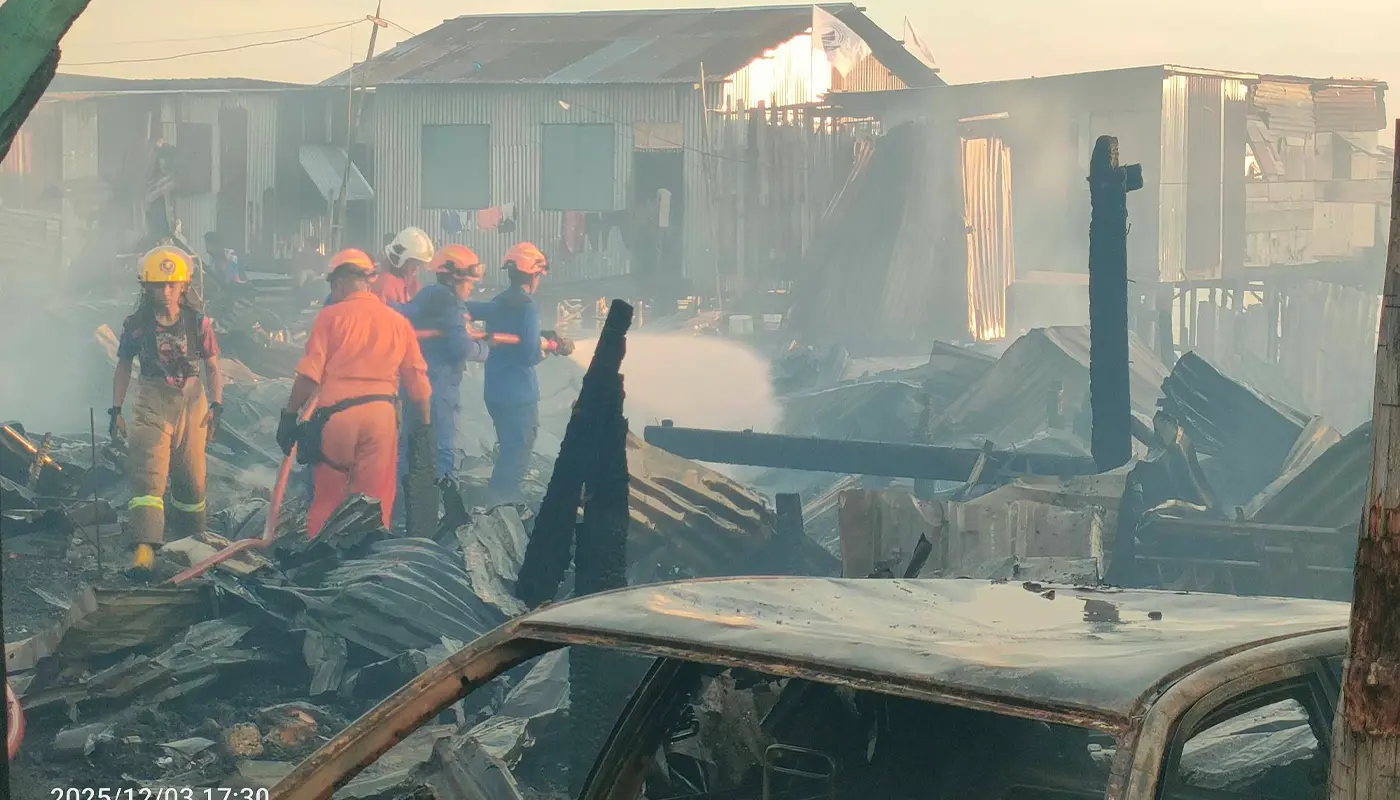
TAWAU – A significant blaze has completely destroyed 18 overwater homes in a village here, though rapid intervention by emergency services prevented a far more extensive catastrophe.
The fire erupted on Wednesday afternoon in Kampung Kurnia Jaya, consuming a temporary settlement built over the sea.
The Sabah Fire and Rescue Department (JBPM) operations centre was alerted to the emergency at 4.20 pm. Firefighting units from the Tawau station arrived at the scene just 14 minutes later. Their immediate priority was to contain the fast-moving fire and protect the surrounding community.
Officials confirmed that the defensive strategy was successful. Firefighters, utilising water from their appliance tanks and directly from the sea, managed to halt the spread of the flames.
This action is credited with saving an estimated 500 adjacent houses from potential destruction. The area of the water village affected measured approximately 150 by 80 feet.
In addition to the homes, a Proton Wira sedan parked in the vicinity was also lost to the inferno. A coordinated effort involving 27 personnel from multiple agencies worked to bring the situation under control.
Teams from the Tawau and Kunak fire stations were supported by the Titingan Community Fire Brigade, a specialised drone unit, the police (PDRM), and the Civil Defence Force (APM).
The officer in charge, PBK I Rosliee Suyut, along with Senior Operations Commander PPgB Mazlan Sarman, led the operation. Firefighting in such aquatic environments presents distinct challenges, often requiring specialised pump techniques and access to open water sources for supply.
Authorities reported that no injuries or fatalities occurred as a result of the incident. The fire was declared under control by 4.45 pm and the entire operation was concluded at 5.47 pm after crews ensured all hot spots were extinguished and the area was safe.
The cause of the fire is now under investigation. Incidents like this highlight the vulnerabilities of informal overwater settlements, which are often constructed with lightweight, highly combustible materials and have limited access routes for emergency vehicles.
Community leaders are expected to coordinate with local authorities to provide assistance to the displaced families.
