



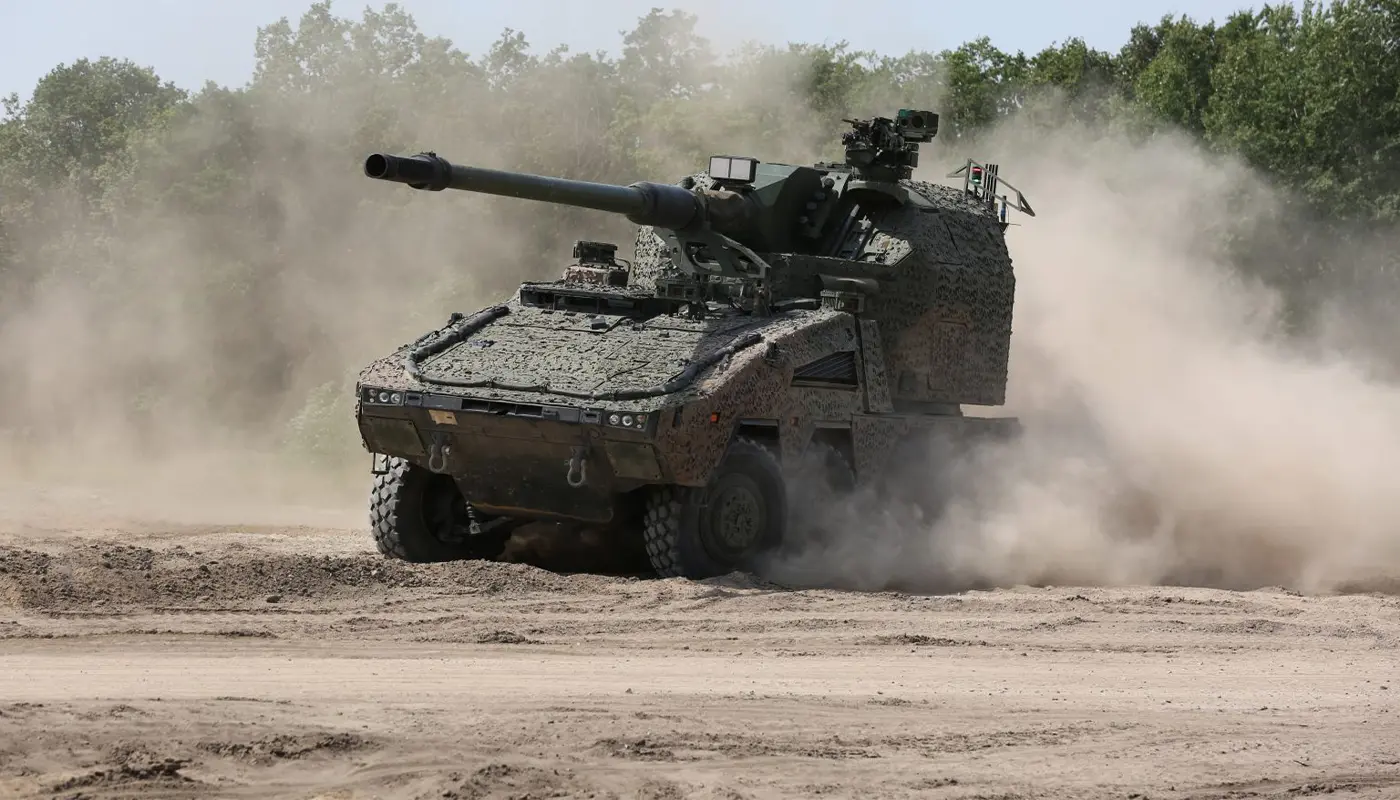
Britain and Germany have signed a joint procurement agreement worth £52 million ($70 million) to acquire advanced mobile artillery systems, marking a significant step in strengthening European defence cooperation.

The deal, announced on 28 December 2025, will see the British Army receives an early capability demonstrator of the RCH 155 system, while Germany will obtain two units for testing.
The RCH 155, developed by Franco-German defence group KNDS in partnership with Rheinmetall, is a highly mobile artillery platform mounted on armoured vehicles. It is capable of firing while on the move and striking targets at ranges exceeding 70 kilometres (44 miles).
Unlike traditional artillery, which must halt before firing, the RCH 155 can deliver eight rounds per minute while manoeuvring, requiring only two crew members to operate.
It can also travel up to 700 kilometres without refuelling, offering enhanced mobility and survivability against counter-battery fire.
British Defence Procurement Minister Luke Pollard emphasised that the system reflects lessons learned from the war in Ukraine.
“This new artillery builds on lessons from Ukraine, enabling our Army to hit targets 70 km away and move fast away from returning fire,” he said.
The agreement is part of the Trinity House defence pact, signed in October 2024, which committed the UK and Germany to closer military collaboration.
Officials from both governments highlighted that the programme will strengthen NATO interoperability and bolster collective defence amid an increasingly contested security environment.
Germany’s Defence Ministry described the acquisition as a step towards modernising its artillery capabilities, while British officials noted that the demonstrator would inform long-term procurement decisions for the UK’s mobile firepower strategy.
The deal also underscores Europe’s push to accelerate defence modernisation in response to evolving threats.
Analysts point out that the RCH 155’s ability to fire on the move could prove decisive in future conflicts, where mobility and rapid response are critical.
With both nations investing jointly, the procurement is expected to reduce costs and speed up delivery timelines.
Defence experts view the partnership as a model for future collaborative projects within NATO, particularly as member states seek to balance national requirements with collective security needs.
This agreement comes at a time when European militaries are reassessing their capabilities in light of the ongoing war in Ukraine, where artillery has played a central role.
The UK and Germany’s decision to jointly procure the RCH 155 highlights a shared recognition of the importance of mobile, survivable, and rapid-response artillery systems in modern warfare.
Sources: Al Arabiya, The News International, TRT World, Kyiv Post
