



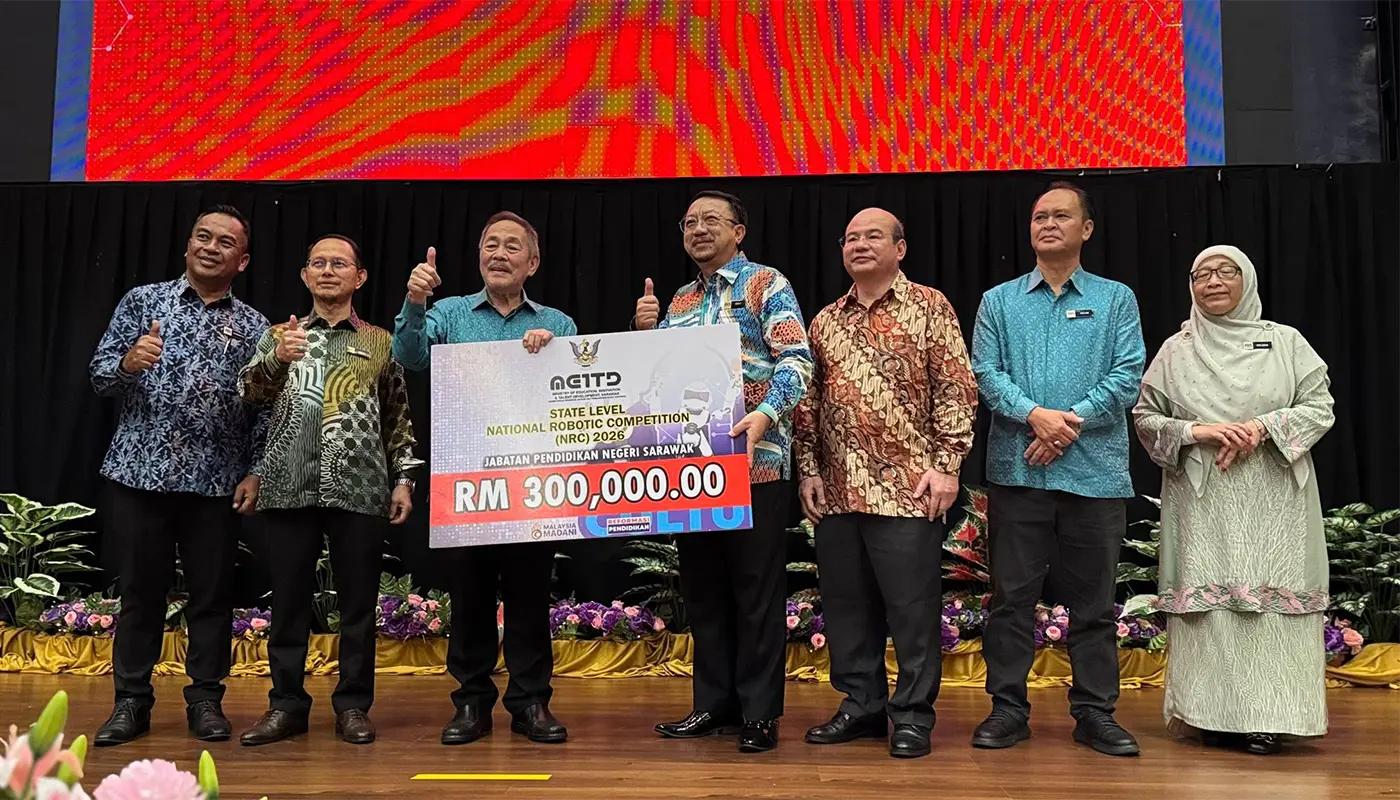
KUCHING – Sarawak has continued to demonstrate its strength in robotics, recording a remarkable track record as overall champion ten times in the National Robotics Competition between 2014 and 2025.

Minister of Education, Innovation and Talent Development, Roland Sagah Wee Inn, highlighted that the achievement reflects Sarawak’s leadership in nurturing Science, Technology, Engineering and Mathematics (STEM) talents.
He noted that Sarawak’s success is not confined to the national stage, as Chung Hua Miri National Secondary School contributed two champion titles and one runner-up at the World Robot Olympiad (WRO), helping Malaysia secure the overall championship last year.
“This outstanding achievement is in line with the ministry’s vision to make Sarawak the host of the World Robot Olympiad (WRO) 2027. It reflects our continued commitment to nurturing world-class STEM talents and positioning Sarawak as a major hub in the fields of robotics, innovation and science education,” he said.
The minister was speaking at the Robotics Kit Handover Ceremony held at the Sarawak State Library, Kuching, in conjunction with the Sarawak State Level National Robotics Competition Development Programme.
A total of 60 schools from across Sarawak are expected to participate in the competition scheduled for July in Sibu.
Officials explained that these achievements are the result of continuous efforts to strengthen STEM education throughout the state.
The initiatives aim to ensure Sarawak remains competitive nationally while also standing out internationally.
The state’s education direction is guided by the Malaysia Education Plan (RPM) 2026–2035, which emphasises the following:
- Empowering digital education and artificial intelligence in classrooms
- Comprehensive STEM talent development from primary to secondary levels
- Project-based learning (PBL) with robotics and innovation
- Strengthening 21st-century skills such as critical thinking, collaboration, and problem-solving
The Sarawak State Education Department has also set a strategic direction based on a proactive, persuasive, and productive work culture among education staff.
This approach is expected to boost academic achievement, including excellence in the Malaysian Certificate of Education (SPM), while producing a generation of students who are competent, creative, and ready to meet the challenges of the Industrial Revolution 4.0.
Overall, Sarawak’s success in robotics is more than a series of victories; it represents a solid foundation for the state to emerge as a global centre of excellence in education and innovation by 2035.
