



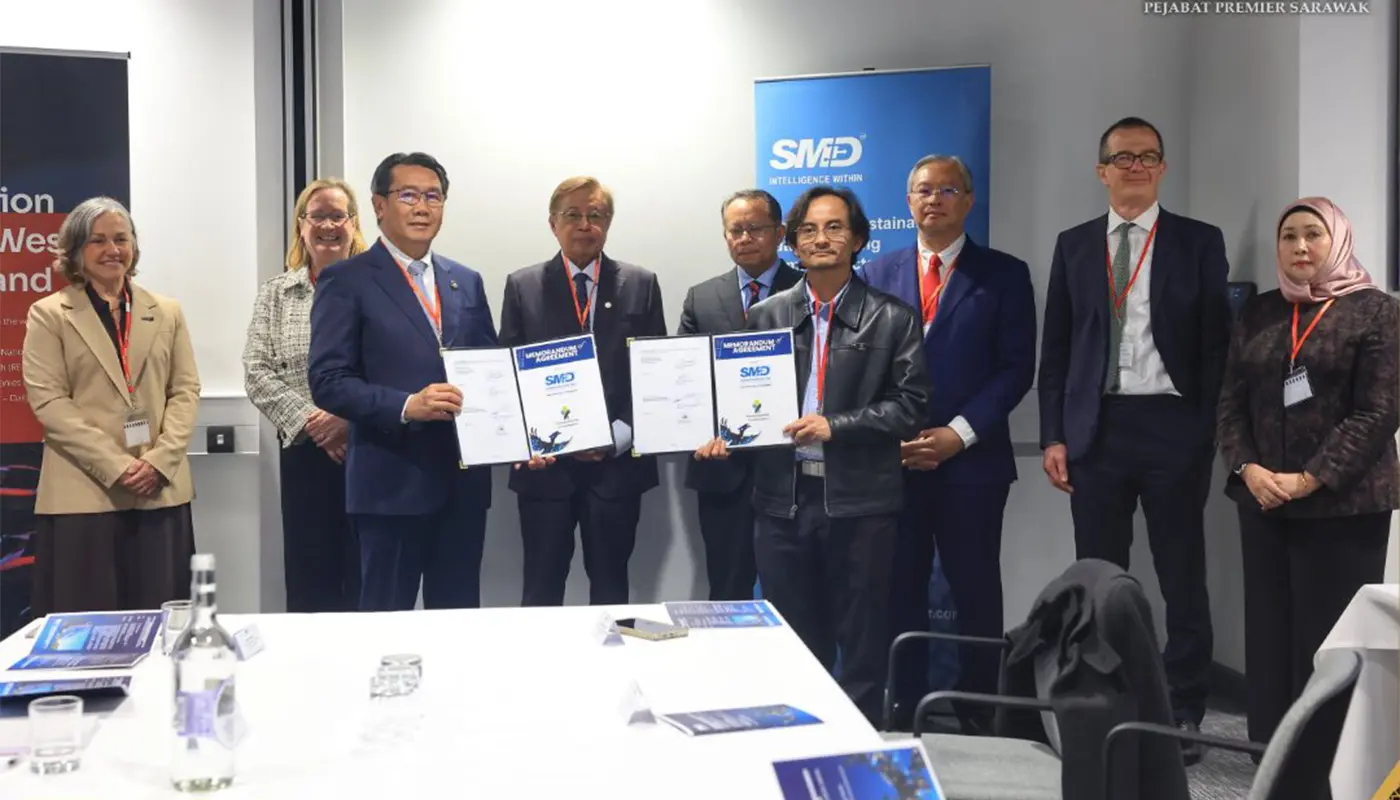
BRISTOL – Sarawak has taken another step towards building a high-value technology economy with a major engagement session in the United Kingdom, focusing on compound semiconductors, aerospace, and climate technology.

The Premier of Sarawak, Datuk Patinggi Tan Sri (Dr) Abang Haji Abdul Rahman Zohari bin Tun Datuk Abang Haji Openg, led the discussions at the NCC – Innovating for Industry, Bristol and Bath Science Park on 5 May.
The event was co-hosted by the University of Bristol and Compound Semiconductor Applications (CSA) Catapult, bringing together leading figures from the UK’s innovation ecosystem.
The Premier explained that Sarawak is undergoing a significant economic transformation, moving away from reliance on natural resources towards industries driven by technology and innovation.
He emphasised that the state’s priorities include strengthening technical capability, ensuring resilience, and building a sustainable and competitive economy.
Central to this strategy is the semiconductor sector, which he described as a “key enabler” for energy systems, aerospace, space technologies, and advanced digital infrastructure.
Under the Sarawak Semiconductor Roadmap 2030, the state is focusing on compound semiconductors, advanced packaging, and system-level capabilities.
Sarawak has been actively engaging with UK institutions and agencies such as the Department for Science, Innovation and Technology (DSIT), the Department for Business and Trade (DBT), UK Research and Innovation (UKRI), CSA Catapult, and Silicon Catalyst.
The Premier highlighted that collaboration with the University of Bristol, reinforced by a Memorandum of Understanding (MOU) signed earlier in Sarawak, is vital to accelerating capability development and moving into high-value segments.
The Premier also linked Sarawak’s semiconductor ambitions with its energy transition agenda. Investments in renewable energy, hydrogen, and sustainable infrastructure are being supported by compound semiconductor technologies, particularly Gallium Nitride (GaN), which is critical for energy efficiency and low-carbon solutions.
Sarawak’s state-backed entity, SMD Semiconductor, is advancing GaN technologies in partnership with CSA Catapult, X-Fab, Camutronics, and the University of Bristol.
Beyond semiconductors, Sarawak is expanding its focus on aerospace and satellite systems. The Premier announced plans to explore the development of a Low Earth Orbit (LEO) satellite with international partners, including the UK.
He explained that integrating space-based and ground-based data would allow Sarawak to make evidence-based, hyper-local decisions for forests, cities, and coastlines.
Practical applications under discussion included flood early warning systems, forest carbon tracking, and climate data systems to support resilience planning.
The session drew participation from major UK industry players such as Rolls Royce, GKN Aerospace, Nexperia, Space West, the Centre for Modelling and Simulation (CFMS), and Sora Aviation.
To support these ambitions, Sarawak has established the Sarawak Aerospace Advisory Council and the Sarawak Space Agency, aligning policy with industry needs.
On the talent front, initiatives include the creation of a Faculty of Aerospace Engineering at i-CATS University College, a free tertiary education scheme, and a fully sponsored four-year PhD programme for Sarawakians at the University of Bristol.
The Premier concluded by expressing confidence in the partnerships formed, stating: “I am confident that the collaboration established today will strengthen our technical capabilities, deepen our international partnerships, and support Sarawak’s ambition to participate more actively in high-value technology sectors.”
