



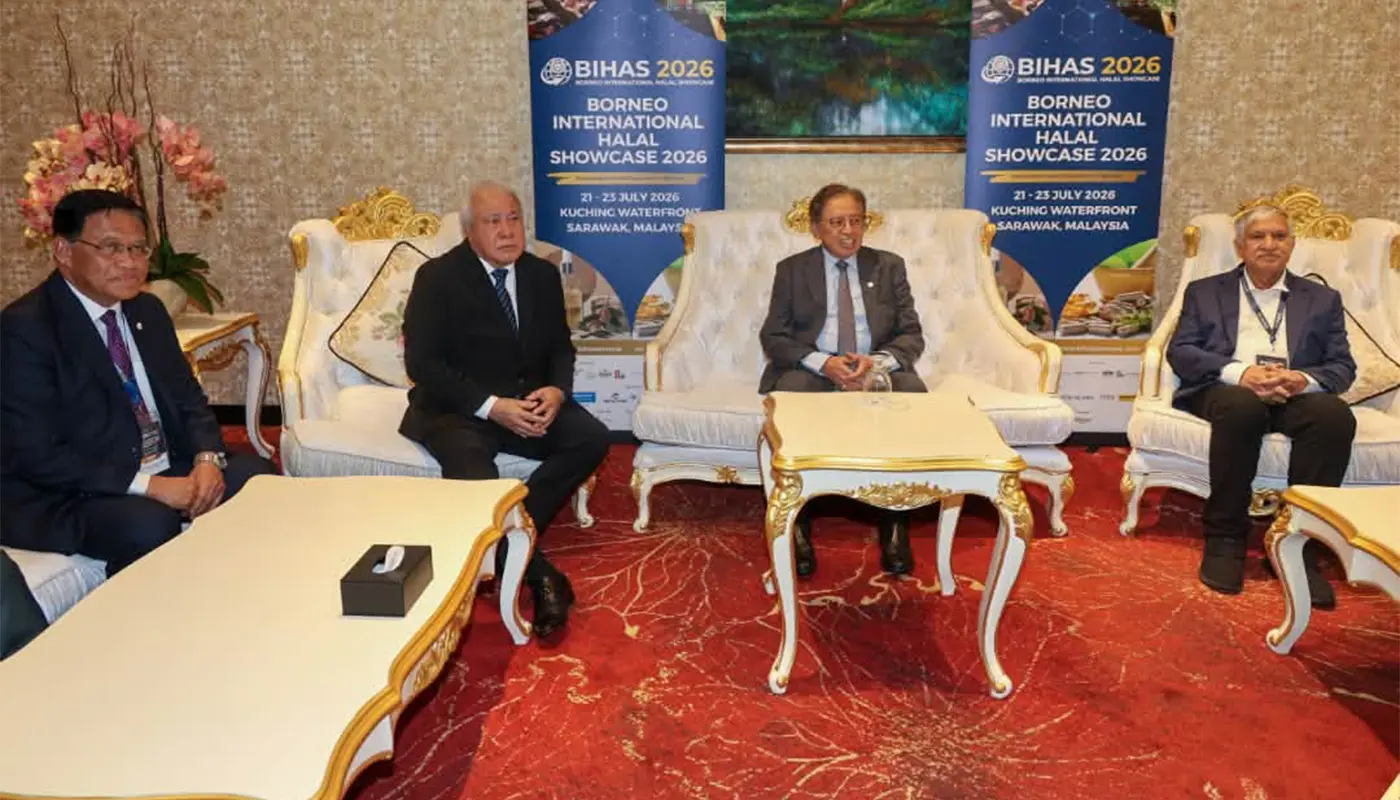
KUCHING – Senior state leadership engaged in high-level discussions with international retail and trade representatives on Tuesday, focusing on strategies to elevate local products onto the global stage. The meeting took place at the Waterfront Hotel, serving as a precursor to the upcoming Borneo International Halal Showcase (BIHAS) 2026.
Sarawak Premier Datuk Patinggi Tan Sri (Dr) Abang Haji Abdul Rahman Zohari bin Tun Datuk Abang Haji Openg hosted the delegation, which was spearheaded by Mustaq Ahmad, the managing director and owner of the renowned Mustafa Center in Singapore.
The gathering underscored the growing importance of strategic partnerships in expanding the reach of Sarawak’s economy beyond domestic borders.
The visiting group included key figures from the Global Halal Alliance (GHA) and Haltex Group Pte Ltd, alongside other international stakeholders. Notable attendees included GHA co-founder Dr Annie Woo and Mustafa Center co-founder Rahmat Shah.
The delegation also featured Iqbal Hussein, representing Mustafa Center, as well as Dylan Tan, who serves as the Page Eight Singapore representative for Sarawak. Emmanuel Marelli, an Italian buyer, was also present, highlighting the diverse geographic interests in the region’s offerings.
Supporting the Premier during these talks were Deputy Premier Datuk Amar Haji Awang Tengah Ali Hasan and Datuk Dr Haji Abdul Rahman bin Haji Junaidi, the Deputy Minister in the Premier’s Department.
Dr Abdul Rahman holds the portfolio for Project Coordinator for Regional Development Agencies, Kuching North City Commission, and Islamic Affairs, indicating the multi-faceted nature of the discussions which bridged commerce, regional development, and religious compliance standards.
A central topic of the briefing was the Sarawak Export Programme, an initiative driven by the Ministry of International Trade, Industry and Investment Sarawak (MINTRED). Officials outlined how this framework is designed to bolster market access for local entrepreneurs through robust international collaboration.
The programme aims to move beyond simple transactional relationships, seeking to build long-term partnerships that integrate Sarawak businesses into global supply chains.
The delegation provided insights into how the Global Halal Alliance ecosystem can facilitate this transition. By leveraging their extensive network, the alliance offers local enterprises access to international retail platforms, structured business matching opportunities, and capability development resources.
This support system is intended to enhance the export readiness of Sarawak companies, ensuring they meet the rigorous standards required by overseas markets.
The range of products identified for promotion reflects the rich agricultural and culinary heritage of the state. Premium Sarawak coffee and pepper, long celebrated for their quality, were highlighted alongside specialty items such as Bario rice. Fresh produce including pineapple and dragon fruit were also noted for their potential.
Furthermore, value-added goods such as Empurau fish, dabai-based products, and traditional kek lapis were discussed as viable exports. Convenience foods, including laksa paste, instant meals, and various beverages, round out the list of items poised for international distribution.
This push for greater export activity aligns with the Sarawak Government’s broader economic aspirations. By strengthening the state’s export ecosystem, authorities hope to enable more Sarawak-made products to penetrate both regional and international markets.
The focus on halal-certified goods taps into a significant and growing global demographic, offering substantial opportunities for growth.
The timing of the courtesy call, just before the official opening of BIHAS 2026, suggests a coordinated effort to maximise visibility for these initiatives.
The showcase is expected to serve as a practical platform where the theoretical frameworks discussed in the meeting can be put into action, connecting producers directly with buyers and distributors.
As global trade dynamics continue to evolve, such collaborations between state governments and private international entities become increasingly vital.
The presence of buyers from Europe and retail giants from Southeast Asia indicates a strong external interest in Sarawak’s unique product portfolio.
The outcome of these discussions may well shape the trajectory of the state’s non-oil and gas sectors in the coming years, providing a diversified revenue stream for local businesses and contributing to overall economic resilience.
