



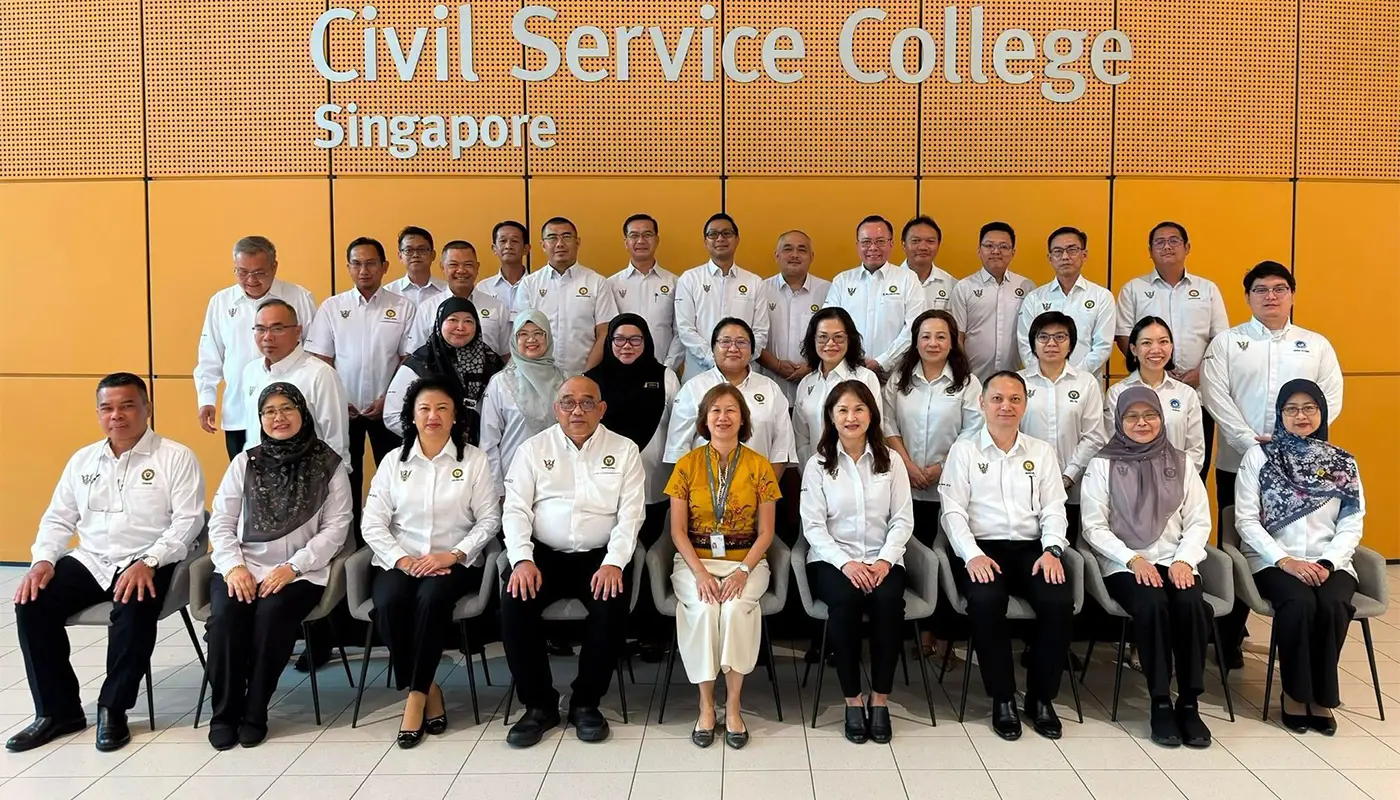
SINGAPORE – A cohort of thirty middle and senior-ranking officers from the Sarawak Civil Service has successfully concluded an intensive leadership programme designed to enhance governance capabilities and public service delivery.

The Customised Leaders in Governance Programme, held at Singapore’s Civil Service College from July 27 to 31, 2026, focused on translating theoretical principles into tangible citizen outcomes through practical exposure and expert mentorship.
Organised jointly by the Leadership Institute of Sarawak Civil Service (LISCS), the Human Resource Development and Management Unit (HRDM), and CSC Singapore, the five-day course provided participants with immersive learning experiences tailored specifically to Sarawak’s administrative context.
This collaborative arrangement reflects ongoing efforts to benchmark state civil service standards against internationally recognised best practices whilst adapting them to local developmental needs.
Curriculum content spanned six critical domains essential for modern public administration. Participants engaged deeply with topics including public governance and accountability, sector transformation, workforce development, resource stewardship, digital innovation, and citizen engagement strategies.
Each module was structured to bridge conceptual understanding with operational realities faced by administrators managing complex service ecosystems across diverse geographical settings.
Instruction was delivered by distinguished practitioners rather than solely academic faculty. Learners benefited from direct interactions with former senior Singaporean public servants, including a past Assistant Chief Executive of CSC Singapore, an experienced human resource leader from the public sector, and a strategist formerly attached to the Prime Minister’s Office.
These experts shared candid insights regarding systemic design, implementation hurdles, and institutional enablers that underpin Singapore’s administrative effectiveness.
Beyond classroom instruction, the programme incorporated site visits to key institutions demonstrating policy execution in practice. Delegates toured the Housing and Development Board to observe large-scale urban planning and public housing delivery mechanisms.
Visits to the Harmony in Diversity Gallery and Singapore City Gallery further connected theoretical discussions on social cohesion and sustainable urban development with observable real-world applications, reinforcing lessons through experiential learning.
A central objective involved equipping officers to adapt relevant foreign models to Sarawak’s unique circumstances rather than replicate them wholesale.
Recognising contextual differences prevents inappropriate transplantation of solutions whilst encouraging critical evaluation of underlying principles. This discernment is vital for ensuring that imported ideas genuinely serve local populations and align with indigenous values and administrative traditions.
Each participant concluded the programme by formulating a personal action plan detailing specific adaptations they intend to implement upon returning home.
These individual commitments link directly to broader state priorities outlined in the Post-COVID-19 Development Strategy 2030, ensuring training investments contribute measurably to strategic objectives. Accountability mechanisms will likely track progress on these plans to maximise return on capacity-building expenditures.
Digital transformation featured prominently throughout the curriculum as both an enabler and a challenge for contemporary governance. Officers explored how technology can streamline service delivery, enhance transparency, and facilitate participatory decision-making when deployed thoughtfully.
Equally important were discussions on managing digital exclusion risks and maintaining human-centred approaches amidst increasing automation of public interfaces.
Resource stewardship received particular emphasis given fiscal constraints facing governments globally. Learning modules addressed efficient allocation methodologies, performance-based budgeting, and value-for-money assessment frameworks applicable to Sarawak’s development spending.
Strengthening these competencies supports sustainable financing of infrastructure and social programmes without compromising long-term fiscal health or intergenerational equity considerations.
Citizen engagement strategies formed another cornerstone of the learning experience. Participants examined diverse consultation mechanisms, feedback channels, and co-creation platforms that foster trust and legitimacy in policy processes.
Understanding how to meaningfully involve communities in decisions affecting their lives is increasingly recognised as fundamental to effective governance beyond mere technical competence or procedural compliance.
Workforce development discussions acknowledged that institutional capability ultimately depends on people. Topics included talent management, succession planning, continuous learning cultures, and motivational systems that attract and retain quality personnel.
Investing in human capital remains foundational to any public service transformation agenda, particularly as demographic shifts and evolving citizen expectations reshape labour markets and service demands.
The partnership between LISCS and Singaporean counterparts exemplifies South-South knowledge exchange adapted to subnational contexts. Rather than relying exclusively on Western models, Sarawak selectively engages regional peers whose developmental trajectories offer more proximate reference points.
Such calibrated internationalisation enriches domestic reform discourse whilst preserving cultural and institutional authenticity essential for sustainable change.
Returning officers now carry responsibility for disseminating acquired knowledge within their respective departments and agencies.
Multiplying impact beyond individual participants requires deliberate internal sharing mechanisms, mentoring arrangements, and pilot project opportunities that test adapted concepts in controlled environments before wider scaling. Institutional learning thus becomes embedded rather than episodic.
Ultimately, this capacity-building initiative represents sustained investment in governance quality as infrastructure for development. Technical skills and policy frameworks matter profoundly, but their effectiveness hinges on leaders who understand both universal principles and particular local conditions.
By cultivating such reflective practitioners, Sarawak strengthens its institutional foundations for achieving ambitious 2030 aspirations whilst serving citizens with greater responsiveness and integrity.
