



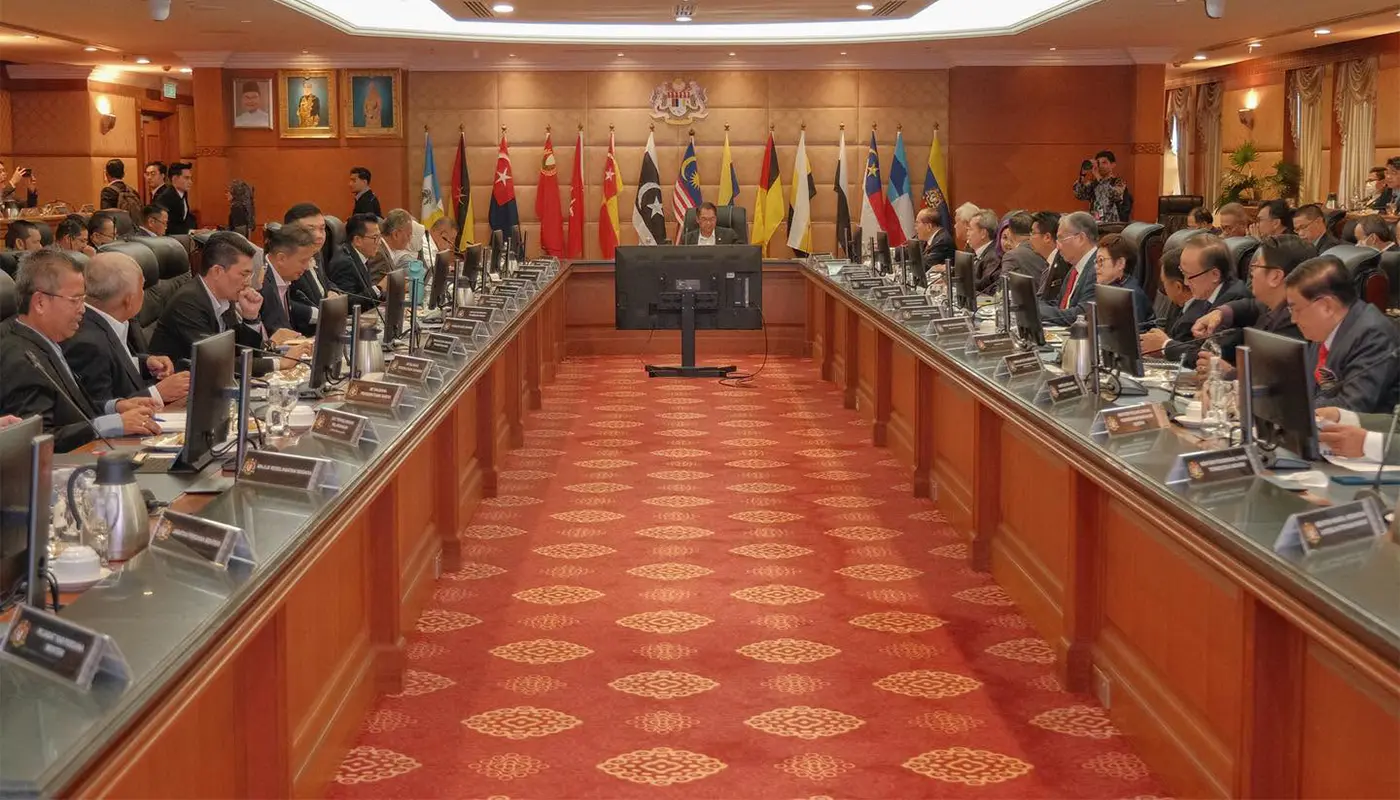
PUTRAJAYA – Federal ministries and government agencies have received strict directives to accelerate the settlement of all outstanding matters pertaining to the Malaysia Agreement 1963. The objective is to ensure every pending issue is fully resolved before the end of this year.

This urgent timeline was emphasised during the second Technical Committee meeting under the Implementation Action Council held earlier this month.
Datuk Amar Douglas Uggah Embas stressed that negotiations on several key files have already spanned nearly a decade. He argued that further delays are unacceptable if the rights and interests enshrined in the founding document are to be genuinely realised for the people of Borneo.
His remarks set a firm tone for the proceedings which focused heavily on expediting implementation rather than mere discussion.
The session was presided over by Datuk Ts Mustapha Sakmud in his capacity as Deputy Chairman of the Technical Committee. He acted on behalf of the Deputy Prime Minister who was unavailable due to medical treatment.
During his address, Mustapha instructed all relevant federal bodies to prioritise these remaining items to ensure comprehensive execution ahead of the main council meeting scheduled for September.
Current data presented by the Sabah and Sarawak Affairs Division indicates mixed progress across twenty-nine tracked matters. Thirteen have been completely settled, whilst five achieved interim resolution status.
Two others have secured policy decisions awaiting finalisation, four remain under active discussion, and five have been escalated to the highest leadership level for consideration.
Significant milestones were also acknowledged during the review. These include the recent transfer of Bintulu Port ownership to the state government following a substantial financial transaction.
Additionally, the Special Grant allocated under Article 112D has been increased substantially for the current fiscal year, demonstrating tangible commitment beyond rhetorical assurances from federal authorities.
Health sector autonomy emerged as a particularly complex area requiring sustained attention. Datuk Amar Professor Dr Sim Kui Hian outlined the necessity of decentralising both statutory and executive functions from federal control.
This includes transferring authority to plan, construct, staff, and maintain public health facilities alongside the requisite funding streams to support such responsibilities effectively.
Workforce shortages present an immediate operational crisis within the state healthcare system. Official figures from June reveal that nearly twenty per cent of established posts remain unfilled, forcing existing personnel to shoulder excessive workloads.
Thousands of additional positions must be created urgently to meet baseline service demands identified in recent manpower audits covering only a fraction of existing facilities.
Infrastructure deficits compound these human resource challenges significantly. Billions of ringgit are required to upgrade dilapidated clinics and hospitals across the region to acceptable standards.
State leaders have pledged unwavering persistence in pursuing health autonomy despite acknowledging the lengthy journey ahead towards achieving parity with Peninsular Malaysia.
Broader strategic agendas were also streamlined through the technical platform during the gathering. Discussions encompassed the Borneonisation of the federal civil service, expansion of state civil service posts under constitutional provisions, environmental jurisdiction transfers, and border area development initiatives.
These multifaceted talks reflect the comprehensive nature of current restoration efforts. A robust four-tier negotiation framework now governs these engagements, evolving considerably since initial discussions began years ago.
This structured approach involves officer-level working groups, ministerial co-chairs, deputy prime ministerial coordination, and ultimately premier-level committees. Such institutionalisation aims to prevent backsliding and maintain momentum through consistent dialogue mechanisms.
Historical context remains vital to understanding current urgency. Past leaders successfully embedded the agreement into the federal constitution after decades of legal ambiguity regarding its status.
This foundational correction enabled subsequent negotiations to proceed on firmer ground, transforming what was once an unregistered arrangement into enforceable constitutional law.
The Sarawak delegation included senior figures responsible for law, finance, economic planning, and state-federal relations. Their collective presence underscored the importance attached to this particular committee session.
All parties reaffirmed their dedication to collaborative problem-solving grounded in mutual respect and genuine federalism principles.
Looking forward, stakeholders recognise that achieving full implementation requires more than administrative compliance. It demands political will, adequate resource allocation, and sustained institutional memory to prevent regression.
The December deadline serves as both a target and a test of commitment from all levels of government involved in this historic restitution process.
