



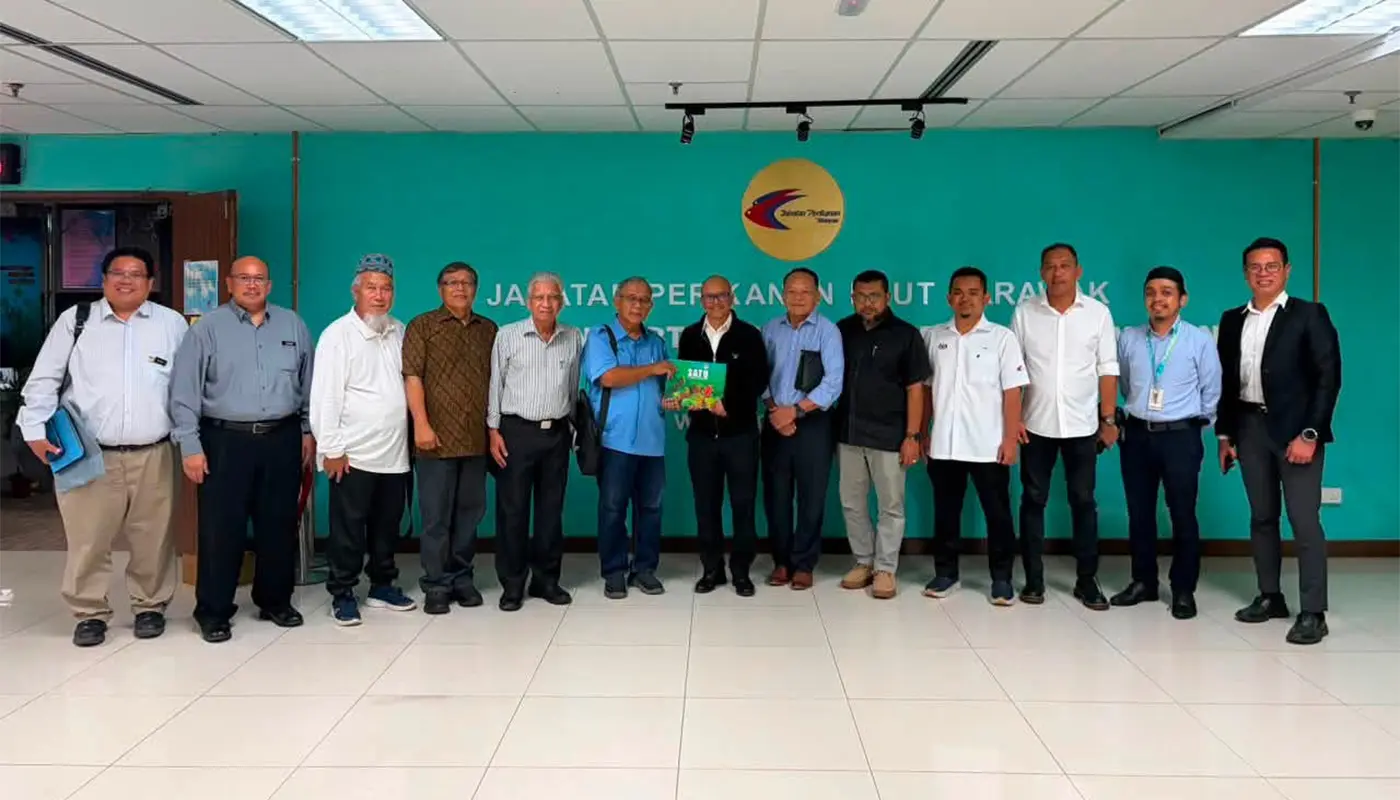
KUCHING – A newly active industry body has initiated formal engagement with state fisheries authorities to advance the deep sea fishing sector. The Sarawak Marine Products Entrepreneurs Association (PERHASIL) conducted an introductory visit to the Sarawak Marine Fisheries Department (JPLS) headquarters on 5 August 2026.

The primary objective of this meeting centred on establishing institutional recognition and opening direct communication channels. PERHASIL representatives formally introduced their organisation to the Senior Director of JPLS, marking the beginning of structured dialogue between private sector entrepreneurs and public regulators.
Committee membership details were officially conveyed during the session. Providing transparent information about organisational leadership helps build trust and enables government agencies to identify appropriate counterparts for future technical discussions and collaborative initiatives within the maritime economy.
Deep sea fishing represents a strategic growth area that PERHASIL aims to actively develop. Unlike coastal operations, offshore capture fisheries require specialised vessels, advanced navigation technology, and substantial capital investment, necessitating coordinated support mechanisms beyond what individual operators can secure independently.
Familiarisation with current industry developments featured prominently in discussions. Understanding the present state of deep sea operations allows the association to align its activities with existing realities rather than pursuing aspirational goals disconnected from practical constraints facing vessel owners and crew members.
Regulatory frameworks governing offshore fisheries received detailed attention during exchanges. Staying informed about latest procedures and policy updates ensures member compliance whilst identifying areas where regulatory adjustments might unlock additional economic potential without compromising resource sustainability or safety standards.
Government assistance programmes constitute a critical enabler for sectoral expansion. PERHASIL sought comprehensive information about available grants, subsidies, training opportunities, and infrastructure support designed specifically for fishermen and marine entrepreneurs operating in deeper waters beyond traditional nearshore zones.
Attracting sustained participation in capture fisheries requires demonstrating viable commercial prospects. Potential entrants need confidence that adequate support systems exist to mitigate inherent risks associated with offshore operations, including weather volatility, equipment failure, and market access challenges unique to distant-water fishing.
Policy clarity reduces uncertainty that often deters private investment. When entrepreneurs understand eligibility criteria, application processes, and expected timelines for government assistance, they can make informed business decisions rather than delaying commitments due to ambiguous administrative landscapes.
Knowledge transfer emerged as an implicit benefit of this initial engagement. Government officials possess institutional memory about past programme successes and failures that can help new associations avoid repeating historical mistakes whilst building upon proven approaches tailored to local conditions.
Industry representation strengthens advocacy effectiveness through unified voice. Individual operators struggling alone lack influence compared to organised bodies presenting consolidated positions backed by collective membership, making association formation strategically valuable for shaping favourable policy environments.
Safety considerations permeate all aspects of deep sea fishing operations. Regulatory discussions inevitably touch upon vessel certification, crew training requirements, emergency response protocols, and insurance mandates that protect human life whilst ensuring operational continuity during adverse conditions at sea.
Market linkage development complements production-focused support. Catching fish represents only half the value chain; equally important are processing facilities, cold storage logistics, transportation networks, and buyer relationships determining whether harvested resources translate into profitable returns for investors and workers alike.
Environmental sustainability concerns increasingly shape fisheries policy worldwide. Responsible operators recognise that long-term business viability depends on healthy fish stocks, making voluntary adherence to science-based catch limits and habitat protection measures economically rational rather than merely regulatory burdens.
Technological modernisation drives competitiveness in global seafood markets. GPS navigation, sonar fish finding, automated handling systems, and digital catch documentation enhance efficiency whilst meeting international traceability standards demanded by premium buyers concerned about legality and sustainability credentials.
Workforce development challenges affect sectoral growth trajectories. Skilled captains, engineers, and deckhands remain scarce despite attractive remuneration, suggesting vocational training partnerships between industry bodies and educational institutions could address human capital bottlenecks constraining fleet expansion plans.
Financial accessibility remains a persistent barrier for aspiring deep sea entrepreneurs. Conventional lenders often perceive offshore fishing as high-risk, indicating potential roles for specialised financing instruments or government-backed guarantee schemes to bridge credit gaps preventing worthy projects from launching.
Infrastructure deficits in landing sites and processing hubs limit value capture locally. Without adequate port facilities, ice plants, and auction halls, catches must be transported elsewhere for sale, reducing margins retained within Sarawak and diminishing multiplier effects on regional economies dependent on fisheries.
Data sharing arrangements could benefit both regulators and industry participants. Real-time catch reporting supports stock assessments informing sustainable quotas whilst providing operators market intelligence about supply volumes and price trends enabling better commercial decision-making under volatile conditions.
Cross-sectoral linkages amplify fisheries development impacts. Tourism operators, restaurants, exporters, and equipment suppliers all connect to capture fisheries value chains, suggesting integrated planning approaches yielding broader economic benefits than siloed interventions targeting fishing vessels exclusively.
Youth attraction to maritime careers requires rebranding perceptions of fishing work. Modernising occupational images through technology integration and professional development pathways may counter stereotypes deterring younger generations from considering offshore fisheries as respectable, rewarding livelihood options worthy of pursuit.
International best practices offer valuable benchmarks for local development. Studying successful deep sea fishing models from Norway, Japan, or New Zealand provides adaptable insights about governance structures, co-management arrangements, and innovation ecosystems applicable to Sarawak’s distinct geographical and socioeconomic context.
Ultimately, this introductory meeting signifies maturation of Sarawak’s deep sea fishing ecosystem. Organised private sector engagement complementing government stewardship creates conditions for sustainable industry growth balancing commercial ambitions with ecological responsibility and social equity considerations essential for lasting prosperity in maritime communities across the state.
