



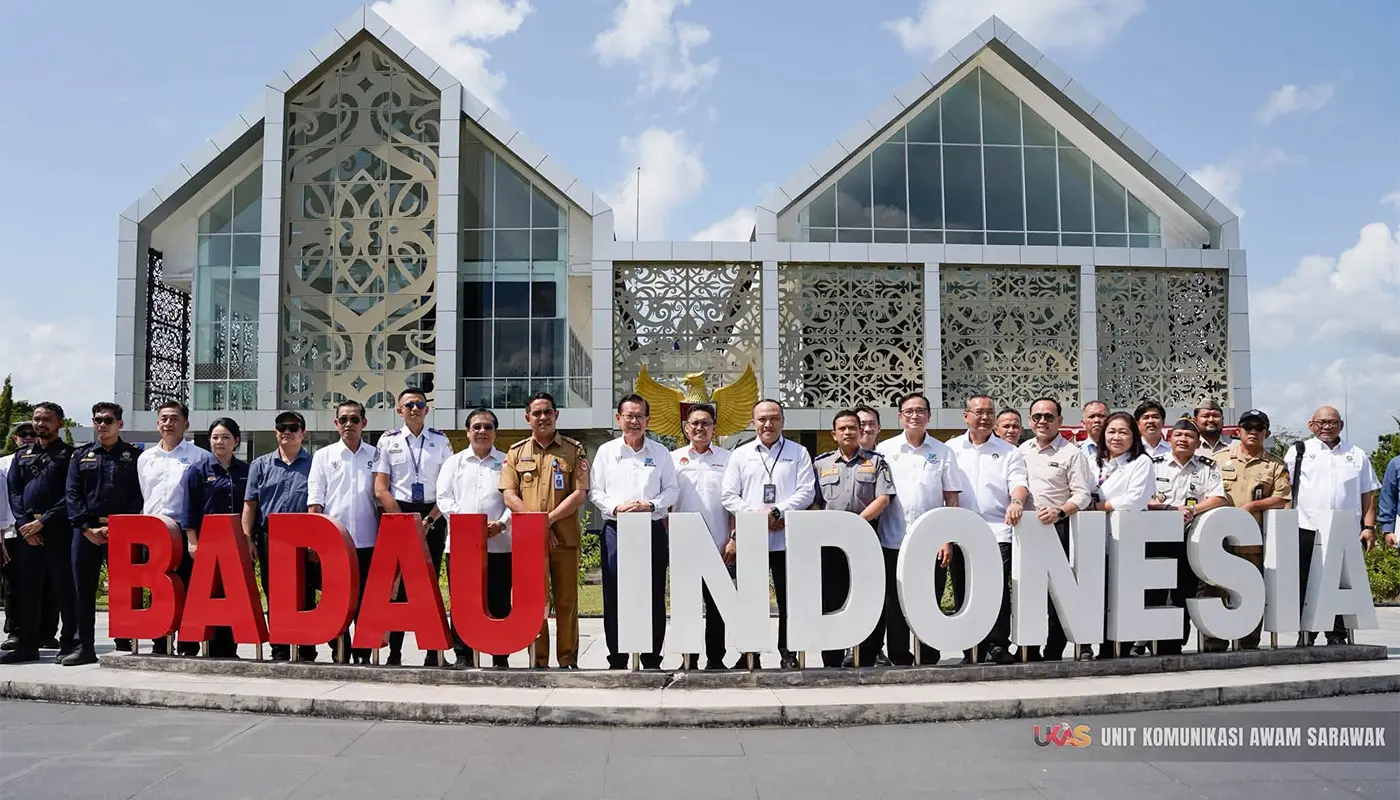
LUBOK ANTU – Plans to establish a new cross-border bus service linking Kuching with Putussibau in West Kalimantan are advancing following a comprehensive assessment of infrastructure readiness at the Lubok Antu-Nanga Badau Immigration, Customs, Quarantine and Security Complex.

The proposed route is anticipated to significantly enhance connectivity between Sarawak and Indonesian Borneo, stimulating growth across tourism, trade, healthcare, and broader economic sectors.
Transport Minister Dato Sri Lee Kim Shin led a working visit to the facility on Monday to evaluate operational capabilities and gather input from key stakeholders.
This fact-finding mission involved consultations with relevant government agencies and prospective bus operators to ensure all logistical requirements are met before services commence. Such groundwork is considered vital for the sustainable implementation of international land transport links.
Current travel conditions between major centres in West Kalimantan present considerable challenges for commuters and traders alike. According to data provided by Indonesian Consul Musa Derek Sairwona, the overland journey from Putussibau to Pontianak presently requires approximately twenty hours.
This lengthy duration acts as a barrier to efficient movement and limits the potential for regular cross-border exchange. Utilising the Lubok Antu-Nanga Badau crossing in conjunction with the Tebedu-Entikong post is projected to reduce this transit time by more than fifty per cent.
During a press conference following his site inspection, Dato Sri Lee highlighted that this dramatic improvement would provide users with a substantially faster and more efficient alternative. Enhanced accessibility is expected to encourage greater frequency of travel for both business and leisure purposes.
Beyond immediate bilateral benefits, the ministry envisions Kuching evolving into a pivotal regional transit hub integrating air and land networks.
With direct flights already operating between Kuching and Jakarta, alongside future participation from AirBorneo, the introduction of cross-border bus services would complete a cohesive multimodal transport ecosystem. This integration positions the state capital as a gateway connecting Indonesian Borneo with wider domestic and international destinations.
Dato Sri Lee explained that passengers arriving from Indonesia could seamlessly transfer at Kuching International Airport for onwards journeys elsewhere. Conversely, travellers landing in Kuching would have convenient access to Kalimantan via the new bus corridor.
Such interoperability strengthens the value proposition of both transport modes whilst offering consumers greater flexibility in route planning. Commercial operators on both sides of the border have indicated strong preparedness to launch services once regulatory clearances are secured.
Biaramas Express from Sarawak and DAMRI from Indonesia have reportedly expressed readiness to begin operations immediately upon receiving necessary approvals. Their commitment suggests that market demand exists and that private sector confidence in the project remains high.
To accelerate progress, the Sarawak Transport Ministry intends to submit formal correspondence to the federal Ministry of Transport requesting expedited processing of approvals.
Recognising the strategic importance of this initiative, state authorities are keen to minimise administrative delays that could postpone tangible benefits for border communities. Swift federal endorsement would enable stakeholders to move rapidly from planning to execution phases.
The working visit also included Deputy Transport Minister Datuk Dr Jerip Susil, Permanent Secretary Datu Wong Hee Sieng, and Sri Aman Division Resident Mahra Salleh, among other dignitaries. Their collective presence underscored the multi-agency coordination required to deliver complex cross-border infrastructure projects successfully.
Collaboration between state, federal, and diplomatic representatives remains central to overcoming jurisdictional and logistical hurdles inherent in international transport corridors.
Improved land connectivity carries implications beyond mere convenience; it fosters deeper socio-economic integration between neighbouring regions. Border towns often rely heavily on cross-border flows for livelihoods, making reliable transport infrastructure a matter of local economic resilience.
By reducing friction at the frontier, such initiatives support inclusive development outcomes aligned with broader regional cooperation frameworks.
Stakeholders anticipate that enhanced mobility will catalyse new commercial opportunities whilst strengthening people-to-people ties.
As implementation timelines become clearer, attention will likely shift towards ancillary services such as rest stops, currency exchange facilities, and digital ticketing systems. Holistic planning ensures that physical infrastructure translates into meaningful improvements in user experience and regional competitiveness.
