



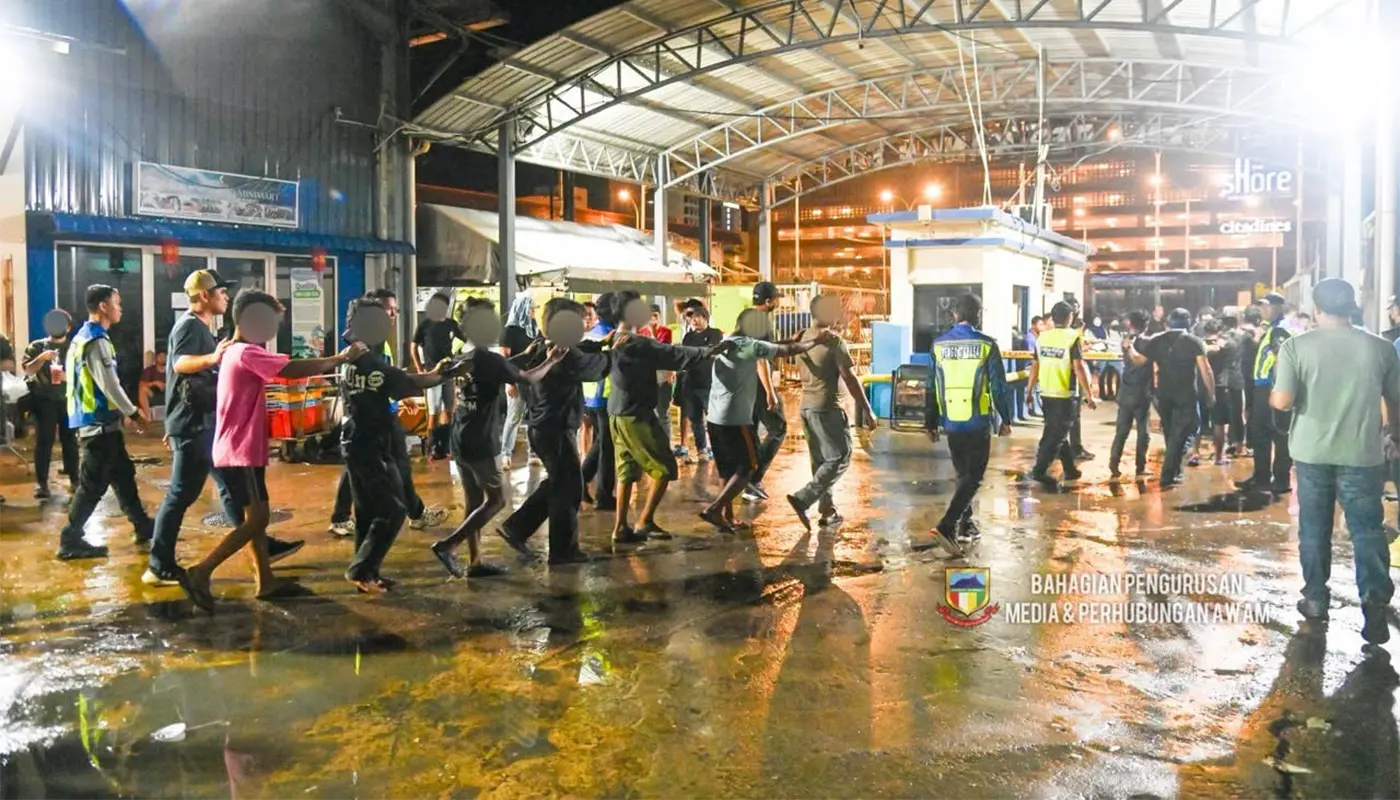
KOTA KINABALU – A comprehensive multi-agency enforcement initiative was executed in the state capital earlier this week to address compliance issues across land and maritime domains.

Operation Todak brought together six distinct government bodies in a coordinated effort to uphold regulatory standards within commercial zones and adjacent waterways surrounding the city centre.
The integrated operation commenced at 11 pm on 4 August 2026, focusing primarily on the Sabah Fish Marketing Sdn Bhd (SAFMA) precinct and Kota Kinabalu Grand Market.
Strategic timing during late-night hours allowed authorities to monitor activities when illicit operations are most likely to occur whilst minimising disruption to legitimate daytime commerce. Geographic concentration maximised resource efficiency across participating agencies with overlapping jurisdictions.
Immigration Department personnel conducted screening of 521 individuals classified as persons under investigation during the land-based component.
This systematic verification process identified ten Filipino nationals suspected of violating Section 6(1)(c) of the Immigration Act 1959/63 regarding valid documentation status.
All detained individuals were subsequently transferred to the Kota Kinabalu Immigration Depot for further processing in accordance with established legal procedures.
Maritime enforcement formed an equally critical dimension of the operation given the waterfront location’s vulnerability to cross-border movements.
The Malaysian Marine Department Sabah Region collaborated with the Malaysian Maritime Enforcement Agency to inspect four vessels operating in surrounding waters.
One boat’s original licence was seized after inspectors discovered that a foreign crew member’s identification documents had expired beyond permissible grace periods.
Both maritime agencies maintained heightened vigilance throughout the operation to detect and prevent escape attempts by individuals jumping into the sea upon noticing enforcement presence.
Such evasive tactics pose serious safety risks requiring immediate intervention capabilities from trained waterborne responders. Proactive positioning of assets ensured rapid response capacity should emergencies arise during inspection activities.
The Malaysian Maritime Enforcement Agency deployed two dedicated vessels crewed by fourteen personnel specifically targeting local fishing craft compliance.
Inspection of one such vessel resulted in seven crew members being referred to immigration authorities for additional verification and processing.
This targeted approach demonstrates intelligence-led deployment, optimising limited maritime resources against the highest-priority vessels based on risk assessment criteria.
Local authority enforcement addressed municipal licensing violations within market premises during the same timeframe. City Hall officers issued compounds to two hawkers conducting business without valid permits in both SAFMA and Grand Market areas.
Seizure of one motorcycle and associated trading equipment reinforced consequences of non-compliance whilst removing unregulated competition affecting licensed vendors’ livelihoods.
The Royal Malaysian Police provided an essential security backbone, enabling safe execution of all operational components across multiple locations simultaneously.
Twenty-one officers from Kota Kinabalu Police Station, Team Cantas, and the Marine Police Force ensured a controlled environment, preventing interference or escalation during sensitive enforcement actions.
Their presence deterred resistance whilst protecting both officers and the public from potential harm during high-stakes interventions.
Inter-agency coordination mechanisms proved vital for seamless information sharing and tactical synchronisation amongst diverse participants. Pre-operation briefings established clear command structures, communication protocols, and jurisdictional boundaries, preventing duplication or gaps in coverage.
Post-operation debriefings will identify lessons learned, informing future joint deployments and procedural refinements, enhancing collective effectiveness.
Data-driven targeting enhances the precision of enforcement efforts beyond random patrols or complaint-reactive responses.
Intelligence analysis identifying hotspots, peak violation times, and modus operandi patterns enables proactive resource allocation where returns on investment are greatest.
Continuous feedback loops between field observations and strategic planning ensure adaptive responsiveness to evolving non-compliance trends.
Community engagement complements coercive measures by fostering voluntary compliance through education and accessible licensing pathways.
Outreach programmes inform vendors about application procedures, fee structures, and benefits of formalisation, reducing barriers to entry for micro-entrepreneurs.
Balanced approaches combining firmness with fairness build public trust essential for sustainable regulatory legitimacy over time.
Environmental and occupational safety considerations remain integral to enforcement operations in busy market environments.
Proper waste management, fire prevention, structural integrity checks, and hygiene standards protect both traders and consumers from preventable hazards. Holistic governance recognises that regulatory compliance encompasses multiple dimensions beyond mere documentation verification.
Long-term urban liveability depends on consistent application of rules rather than sporadic crackdowns generating temporary improvements followed by regression.
Predictable enforcement creates stable expectations, encouraging investment in compliant business models whilst deterring opportunistic violations exploiting perceived laxity. Institutional credibility accumulates through demonstrated commitment to equitable treatment across all stakeholder groups.
Capacity building amongst enforcement personnel ensures professional conduct meeting international human rights standards alongside domestic legal requirements.
Regular training on de-escalation techniques, cultural sensitivity, evidence handling, and procedural justice strengthens public confidence in governmental authority.
Competent officers represent the face of state power, shaping citizen perceptions of legitimacy more profoundly than policy pronouncements alone.
Regional cooperation frameworks may enhance cross-border coordination addressing transnational challenges like irregular migration and unlicensed fishing exceeding single-jurisdiction capacities.
Information sharing agreements, joint patrol arrangements, and harmonised standards reduce arbitrage opportunities exploited by offenders navigating jurisdictional seams.
Collaborative governance reflects recognition that interconnected problems demand interconnected solutions transcending administrative silos.
