



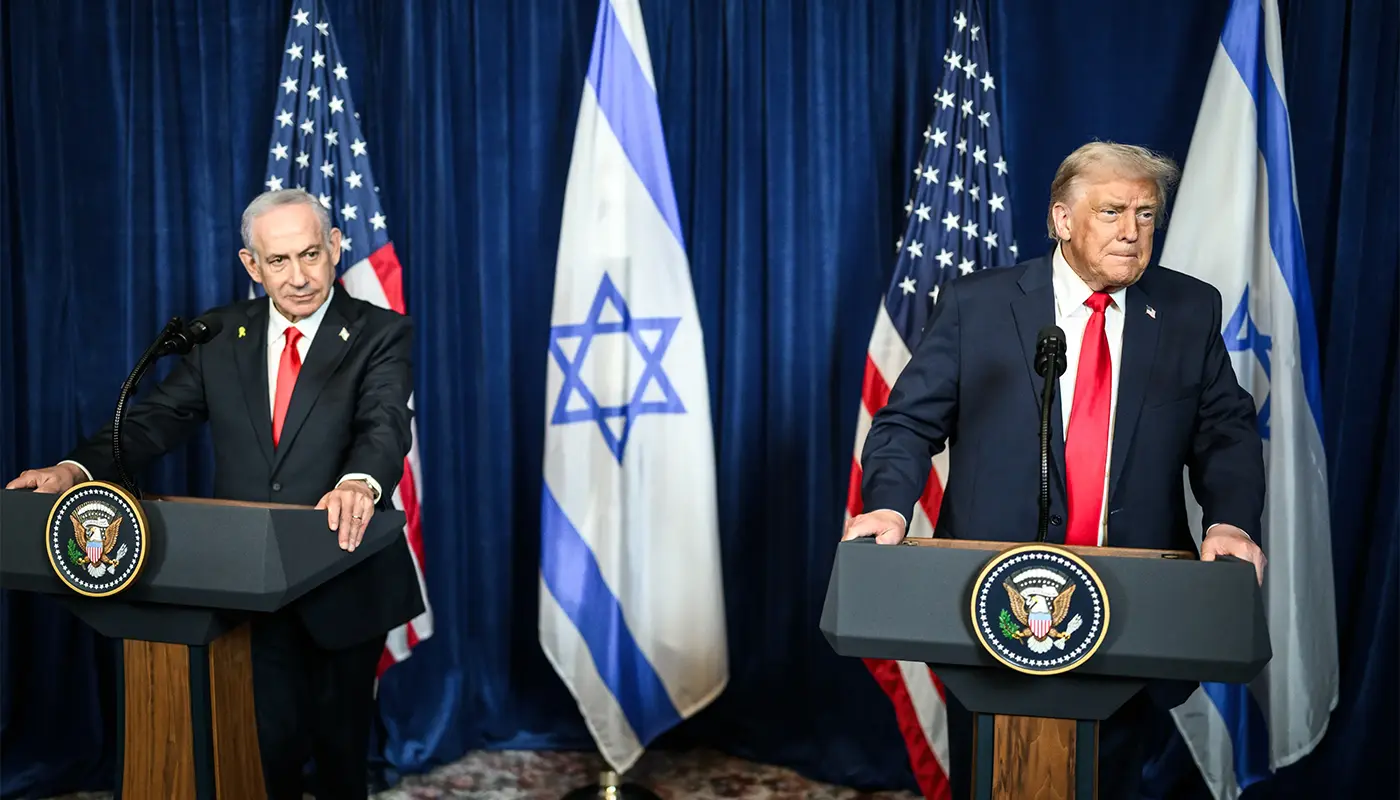
JERUSALEM – Israeli Prime Minister Benjamin Netanyahu has rejected a 15-point US-backed plan for Gaza, saying Israeli forces will not withdraw from the territory until Hamas has been fully disarmed.
The decision places further pressure on efforts led by the United States and other mediators to move forward with a proposed framework aimed at reducing hostilities and establishing a new system of administration in Gaza.
Netanyahu made the position clear during a cabinet meeting on Sunday, saying Israel would not accept the plan in its current form. “Israel rejects the 15-point document,” Netanyahu said.
He said Israeli forces would remain in place until Hamas was completely disarmed and would continue military operations that Israel says are intended to protect its troops and civilians from threats. Netanyahu also confirmed that Israeli and US officials were continuing discussions over the proposal.
“They have ideas, some of which are acceptable to us and some are not acceptable to us, and we know how to stand firm on these things,” he said. The White House did not immediately issue a response to Netanyahu’s remarks.
Hamas, meanwhile, said it remained committed to implementing the roadmap. In a statement issued later on Sunday, the Palestinian resistance group called on mediators and countries involved in guaranteeing the agreement to take action to prevent violations that could undermine the process.
The disagreement centres largely on the sequence of military withdrawal and disarmament.
The US-backed proposal calls for Hamas and other armed groups in Gaza to surrender their weapons, while the wider roadmap envisages an Israeli military withdrawal and the eventual transfer of day-to-day administration to a Palestinian technocratic committee.
Netanyahu, however, has insisted that disarmament must be complete before Israel withdraws. He said Israel’s interpretation of disarmament includes not only heavy weapons but also smaller weapons held by Hamas.
The 15-point proposal initially places emphasis on removing Hamas’s heavier weapons, weapons production facilities, arms storage sites and tunnel infrastructure.
US President Donald Trump announced the agreement on July 30 and described it as a major step towards lasting peace and security. The plan was associated with the US-led Board of Peace, which was established in February 2026 and includes a number of countries from the Middle East and elsewhere.
The Board of Peace is intended to play a role in overseeing the next phase of the process, including arrangements for governance and security in Gaza.
Hamas had previously indicated that it accepted the latest version of the roadmap after negotiations, but said implementation would depend on an end to Israeli military action, an Israeli withdrawal from Gaza and progress on reconstruction.
Netanyahu’s latest statement has therefore raised questions about whether the proposed sequence can be implemented as originally intended.
He also reiterated his opposition to the establishment of a Palestinian state. “As long as I am prime minister, no Palestinian state will arise,” Netanyahu said.
The position could create additional difficulties for the mediators attempting to establish a transitional administration for Gaza.
The proposed Palestinian technocratic committee would be expected to manage the territory’s daily affairs under the oversight of the Board of Peace. However, its ability to operate would depend heavily on cooperation from Israel and the other parties involved.
Analysts and regional observers have already expressed concerns over the implementation of the ceasefire arrangements between Israel and Hamas.
Although a ceasefire took effect in October 2025, Israeli military strikes have continued in Gaza, according to Palestinian authorities and prominent international news medias, with further casualties reported since the agreement came into effect.
Palestinian news agency Wafa reported that at least one child was injured by Israeli army gunfire in the Al-Najjar neighbourhood of Khan Younis last Sunday.
Gaza’s health authorities said at least 1,258 people had been killed and 4,139 wounded since the ceasefire began in October 2025. More than 800 bodies were also reported to have been recovered from rubble during the same period.
The reported figures cover the period since the ceasefire and are separate from the much higher overall toll recorded since the conflict began in October 2023.
According to Gaza’s health ministry, at least 73,386 people have been killed and 174,250 wounded in Gaza since October 2023.
The continuing violence, combined with the dispute over Hamas’s disarmament and the Israeli military withdrawal, leaves the next stage of the US-backed roadmap uncertain.
For Palestinians, the rejection has also raised concerns about whether the proposed political and administrative transition can proceed.
The disagreement between Netanyahu’s government and Washington could become another major obstacle to efforts to implement the plan, particularly if the two sides remain divided over the conditions for an Israeli withdrawal.
With Hamas maintaining its support for the roadmap and Israel rejecting the document in its present form, mediators face the challenge of finding a sequence acceptable to all sides while attempting to prevent further escalation in Gaza.
