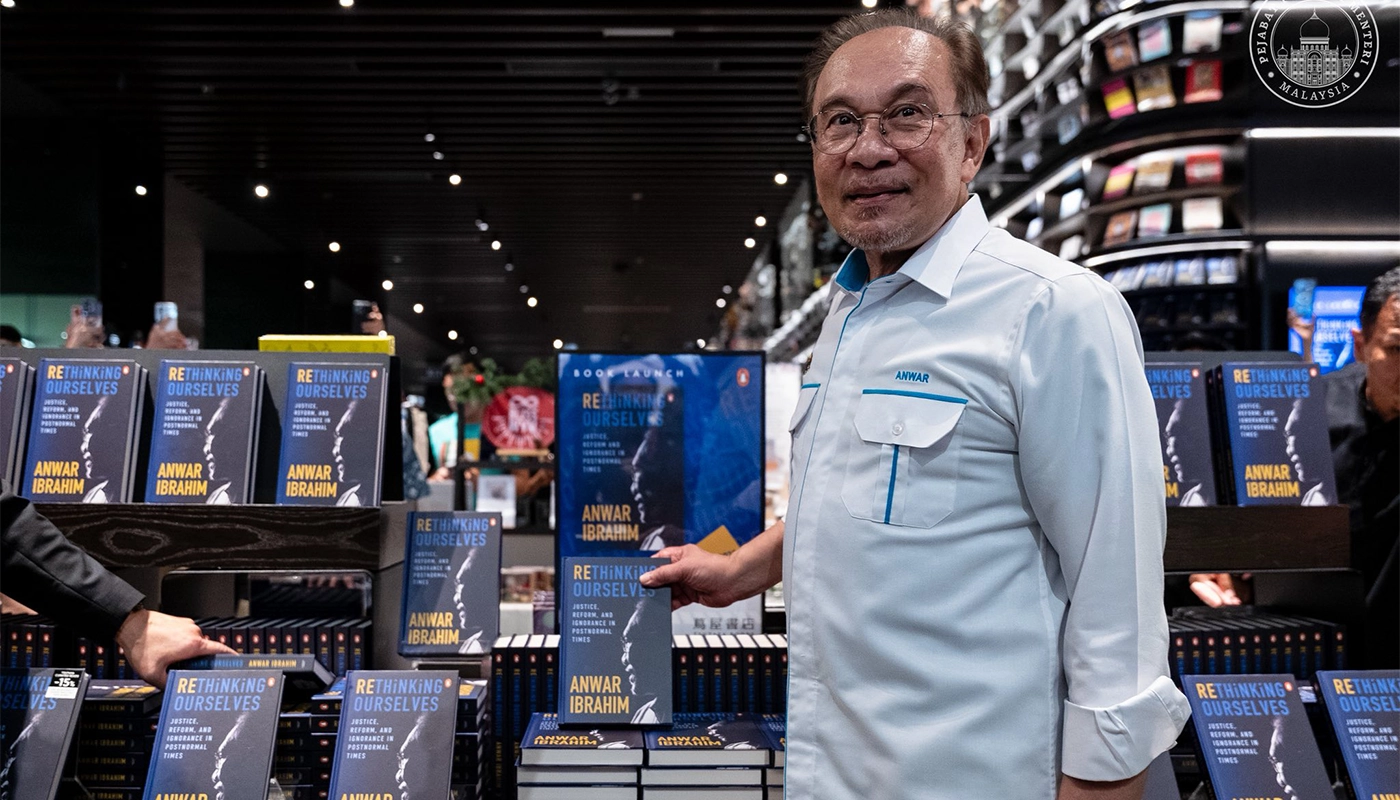
BUKIT JALIL – Prime Minister Datuk Seri Anwar Ibrahim has unveiled his latest book, Rethinking Ourselves: Justice, Reform and Ignorance In Postnormal Times, at a ceremony attended by his wife Datuk Seri Dr Wan Azizah Wan Ismail. The launch drew attention to themes of justice, race, humanity, and the challenges facing modern societies.
The manuscript, which has been in development for over a decade, is supported by three major publishers. Hurst London will distribute the book across the United Kingdom, Europe and the United States, while Penguin will handle Malaysia and Asia. Hong Kong University Press is set to publish the China and East Asia edition beginning January next year.
Anwar explained that the book was inspired by notes written during his time in Sungai Buloh, where reflection on national identity, justice, and dignity shaped the foundation of the work. He described the text not merely as a memoir but as a framework for building a civilised nation rooted in values, moral courage, and respect for its people.

The book raises pressing questions about corruption, racism, and extremism, while also exploring how post-colonial societies can reclaim intellectual sovereignty and restore dignity.
It further examines contemporary challenges such as digital transformation, artificial intelligence, and energy transition, urging Malaysia to embrace progress without losing its moral compass.

“Technology empowers us, but values and humanity give meaning to progress,” Anwar noted, emphasising the importance of balancing innovation with ethical responsibility.
The Prime Minister dedicated the book to his wife Azizah, acknowledging her role in supporting his writing journey through long nights and busy schedules. He described her as a loyal companion and source of strength throughout the process.
In a gesture of social commitment, Anwar pledged that all royalties from the book will be channelled to underprivileged students. The initiative aims to ensure that education continues to open pathways for change, enabling future generations to uplift themselves and their families.
He concluded by stressing that the true strength of a nation lies not in political rhetoric but in securing a free and dignified future for its youth.