



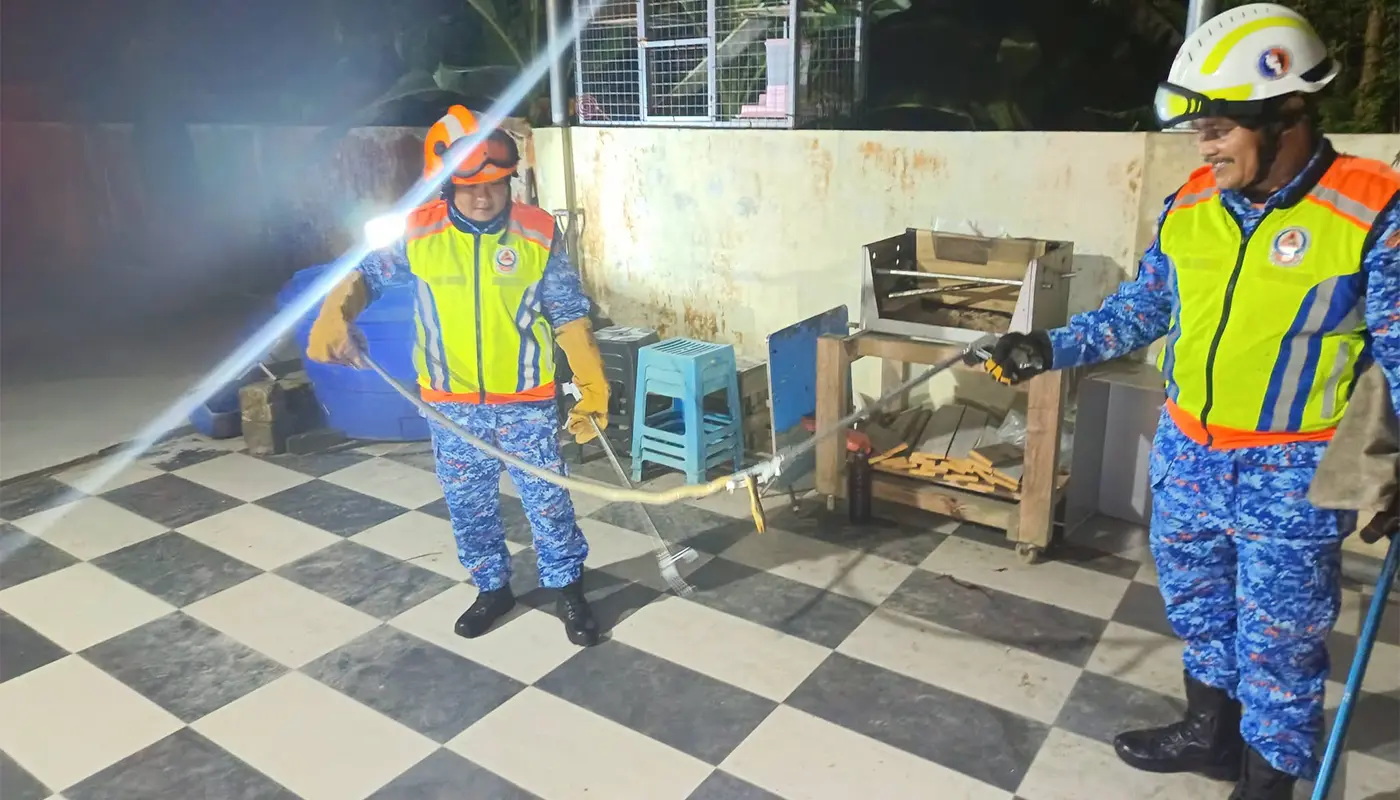
MUKAH – Civil defence responders successfully secured a venomous serpent discovered on a residential property in this district late on Saturday, ensuring the safety of local inhabitants.

The one-metre black cobra was located behind a house, prompting an immediate emergency call to the PKOD Mukah operations centre for professional wildlife assistance.
The KMU snake-catching unit was swiftly deployed upon receiving the distress notification. Personnel arrived at the scene equipped with specialised tools designed for handling venomous species, recognising the elevated risks associated with cobra encounters compared to non-venomous reptiles.
Proper equipment and technique are paramount when managing such potentially lethal animals. Responders employed a pincer method to safely restrain and capture the serpent without provoking defensive strikes.
This controlled approach minimises danger to both the operators and the animal, allowing for secure containment whilst avoiding unnecessary harm. The technique requires precision and experience, particularly in confined outdoor spaces where escape routes may be limited.
The operation concluded without incident, with the cobra successfully removed from the premises. Authorities confirmed that the location was subsequently brought under full control and declared safe for residents.
Such swift resolutions prevent prolonged anxiety for households and eliminate immediate threats to community members, especially children and elderly individuals who may be more vulnerable.
Black cobras, while less commonly encountered than some other species in Sarawak, possess potent neurotoxic venom requiring serious respect and caution. Their presence near human dwellings often indicates nearby prey sources or suitable shelter conditions.
Understanding these patterns helps communities implement preventive measures whilst maintaining realistic expectations about coexistence with native wildlife.
The agency’s local motto, “APM Mukah, Nang Steady”, reflects the dependable nature of service provided to this coastal community.
Residents have come to trust that calls for assistance will be met with competent, composed responses regardless of the hour or complexity of the situation. This reliability forms the bedrock of public confidence in emergency services.
Officials remind the public that the standing advisory remains clear: “There is a disaster; call APM.” This encompasses not only major catastrophes but also localised emergencies, including dangerous wildlife intrusions.
Attempting to handle venomous snakes without proper training can result in severe injury or death, making professional intervention the only sensible course of action.
For any emergency cases within the district, the dedicated hotline 084-872814 operates continuously throughout the day and night.
This twenty-four-hour accessibility ensures that help is always reachable when unexpected threats emerge. Prompt reporting enables faster response times and better outcomes for all parties involved in wildlife conflict situations.
Urban and semi-rural development in Mukah continues to interface with natural habitats where reptiles thrive. Seasonal weather patterns, land clearing activities, and prey availability all influence snake movement patterns and encounter frequencies.
Community awareness of these factors supports proactive safety practices alongside reactive emergency responses.
Preventive landscaping and property maintenance can reduce attractive features for serpents seeking shelter. Keeping vegetation trimmed, removing debris piles, and sealing structural gaps limit hiding spots near homes.
However, complete elimination of wildlife presence is neither possible nor ecologically desirable, reinforcing the need for accessible professional removal services.
The successful capture demonstrates the value of trained personnel who understand both animal behaviour and human safety protocols.
Their expertise bridges the gap between conservation concerns and public protection needs, enabling outcomes that serve multiple stakeholders. Such balanced approaches characterise modern wildlife management in populated areas.
Residents are encouraged to familiarise themselves with emergency contact information before crises occur. Having numbers readily available reduces panic-induced delays during stressful encounters.
Community preparedness complements official response capabilities, creating layered safety nets that protect vulnerable populations effectively.
