



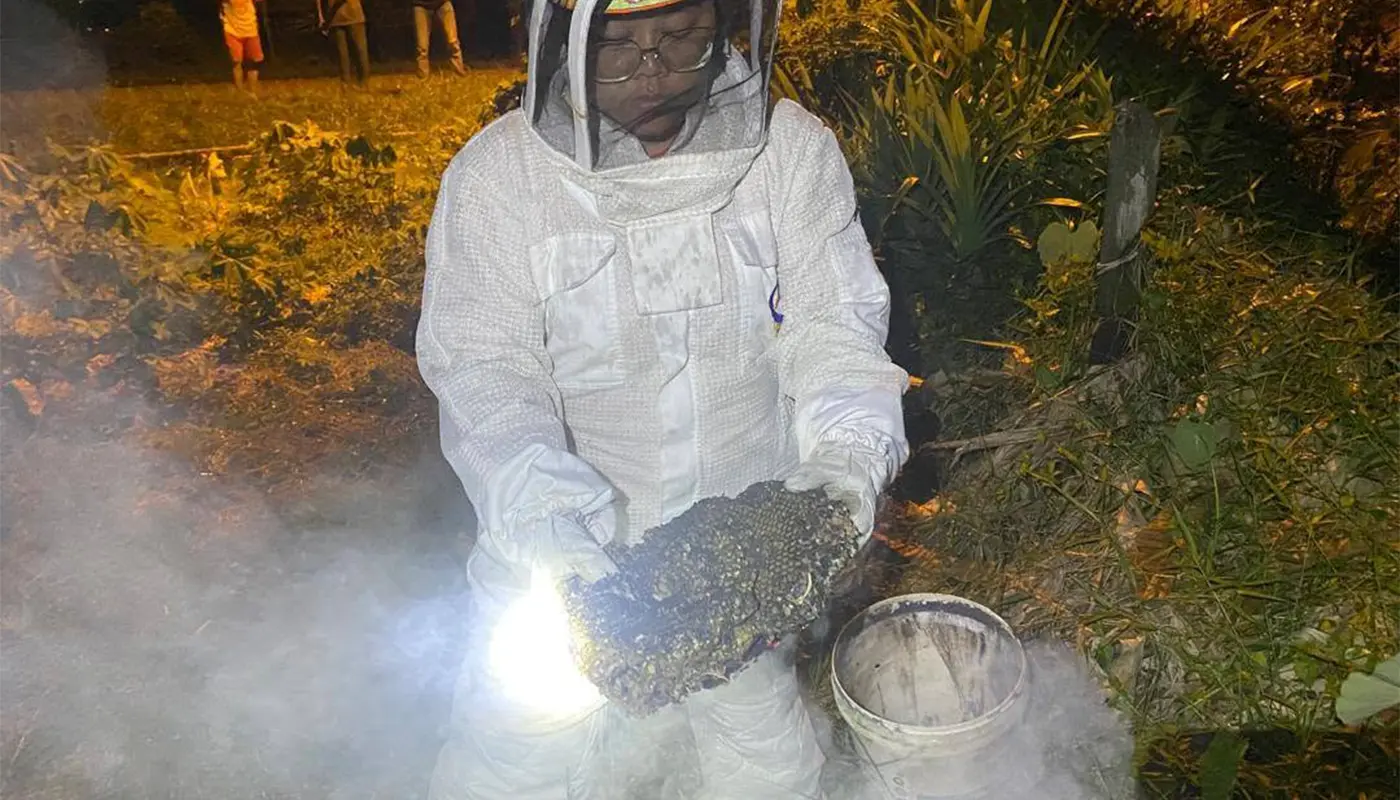
TANJUNG MANIS – Civil defence personnel successfully eliminated a significant insect hazard discovered in close proximity to residential property in this district on Saturday.

A wasp nest comparable in dimensions to a standard bucket was located within a crystal fruit tree adjacent to a dwelling in Kampung Baru Rajang, posing considerable risk to nearby inhabitants.
The Tanjung Manis District Civil Defence Force received notification from concerned members of the public regarding the dangerous colony.
Recognising the potential for severe stinging incidents, particularly given the nest’s substantial size and location near human activity, authorities promptly initiated removal proceedings to safeguard community welfare.
A four-member response team was mobilised to attend the scene with appropriate protective equipment and suppression tools.
The squad conducted an initial site assessment to determine the safest and most effective elimination strategy, taking into account the nest’s position within the tree canopy and surrounding environmental conditions that could affect operational safety.
Personnel employed controlled burning techniques to destroy the nest completely. This method is frequently utilised for large colonies situated in vegetation where physical removal might provoke aggressive defensive swarming.
Thermal destruction ensures thorough elimination whilst minimising the duration of exposure for responders working in potentially hazardous proximity to agitated insects.
The operation concluded successfully without injury to team members or bystanders. Authorities confirmed that the immediate threat had been neutralised and the area rendered safe for normal residential use.
Such interventions prevent potential mass stinging events that could result in serious allergic reactions or medical emergencies, particularly among vulnerable populations.
Wasp colonies of this magnitude typically develop over extended periods, often going unnoticed until they reach problematic sizes. Crystal fruit trees and similar vegetation provide attractive nesting sites due to sheltered branching structures and proximity to food sources.
Regular property inspections can help identify developing nests before they become unmanageable hazards requiring emergency intervention.
Civil defence officials strongly advise against any attempt to approach or disturb wasp colonies independently. Even experienced individuals risk triggering coordinated defensive attacks when nests are threatened.
Multiple simultaneous stings can cause life-threatening anaphylaxis in sensitised persons, and even non-allergic individuals may suffer severe pain and swelling from envenomation.
The public is urged to contact authorities immediately upon discovering nests that could threaten safety. Professional responders possess specialised protective gear, suppression equipment, and tactical training unavailable to civilians.
Their expertise enables safe resolution of situations that might otherwise escalate into medical emergencies or property damage incidents.
Community awareness plays a vital role in preventing wasp-related injuries. Residents should remain vigilant during outdoor activities, particularly in areas with dense vegetation or known insect activity.
Teaching children to recognise and avoid nests reduces accidental disturbances that commonly trigger defensive responses from protective colonies.
Seasonal patterns influence wasp population dynamics and nest-building behaviour in Sarawak. Periods of abundant rainfall followed by warm weather often accelerate colony growth and expansion.
Understanding these cycles helps communities anticipate peak activity periods and implement preventive monitoring practices around homes and communal spaces.
Successful operations like this one demonstrate the breadth of emergency services provided beyond traditional disaster response. Wildlife and pest hazards constitute legitimate public safety concerns warranting professional attention.
The willingness of civil defence teams to address such issues reflects a comprehensive commitment to community wellbeing across diverse threat categories.
Residents encountering similar hazards should utilise established reporting channels rather than delaying action out of uncertainty.
Early notification allows for planned interventions during optimal conditions, reducing risks associated with nighttime operations or adverse weather.
Proactive communication between citizens and responders strengthens overall community resilience against environmental hazards.
