



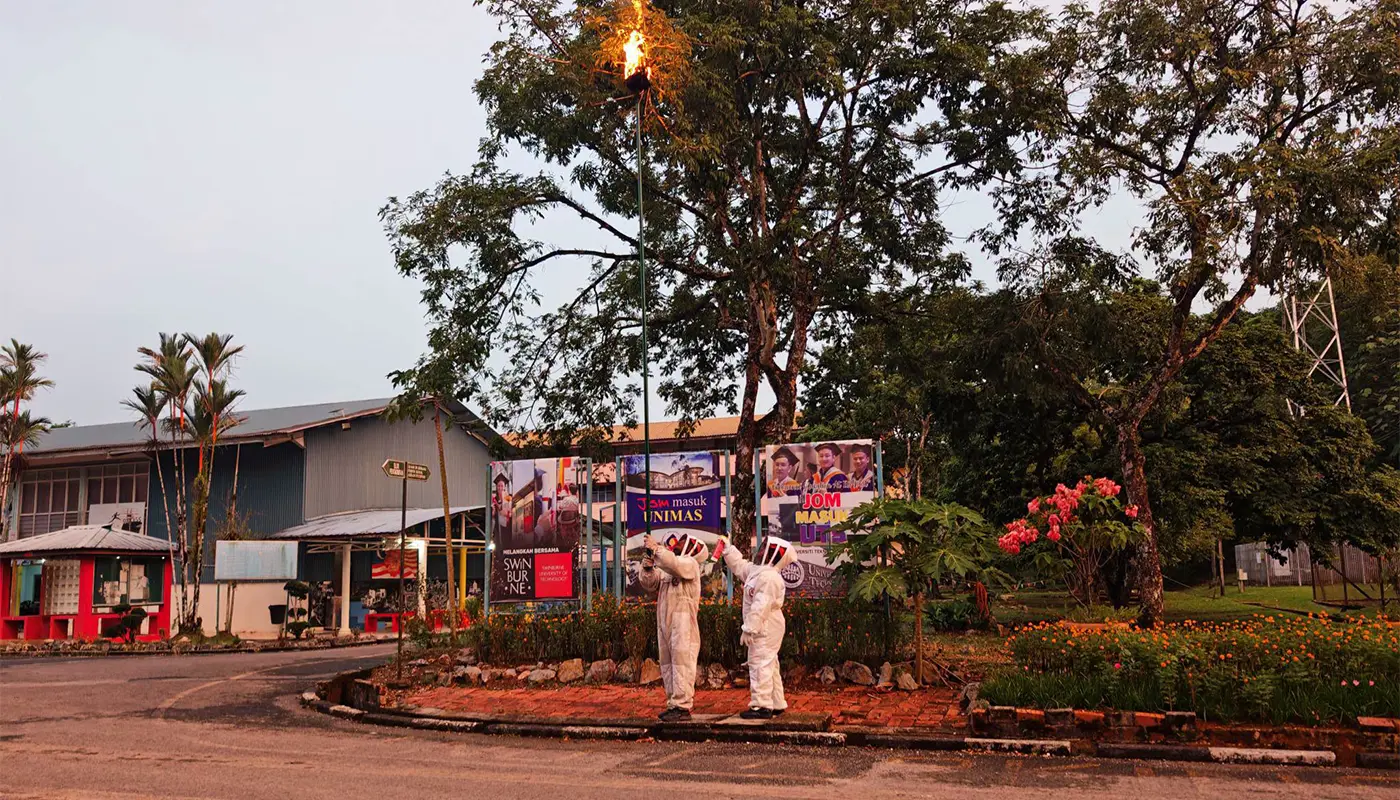
BAU – An emergency response was activated on Thursday afternoon following reports of a potentially hazardous insect nest discovered at a secondary school in the Bau district.

The incident prompted swift action from local civil defence authorities to ensure the safety of students and staff members.
The District Operation Control Centre of the Bau Civil Defence Force received an urgent telephone call at approximately 3:50 pm.
Members of the public alerted officials to the presence of what was identified as a land wasp colony at Sekolah Menengah Kebangsaan Paku.
Such discoveries can pose significant risks in educational environments where large numbers of young people gather daily.
Upon receiving the notification, the control centre immediately classified the situation as a Minor Support Service case involving land wasps.
This categorisation allows for a targeted and proportionate response from specialised teams trained to handle wildlife-related hazards in populated areas. The rapid classification ensures that appropriate resources are deployed without unnecessary delay.
Land wasps, while generally less aggressive than their aerial counterparts when undisturbed, can become highly defensive if their nest is threatened.
Schools present particular challenges for pest management due to the need to minimise disruption to educational activities while ensuring complete safety.
The presence of such nests near classrooms or playgrounds requires careful assessment by professionals who understand both the biological behaviour of these insects and the practical constraints of working in educational settings.
The Bau Civil Defence Force maintains dedicated contact lines for residents facing similar emergencies. Individuals encountering dangerous wildlife situations in the district can reach the local office directly or utilise the national emergency number.
These communication channels remain essential for coordinating timely responses to incidents that could threaten public safety.
Educational institutions across Sarawak regularly encounter challenges related to wildlife management. The tropical climate and abundant vegetation provide ideal conditions for various species to establish colonies near human settlements.
Schools, with their extensive grounds and frequent outdoor activities, often find themselves at the intersection of natural habitats and human occupation.
Civil defence organisations throughout Malaysia have developed considerable expertise in managing these situations.
Their approach typically involves assessing the immediate risk level, determining the most effective removal method, and implementing measures to prevent future occurrences.
Professional handling is crucial because improper attempts to remove wasp nests can provoke aggressive defensive behaviour from the colony.
The incident at SMK Paku highlights the ongoing importance of vigilance in maintaining safe school environments.
Staff members and students are encouraged to report any suspicious insect activity to authorities rather than attempting to address potential hazards independently.
Early detection and professional intervention remain the most effective strategies for preventing serious injuries from wasp stings.
Local authorities continue to emphasise the availability of emergency services for wildlife-related incidents.
The Bau district office stands ready to assist residents with similar concerns, ensuring that communities can maintain confidence in their ability to respond effectively to unexpected natural hazards.
Regular maintenance checks and prompt reporting of potential issues contribute significantly to overall campus safety.
The successful management of such incidents depends on cooperation between educational institutions, civil defence forces, and the wider community.
When all parties remain alert and responsive, schools can provide secure learning environments despite the challenges posed by Malaysia’s rich biodiversity.
This collaborative approach ensures that natural phenomena do not disrupt the essential work of education.
