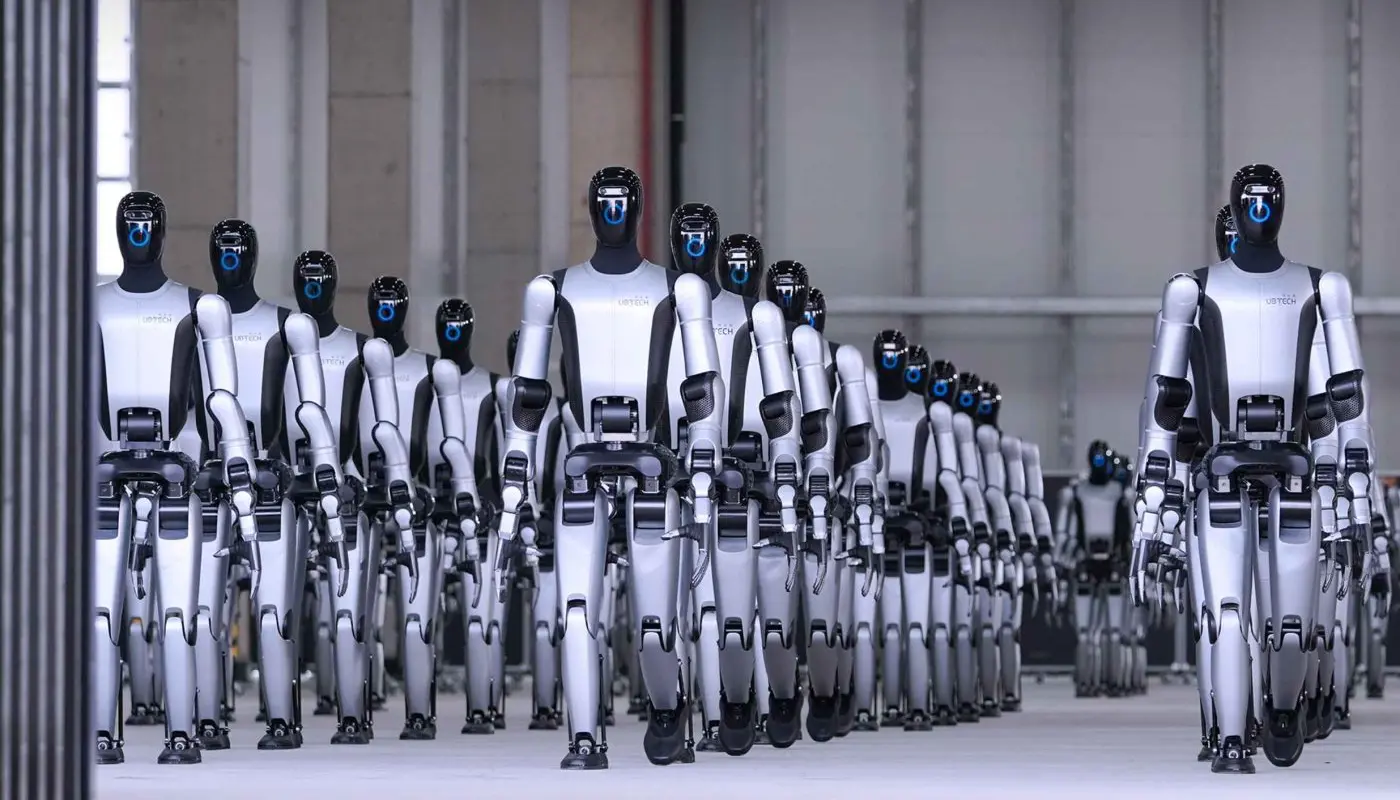
GUANGXI – China has begun deploying humanoid robots to assist with border patrol operations along its shared borders with Vietnam, marking a significant step in the integration of artificial intelligence into public security.
The initiative involves the use of Walker S2 humanoid robots, developed by Shenzhen-based UBTECH Robotics Corp., at the busy Fangchenggang border crossing in Guangxi province. The company secured a contract valued at approximately $37 million to supply and operate the machines.
Officials have described the deployment as part of a broader strategy to explore “embodied intelligence,” where artificial intelligence systems are integrated into physical machines capable of functioning in complex, real-world environments.

The Fangchenggang crossing is one of the most active gateways between China and Vietnam, with thousands of cargo trucks, buses, and travellers passing through daily.
Authorities believe the site provides an ideal testing ground for humanoid robots, given the need for inspections and logistics to be conducted swiftly and without disruption.

The Walker S2 robots are full-sized humanoid machines equipped with articulated arms, legs, and a torso designed to replicate human movement.
They are capable of performing a range of tasks including patrolling, assisting with inspections, guiding travellers, managing crowd flow, and supporting logistics operations.
According to UBTECH, the robots are powered by BrainNet 2.0, a dual-loop AI architecture that enables multimodal reasoning and autonomous decision-making.
This allows the machines to adapt to dynamic conditions at the border, such as fluctuating traffic volumes and unexpected logistical challenges.
Chinese planners view the deployment as a milestone in the country’s technological ambitions, aligning with Beijing’s wider emphasis on innovation and security under its long-term development strategies.
The move also reflects China’s growing investment in robotics and artificial intelligence as part of its economic and security modernisation.
Observers note that while the robots are not intended to replace human officers, they are expected to complement existing personnel by handling repetitive or physically demanding tasks. This could free up human staff to focus on more complex duties requiring judgement and discretion.
The deployment has attracted international attention, with analysts highlighting both the potential benefits and challenges of integrating humanoid robots into sensitive security operations.
Questions remain about reliability, public acceptance, and the long-term implications of relying on artificial intelligence in border management.
Nevertheless, the project signals China’s determination to push forward with advanced technologies in areas traditionally dominated by human labour.
The Fangchenggang trial may serve as a model for future applications of humanoid robotics in other sectors, including logistics, healthcare, and disaster response.
As the rollout begins, the border crossing will serve as a live demonstration of how artificial intelligence and robotics can be harnessed to manage high-pressure environments, offering insights into the evolving relationship between technology and public security.
Sources: Earth.com, SCMP, Social Media