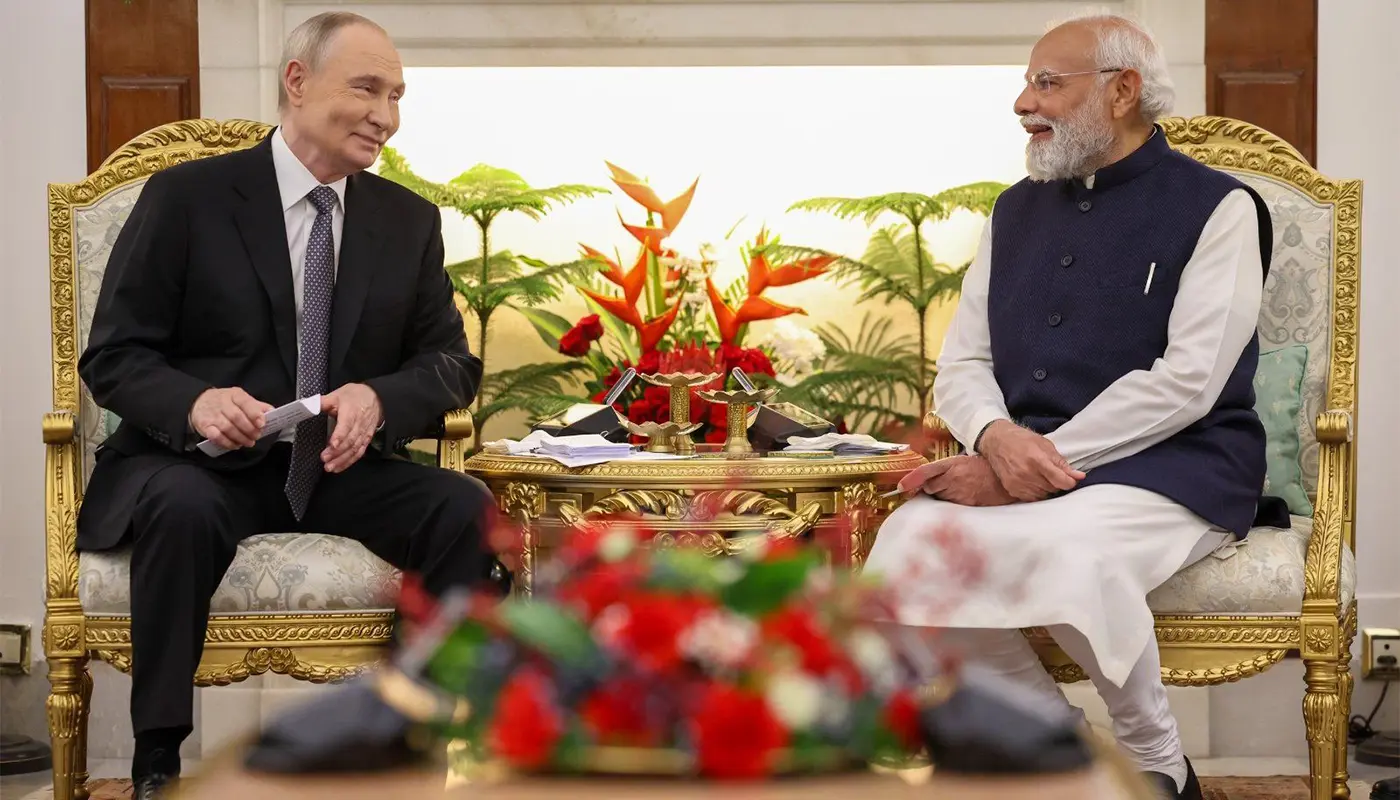
NEW DELHI – Indian Prime Minister Narendra Modi and Russian President Vladimir Putin have agreed to deepen economic and defence cooperation, unveiling a Vision 2030 roadmap during the 23rd India-Russia Annual Summit in New Delhi.
The agreement comes as India faces mounting U.S. tariff pressures over its continued purchases of Russian oil.
Putin, making his first visit to India in four years, was welcomed with a ceremonial 21-gun salute at Rashtrapati Bhavan. The Russian leader emphasised Moscow’s readiness to provide “uninterrupted fuel supplies” to India, despite Western sanctions.

However, Indian officials struck a cautious tone, noting that energy companies would continue to base decisions on “market dynamics and commercial issues”.
India’s imports of Russian oil have fluctuated sharply in recent months. Official data shows a 38 percent drop in October, followed by record purchases in November, before sanctions triggered expectations of a three-year low in December. Analysts suggest India is balancing discounted Russian supplies with the risk of punitive U.S. measures.

Alongside energy, defence cooperation featured prominently. Both sides agreed to expand joint manufacturing of spare parts and advanced systems under India’s “Make in India” initiative.
Discussions included potential procurement of additional S-400 missile systems, while a joint statement highlighted plans for co-development of new technologies.
Modi described the partnership as “a guiding star,” stressing that ties have “stood the test of time.” He reiterated India’s call for a peaceful resolution to the Ukraine conflict, while Putin questioned Washington’s stance, asking why India should be denied the same rights to purchase Russian fuel as the U.S. itself.
The summit also produced agreements on labour mobility, agriculture, healthcare, and shipping. Russia pledged to import more Indian goods, aiming to raise bilateral trade to $100 billion by 2030, up from $68.7 billion in FY2024–25.
Meanwhile, New Delhi is preparing for trade talks with Washington beginning 10 December, seeking to ease tariffs imposed by President Donald Trump. Officials hope to conclude the first tranche of a bilateral trade agreement within the year.
The outcomes underscore India’s delicate balancing act: strengthening its long-standing partnership with Moscow while negotiating with Washington to protect its economic interests.
Sources: Indian Express, Reuters, The Hindu