



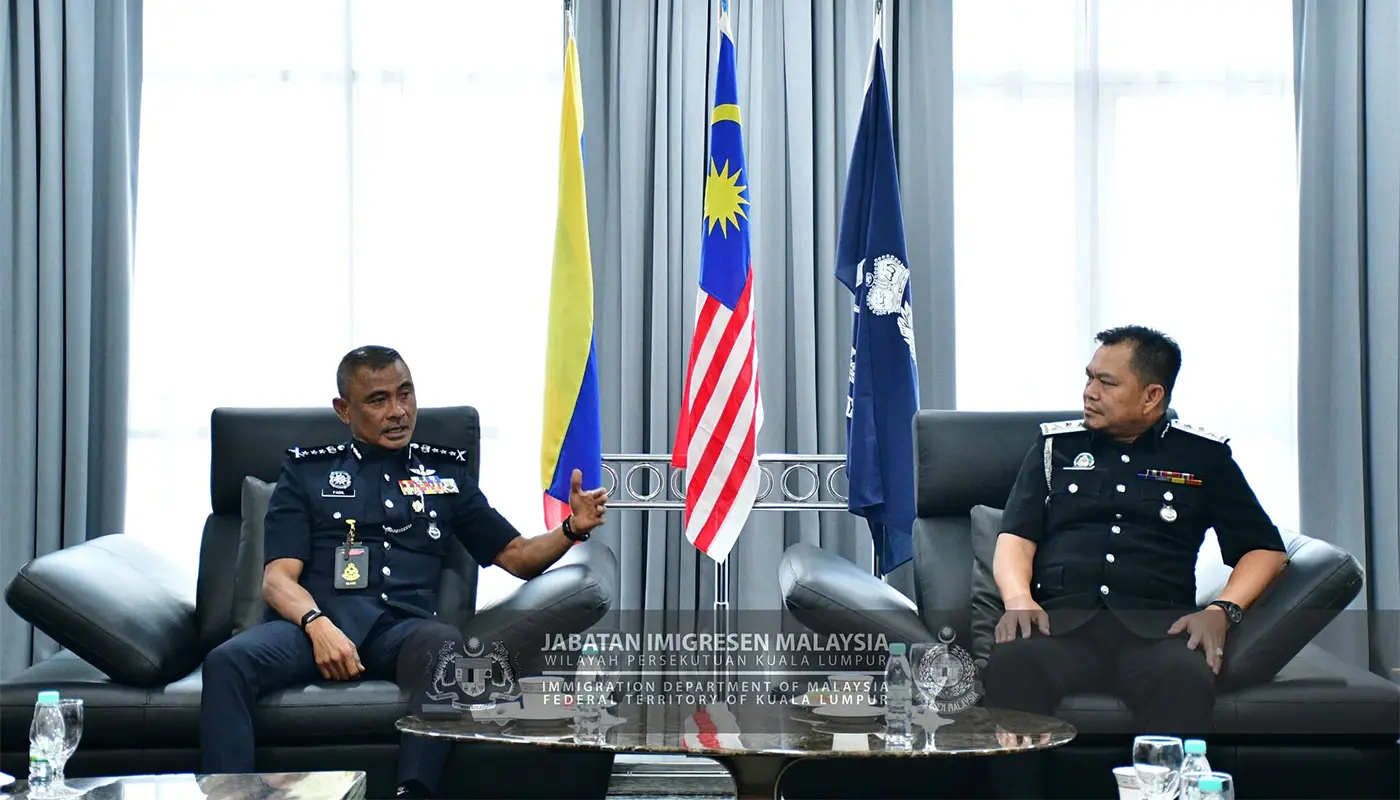
KUALA LUMPUR – Senior leadership from the federal capital’s immigration and police contingents convened for a high-level meeting aimed at reinforcing inter-agency cooperation. The official courtesy visit took place on Tuesday morning within the executive suites of the Kuala Lumpur Police Contingent Headquarters, marking a significant step in aligning operational strategies between two critical enforcement bodies.

The session commenced at 11.30 am in the Guest Room located on Level 12 of Tower A. This strategic dialogue underscores the mutual recognition that effective urban security relies heavily on seamless coordination between distinct but complementary authorities. Both organisations share overlapping responsibilities regarding public order and law enforcement within the metropolitan area.
Leading the immigration delegation was State Director PgK Hamsha bin Injau. He was supported by a senior management team comprising key divisional heads essential to operational planning. Among those present were Deputy Director of Control KPP Marina binti Habibon and Head of Enforcement Division PPK Muhammad bin Mohd Zain. Corporate Division Head PPI Siti Aspanisya binti Zimi also attended alongside other senior officers, demonstrating the comprehensive nature of the institutional engagement.
Host duties were fulfilled by Police Commissioner YDH Dato’ Fadil bin Haji Marsus, who received the visiting party with customary protocol. He was accompanied by his deputy, YDH DCP Datuk Mohd Azani bin Omar, ensuring that top-tier command representation was maintained throughout the discussions. The warm reception set a collaborative tone for the proceedings that followed.
Central to the agenda was the enhancement of unity and mutual understanding between the Royal Malaysia Police and the Immigration Department. Discussions moved beyond ceremonial pleasantries to address practical aspects of joint enforcement. Participants exchanged views on optimising field collaboration, recognising that integrated approaches yield superior outcomes in maintaining safety and regulatory compliance across the city.
The meeting environment was described as harmonious and productive, fostering open communication channels between the agencies. Such bilateral engagements are vital for resolving potential friction points before they impact operational effectiveness. By establishing personal rapport amongst commanders, future coordination during complex operations or emergencies can proceed with greater fluidity and trust.
Symbolic gestures reinforced the substantive discussions held during the visit. The session concluded with an exchange of souvenirs and a commemorative photograph, serving as tangible markers of the strengthened partnership. These traditions, whilst formal, carry weight in institutional culture by publicly affirming commitment to shared objectives and mutual respect.
Stakeholders anticipate that the momentum generated from this encounter will translate into smoother execution of enforcement duties. The well-being of communities in the Federal Territory depends significantly on how effectively these agencies synchronise their efforts. Regular high-level interactions help ensure that strategic priorities remain aligned amidst evolving security challenges.
This visit reflects a broader trend towards holistic governance where siloed operations give way to networked responses. As urban environments grow more complex, the ability of different uniformed services to operate as a cohesive unit becomes increasingly paramount. Continued dialogue at this level is expected to yield dividends in both crime prevention and immigration management.
Observers note that such proactive relationship-building often precedes major joint initiatives or policy implementations. By investing time in foundational cooperation now, both contingents are laying groundwork for future successes. The commitment displayed suggests a long-term vision for integrated security architecture within the nation’s capital.
Ultimately, the gathering reaffirmed that safeguarding Kuala Lumpur is a collective endeavour requiring constant refinement. Through sustained engagement and shared purpose, immigration and police forces aim to deliver enhanced stability for residents and visitors alike. The positive atmosphere observed indicates strong institutional will to maintain this constructive trajectory moving forward.
