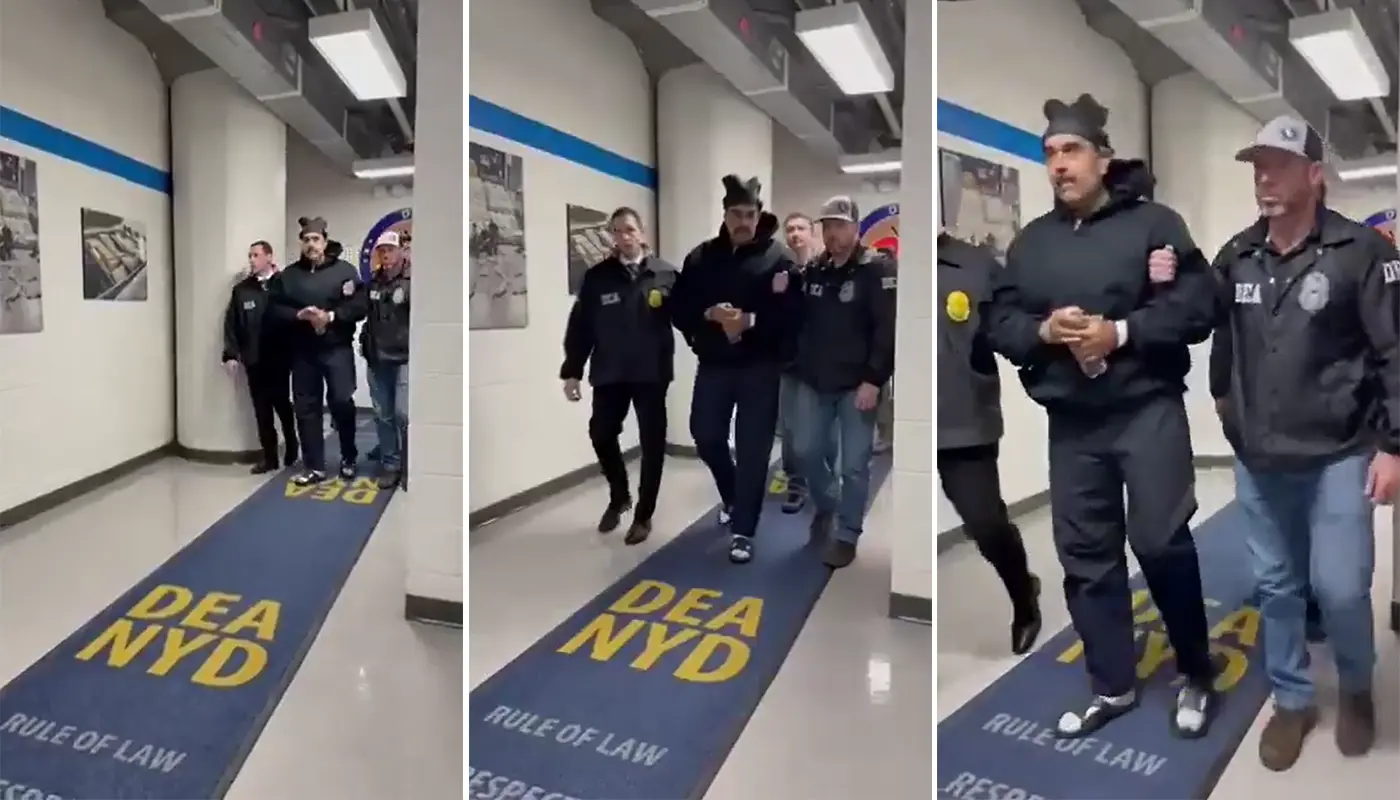
Venezuelan President Nicolás Maduro was being held in a New York detention centre on Sunday after a dramatic and highly controversial US arrest operation that saw him and his wife, Cilia Flores, seized by American forces and flown out of Caracas, officials and witnesses said. The unprecedented operation has triggered global debate over its legality and impact on Venezuelan sovereignty.
The surprise US military invasion early on Saturday involved air strikes on key sites around Venezuela’s capital, including military bases, and disrupted power in parts of Caracas.
US special operations forces reportedly breached the presidential residence in the Fort Tiuna military complex, capturing Maduro and Flores without significant resistance, according to military sources.
The couple was transported first to a US naval vessel and subsequently to New York, where Maduro was seen handcuffed being led into the Metropolitan Detention Centre in Brooklyn.
At a press conference held at his Mar-a-Lago estate, US President Donald Trump addressed the operation’s outcome and his plans for Venezuela’s political future.
“We will run the country until such time as we can do a safe, proper and judicious transition.” Mr Trump said, without providing a clear timeline for how long this oversight might last.
He described the mission as part of broader efforts to stabilise Venezuela and to counter what his administration has characterised as the Maduro regime’s involvement in drug trafficking and narcotics distribution to the United States.
Trump also signalled a significant economic interest in Venezuela’s vast crude oil reserves, vowing that major US oil firms would be invited to invest in refurbishing the country’s deteriorated energy infrastructure.
“We have the greatest oil companies in the world … and we’re going to be very much involved in it.” Trump said, hinting at a deeper involvement in Venezuela’s energy sector.
The operation has drawn fierce criticism from legal experts and foreign governments, who argue that unilaterally removing a foreign head of state and taking him into US custody is contrary to international law and norms of Venezuelan sovereignty.
The United Nations has called for urgent discussions, and nations such as China and Russia condemned the action as an illegal intervention.
In Venezuela, the political situation remains deeply unsettled. The country’s Supreme Court appointed Vice President Delcy Rodríguez as acting president, though she denounced the US action as “illegal” and categorically rejected US authority over Venezuelan affairs. Rodríguez maintained that Maduro remains the legitimate leader and demanded his immediate release.
Despite celebrations among some US backed Venezuelan politicians in the United States who viewed Maduro’s detention as accountability for alleged corruption and human rights abuses, the broader Venezuelan public remains divided, with protests reported in several cities.
The nation’s security forces continue to control major installations in Caracas, and the future arrangement of political authority in Venezuela is far from certain.
Maduro, who has led Venezuela since 2013, is expected to face federal charges in the Southern District of New York, including alleged narco-terrorism and drug trafficking conspiracy counts that date back to indictments originally filed in 2020. His court appearance is anticipated early in the week.
As world leaders and international organisations assess the aftermath of the US action, questions linger about the example set by this bizarre intervention and its long-term implications for regional stability and international law.
Sources: Reuters, Al Jazeera, The Independent, Associated Press