



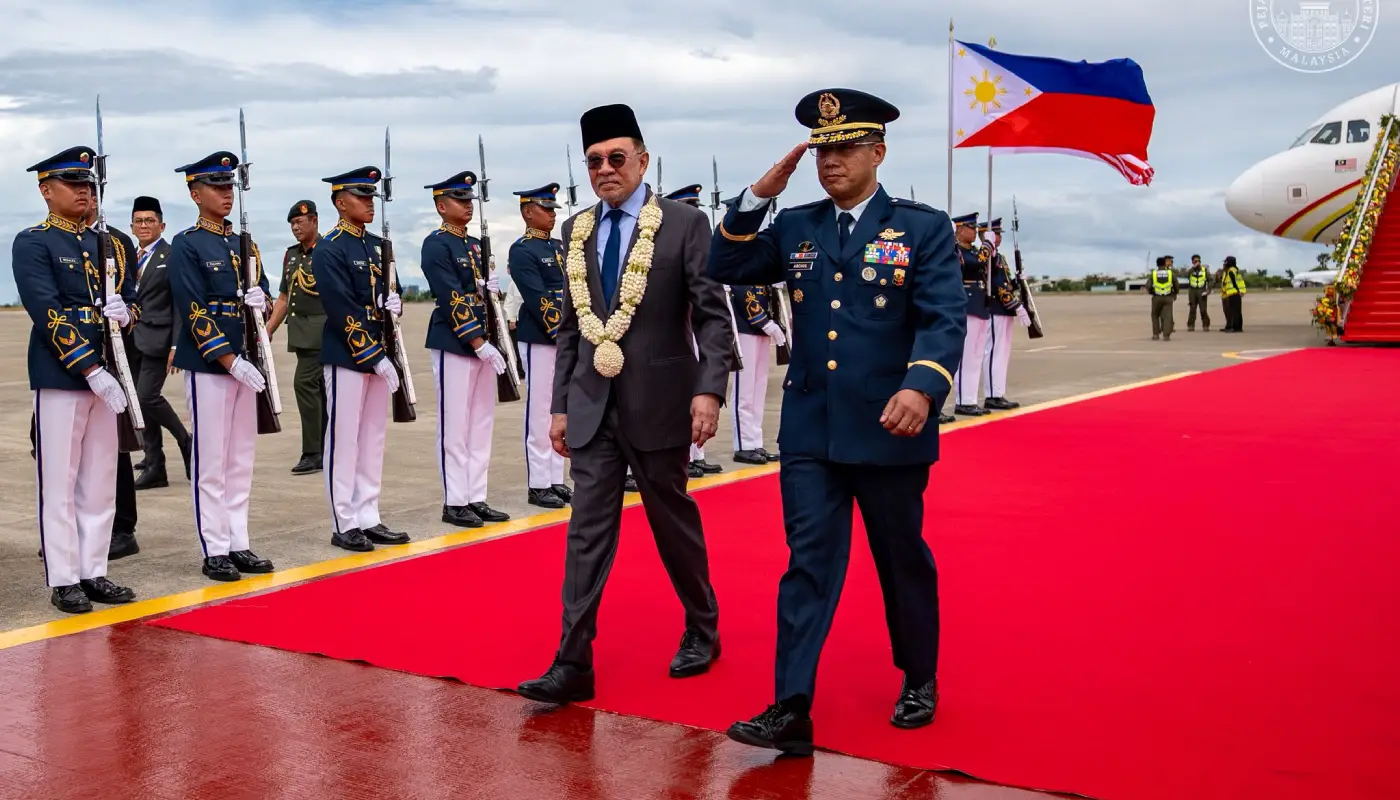
CEBU CITY – Malaysian Prime Minister Datuk Seri Anwar Ibrahim arrived in Cebu City, Republic of the Philippines, on Thursday afternoon to participate in the 48th ASEAN Summit and Related Meetings.

The summit, chaired this year by the Philippines, brings together leaders from across Southeast Asia to deliberate on pressing regional and global issues.
Anwar, accompanied by his wife Datuk Seri Dr Wan Azizah Wan Ismail, is representing Malaysia at the high-level gathering.
The summit is expected to address a wide range of topics, with particular emphasis on the ongoing global energy supply crisis.
Leaders are anticipated to explore strategies for strengthening resilience, ensuring sustainable energy access, and fostering cooperation among ASEAN member states.
The Prime Minister highlighted the importance of ASEAN’s collective spirit, describing the union as a close and responsible family.
He underscored the need to uphold ASEAN’s ideals while adapting to contemporary challenges, noting that the summit provides a platform for member nations to reaffirm their commitment to unity and shared progress.
The Philippines, as chair of ASEAN this year, has prioritised discussions on energy security, regional stability, and economic cooperation.
Cebu City was chosen as the host location to symbolise the country’s role in facilitating dialogue and collaboration among member states.
The ASEAN Summit, established in 1967, has evolved into a cornerstone of regional diplomacy, providing a forum for leaders to address issues ranging from trade and investment to security and cultural exchange.
The 48th edition continues this tradition, with leaders expected to issue joint statements and outline cooperative measures to tackle shared challenges.
Malaysia’s participation reflects its longstanding commitment to ASEAN’s vision of integration and solidarity.
Anwar’s presence at the summit reinforces Malaysia’s role in shaping regional policies and contributing to collective solutions.
Observers note that the global energy crisis has placed additional pressure on ASEAN economies, making this year’s summit particularly significant.
Discussions are expected to cover both immediate responses and long-term strategies, including renewable energy initiatives and cross-border cooperation.
The summit also serves as an opportunity for Malaysia to strengthen bilateral ties with the Philippines and other ASEAN members.
Beyond energy, leaders are likely to address issues such as digital transformation, climate change, and regional security, ensuring ASEAN remains relevant in a rapidly changing global landscape.
As proceedings continue in Cebu City, the summit is set to reaffirm ASEAN’s role as a vital regional bloc, committed to unity, resilience, and shared prosperity.
