



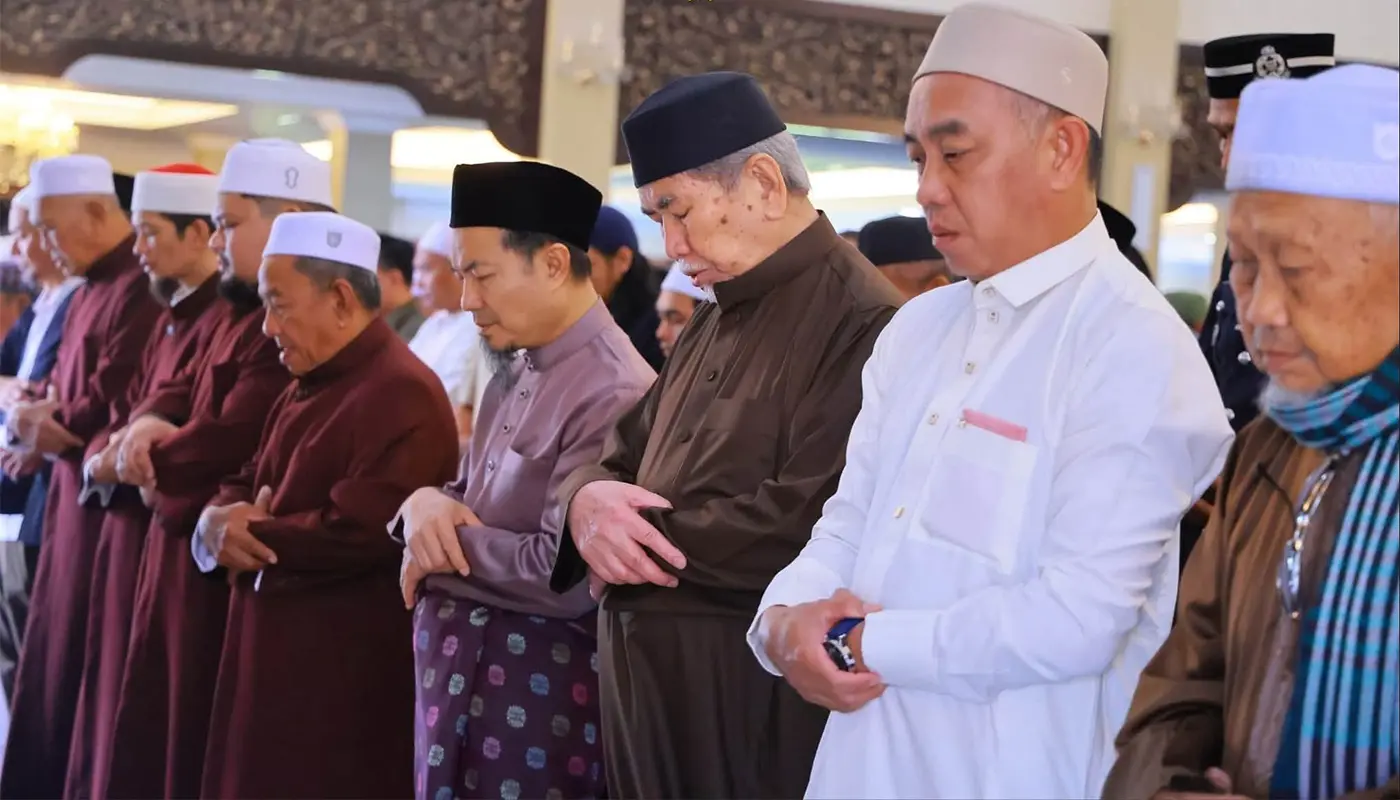
KUCHING – The Sarawak Governor, Tun Pehin Sri Dr Haji Wan Junaidi bin Tuanku Jaafar, participated in the weekly congregational prayers at the Darul Hana Mosque on Jalan Tun Salahuddin this Friday.

The state’s highest-ranking official joined hundreds of devotees for the midday religious observance, underscoring the continued importance of faith-based community engagement among public leaders in the region.
Upon his arrival at the historic mosque, which sits prominently along the Sarawak River, His Excellency was received by members of the mosque’s management committee alongside senior officers from the Sarawak Astana.
The gathering reflected a routine yet significant aspect of public life in Sarawak, where religious duties often intersect with civic responsibilities.
The event drew notable religious figures, including the Sahibus Samahah Mufti of Sarawak, Datu Haji Khalidi bin Haji Ibrahim. The presence of the state’s chief Islamic authority highlighted the ceremonial and spiritual weight of the occasion.
Such appearances by high-profile officials are common during major religious festivals and weekly prayers, serving to reinforce social cohesion and respect for religious traditions.
The sermon delivered during the service focused on contemporary ethical challenges facing Muslim communities.
Ustaz Dr Aswandi bin Laman, who serves as the Head of the Leadership and Communication Department at the Institut Aminuddin Baki, addressed the congregation on the theme “Halal Dicari, Hidup Diberkati”. This phrase translates to “Seeking Halal, Life is Blessed”, pointing towards the central message of the talk.
Dr Aswandi emphasised the necessity for Muslims to scrutinise the origins of their daily sustenance. He urged attendees to ensure that all aspects of their consumption, including food, beverages, clothing, and other essential items, strictly adhere to Islamic legal standards.
The lecture extended beyond dietary laws to encompass broader lifestyle choices, suggesting that spiritual well-being is intrinsically linked to ethical consumerism and lawful earnings.
In response to the sermon’s themes, the governor issued a statement encouraging the public to internalise the advice given. He called for the reminders to serve as a practical guide for everyday life.
According to His Excellency, individuals should remain vigilant in safeguarding the sources of their income and verifying that every item used in daily routines meets halal requirements.
This endorsement from the state’s head adds considerable weight to the religious guidance provided, bridging the gap between spiritual instruction and public conduct.
The Darul Hana Mosque has become a focal point for both religious and cultural activities in Kuching since its establishment.
Its location near key government buildings makes it a convenient venue for officials wishing to participate in public worship without disrupting their administrative duties.
The architecture of the mosque itself, blending traditional Malay design with modern elements, symbolises the harmonious integration of heritage and progress in Sarawak.
Religious scholars note that the emphasis on halal certification has grown significantly in recent years. With global supply chains becoming more complex, consumers face greater challenges in verifying the compliance of products with Islamic law.
The sermon’s focus on this issue reflects a broader trend within the Malaysian Muslim community, where awareness of ethical sourcing and religious compliance is rising.
The governor’s participation also signals the state government’s commitment to maintaining strong ties with religious institutions.
By attending such events, public figures demonstrate respect for the diverse cultural and religious fabric of Sarawak.
This approach is consistent with the state’s longstanding policy of promoting unity and mutual respect among its multi-ethnic population.
Officials from the Sarawak Astana noted that the governor’s schedule regularly includes time for personal religious observances.
These moments are viewed not merely as private acts of devotion but as public demonstrations of leadership values.
The seamless integration of these duties into the official calendar suggests a holistic approach to governance, where moral and ethical considerations are paramount.
The event concluded without incident, with worshippers dispersing to continue their weekend activities. The messages delivered from the pulpit are expected to resonate throughout the community in the coming days, particularly among those seeking to align their commercial and personal lives more closely with religious principles.
As Sarawak continues to develop economically, the balance between modernisation and traditional values remains a key topic of discussion among residents and leaders alike.
