



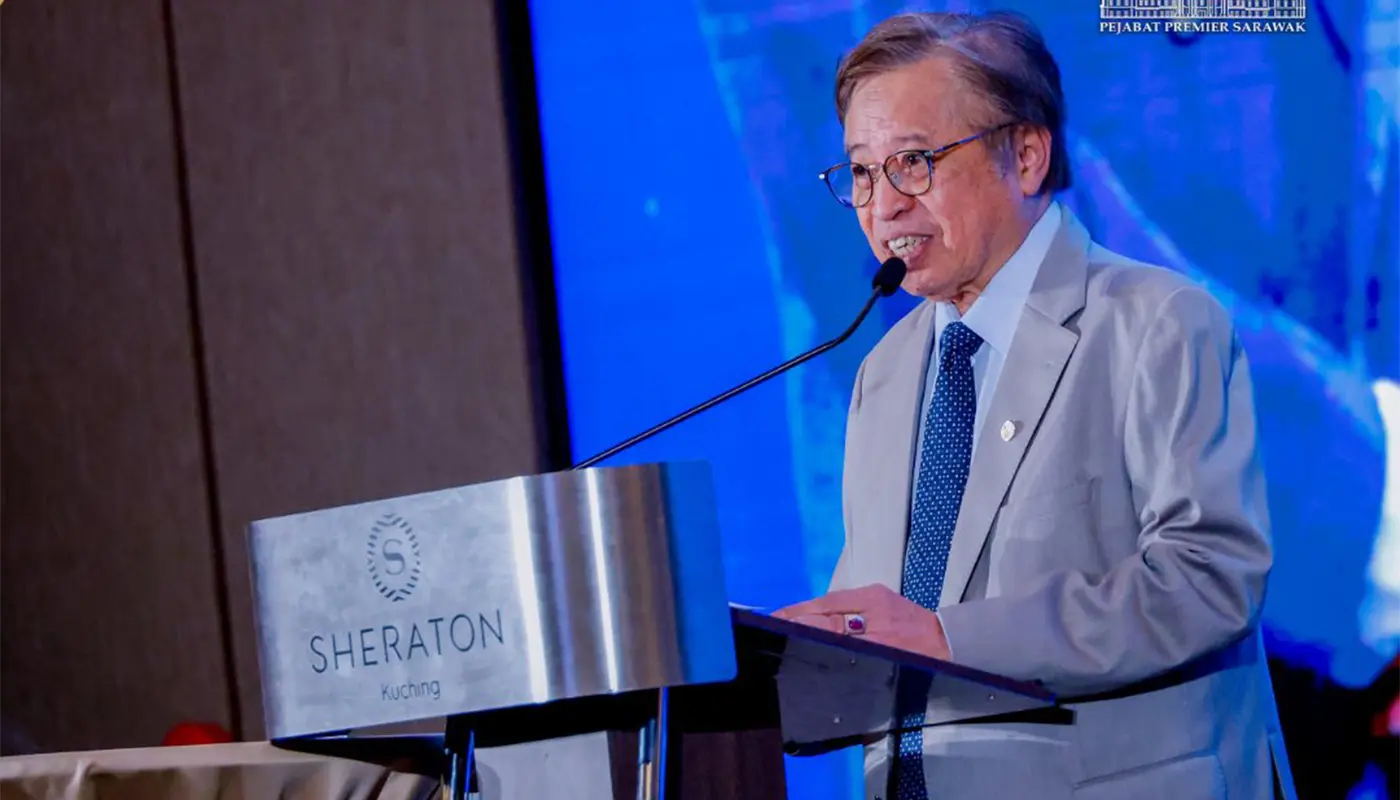
KUCHING – The signing of the Engineering, Procurement and Construction (EPC) contract for the Sirung Project has been described by Sarawak Premier Datuk Patinggi Tan Sri (Dr) Abang Haji Abdul Rahman Zohari bin Tun Datuk Abang Haji Openg as a landmark step in strengthening the state’s economy and energy future.

He emphasised that the initiative represents more than just an agreement but a strategic direction in harnessing natural resources to deliver tangible benefits for the people of Sarawak.
The Premier explained that the project aligns with the Post-COVID-19 Development Strategy 2030 (PCDS 2030), which aims to transform Sarawak into a developed and high-income region by 2030. The strategy is built on three pillars: economic prosperity, inclusivity, and environmental sustainability.
To achieve this, Sarawak is targeting an increase in Gross Domestic Product (GDP) from RM136 billion in 2019 to RM282 billion by 2030, a goal that requires strategic projects such as Sirung to reinforce the state’s economic foundation.
Highlighting Sarawak’s fiscal progress, he noted that state revenue reached RM14.187 billion in 2024, the highest in its history and nearly double compared to pre-2017 levels.
For 2026, revenue is projected at RM13.049 billion, with RM4.6 billion expected from State Sales Tax (SST). Petroleum products alone are anticipated to contribute RM3.5 billion, underscoring the importance of the oil and gas sector.
The Premier stressed that the five percent SST on petroleum products has become a vital instrument, generating between RM2.5 billion and RM4.8 billion annually depending on global market conditions.
He also highlighted the role of Petroleum Sarawak Berhad (PETROS) in ensuring greater value from Sarawak’s natural resources.
Regarding the Sirung Project, he said PTTEP is targeting first production by 2028 through the Sirung-Chenda development, with an estimated output of 15,000 barrels per day.
The project incorporates “Zero Routine Flaring” technology and remote offshore operations designed to be efficient and environmentally friendly, in line with Sarawak’s low-carbon aspirations.
The Premier added that revenue from oil and gas will continue to support infrastructure and welfare projects, including roads, bridges, water supply, electricity, schools, clinics, digital networks, and social assistance, particularly in rural areas.
He also reaffirmed the state’s commitment to the Free Higher Education Sarawak (FTES) initiative, which will produce skilled manpower for strategic industries such as energy, engineering, and advanced technology.
He commended Brooke Holding’s involvement in the project, noting that it reflects Sarawak’s efforts to strengthen local companies to compete internationally.
He also welcomed Affin Bank’s support, which he said demonstrates the importance of cooperation between industry and financial institutions in building Sarawak’s economic ecosystem.
The Premier emphasised that Sarawak is not solely reliant on oil and gas but is actively diversifying into hydrogen, renewable energy, downstream industries, digital infrastructure, advanced manufacturing, semiconductors, and aerospace technology.
“Sarawak’s strategy is not to choose one sector over another, but to build on existing strengths, capture value wisely and use today’s resource wealth to finance the economy of the future,” he said.
He concluded by welcoming continued investment from PTTEP, stressing that collaborations with international players must balance capital and technology inflows with fair returns, local participation, and long-term benefits for the people of Sarawak.
