



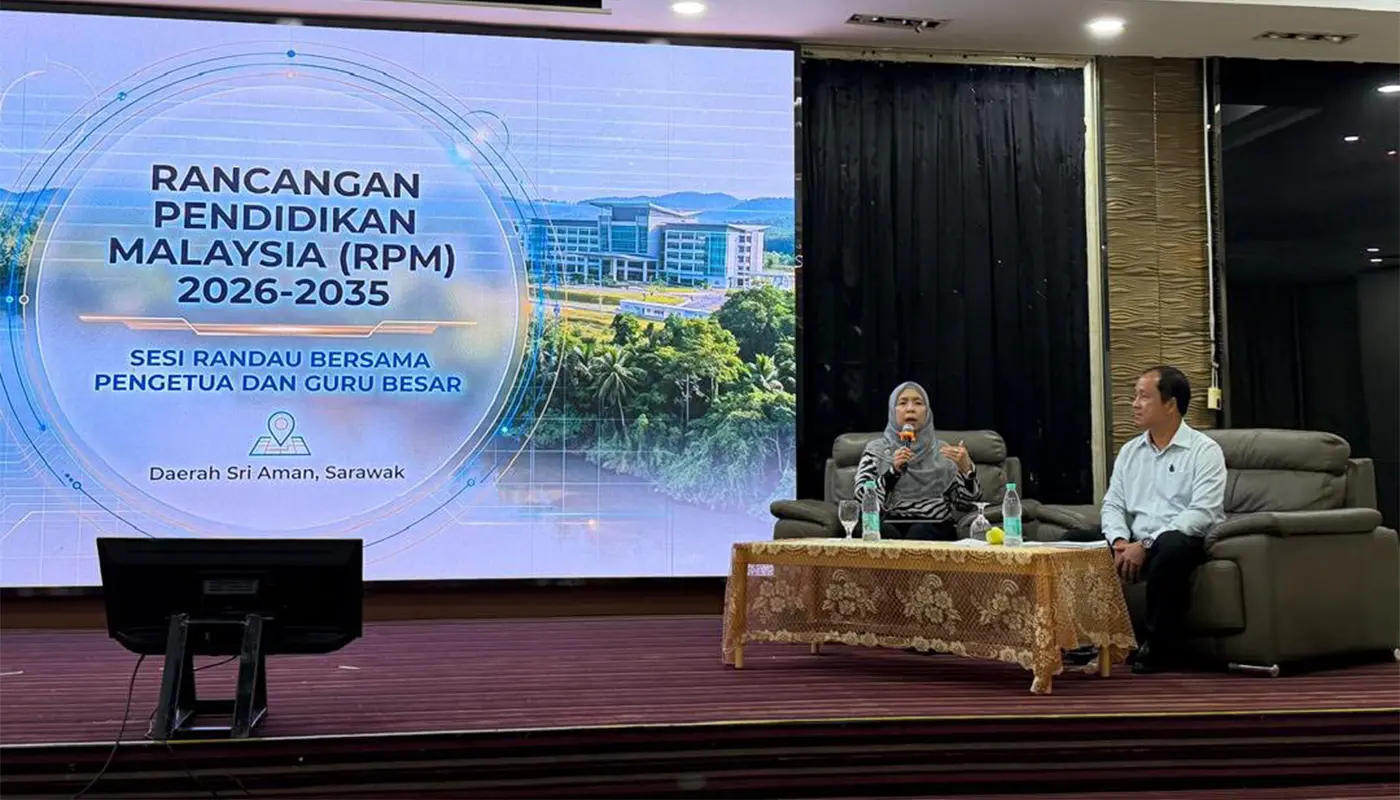
SRI AMAN – Principals and headmasters from across Sri Aman District gathered for a Randau session to discuss the Malaysia Education Plan (RPM) 2026–2035, underscoring the state’s commitment to strengthening the direction of national education.

The session, held in a professional and open atmosphere, was led by Puan Aniza Kamarulzaman, Director of the Educational Resources and Technology Division (BSTP) at the Ministry of Education Malaysia.
She presented the framework for the new education direction, focusing on digital transformation, empowerment of 21st century pedagogy, and comprehensive school leadership development.
Also present were Mr Omar bin Haji Mahli, Sarawak Director of Education, alongside the Sri Aman District Education Officer and representatives from local educational institutions.
Their participation highlighted the importance of collaboration between federal and state education authorities in shaping future strategies.
In her address, Puan Aniza emphasised that RPM 2026–2035 is more than a policy document. “Educational transformation requires a comprehensive shift in mindset, not only among students but also school leaders and educators. The role of teachers as facilitators of learning needs to be strengthened in line with technological developments and future needs,” she said.
She explained that the plan is designed to ensure Malaysia’s education system remains relevant, inclusive, and globally competitive.
Key priorities include integrating educational technology, strengthening digital literacy, and promoting flexible, student-centred learning approaches that reflect diverse contexts.
The roundtable format allowed principals and headmasters to share their perspectives, challenges, and proposals for implementation at the grassroots level.
Among the issues raised were the need for stronger digital infrastructure in rural schools, continuous professional training for teachers, and effective change management within school organisations.
Puan Aniza also stressed the importance of strategic collaboration between the Ministry of Education, State Education Departments, District Education Offices, and schools.
She noted that policies must be translated effectively into practice, ensuring that the realities faced by schools are taken into account when refining national strategies.
The Randau session was seen as a vital platform for inclusive dialogue, reflecting the ministry’s commitment to responsive governance in education.
By prioritising open discussion, the session strengthened understanding of the aspirations behind RPM 2026–2035 and reinforced the collective effort to drive structured, progressive, and continuous transformation.
For Sarawak, the engagement highlighted the state’s role in advancing national education goals while addressing local needs.
The collaborative approach is expected to support the development of a generation equipped with future-ready skills, strong values, and the resilience to thrive in a competitive global environment.
