



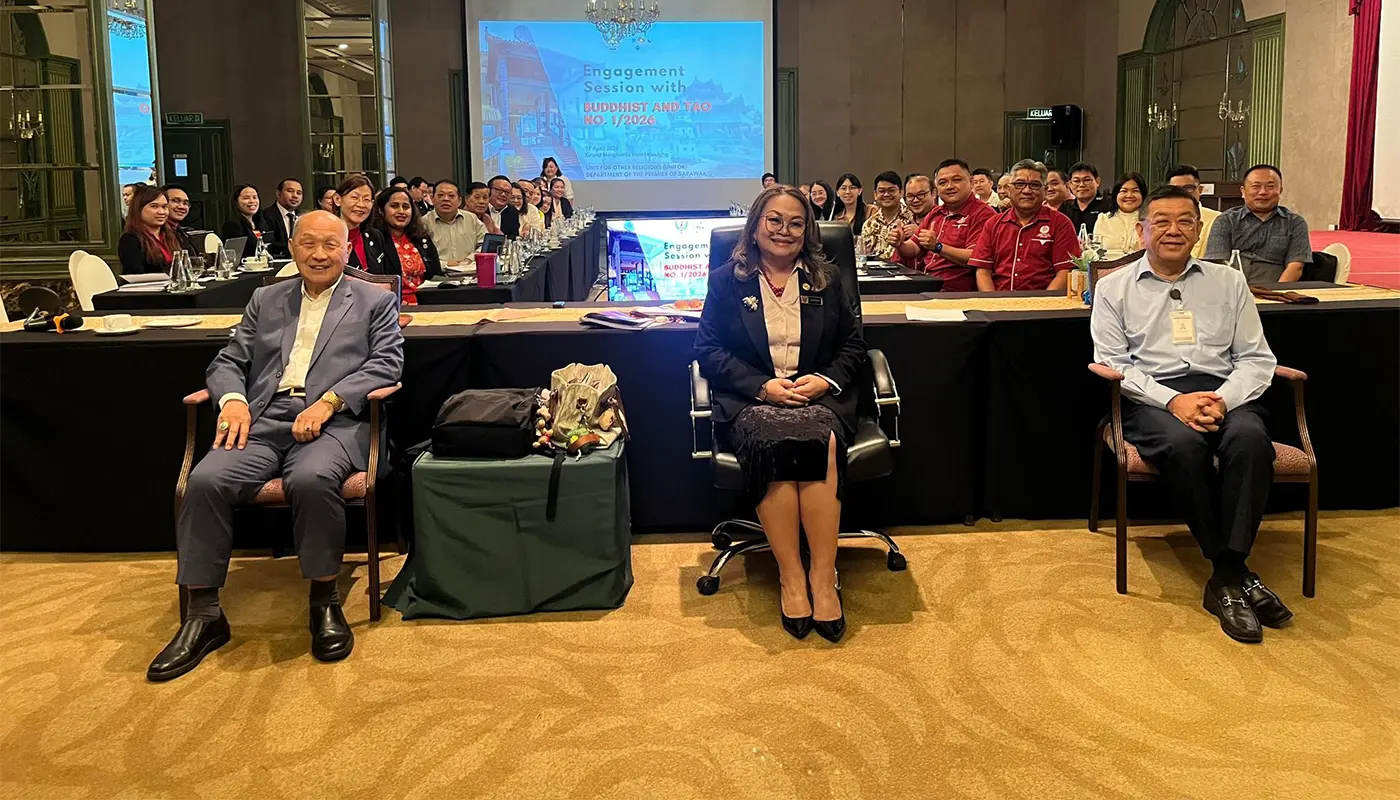
KUCHING – The Unit for Other Religions (UNIFOR) successfully held its third stakeholder engagement session of 2026 on 17 April, bringing together leaders from Buddhist and Taoist organisations at the Grand Margherita Hotel.

This marked the first session of the year dedicated specifically to Buddhist and Taoist representatives, with participation from the Federation of Buddhist Associations Sarawak and the Federation of Sarawak Temple Associations.
The event was chaired by UNIFOR Director, Yang Berbahagia Dato Georgina Apphia Ngau, and attended by Yang Berbahagia Datuk Tay Chin Kin, Chairman of the Federation of Buddhist Associations Sarawak, alongside Yang Berbahagia Dato Sri Richard Wee, President of the Federation of Sarawak Temple Associations.
The session drew temple leaders, committee members, and community representatives, reflecting a strong spirit of collaboration and inclusivity.
Discussions centred on strengthening partnerships between government agencies and religious institutions, with emphasis on understanding grassroots needs, organisational structures, and challenges faced by Buddhist and Taoist temples across Sarawak.
A key highlight was UNIFOR’s introduction of a new initiative to develop a comprehensive digital database of houses of worship.
This repository will include detailed temple profiles, registration records, and management structures, enabling more efficient coordination and improved information sharing between stakeholders.
The engagement also addressed the importance of financial accountability. UNIFOR reaffirmed that all approved assistance must adhere to principles of integrity, transparency, and accountability.
These standards are seen as vital for ensuring sustainability and maintaining public trust in the management of religious institutions.
Participants welcomed the initiative, noting that accurate data and responsible fund management will help strengthen the role of temples in serving their communities.
The session also provided a platform for dialogue on how religious organisations can continue contributing to Sarawak’s social and cultural development.
Moving forward, UNIFOR pledged to continue supporting religious diversity and inclusivity across the state.
Efforts to enhance data management systems will be expanded, while encouraging active participation from all houses of worship to ensure community voices remain central to Sarawak’s growth.
The engagement session concluded with a shared commitment to unity and collaboration, reinforcing Sarawak’s reputation as a state that values harmony among its diverse religious communities.
