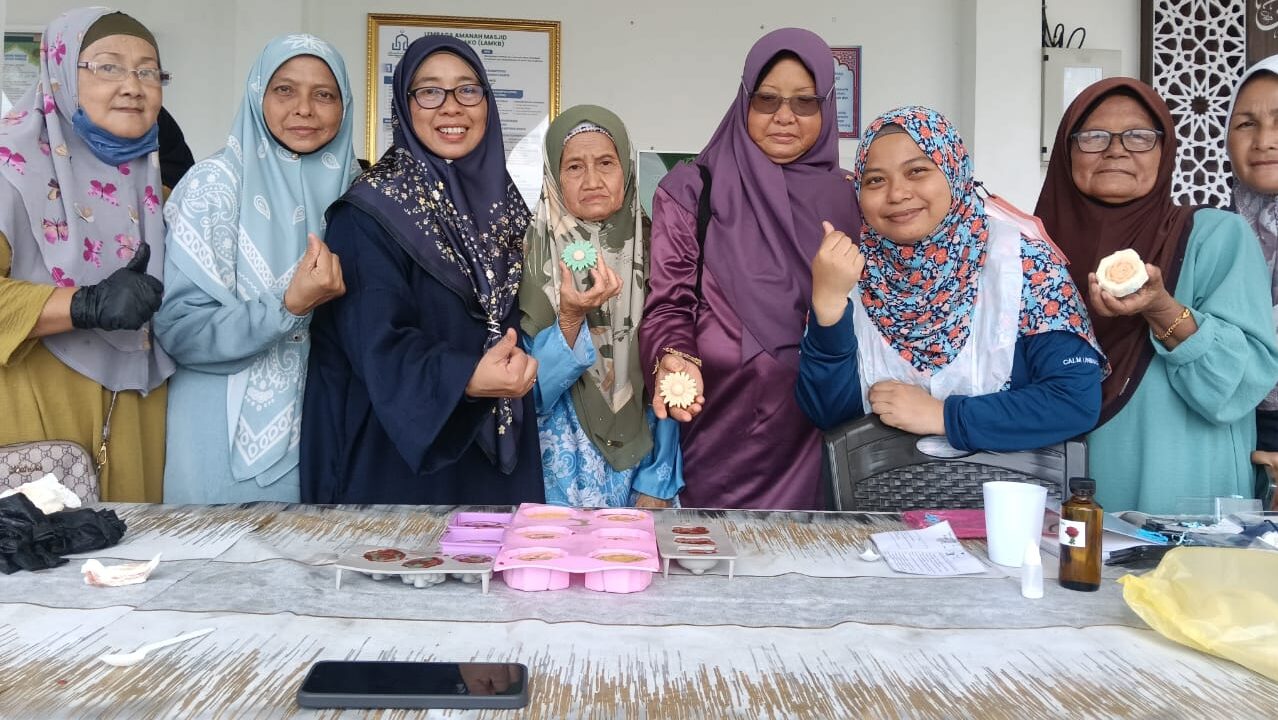
KUCHING — Universiti Malaysia Sarawak (UNIMAS) continues to play an active role in empowering rural communities through knowledge sharing and skills development, this time benefiting residents of Kampung Bako through a hands-on Soap and Eco-Enzyme Workshop held at the Al-Hidayah Mosque.
The programme was organised by UNIMAS through its Faculty of Resource Science and Technology (FSTS) under the Public University Community Empowerment Programme @UniMADANI. It reflects the university’s ongoing commitment to support community development while promoting sustainable practices and income-generating opportunities.
The workshop was supported by two projects sponsored by the Ministry of Finance, with a total allocation of RM100,000. The funding was secured by two chemists from FSTS, covering initiatives related to soap production and detergent development. The projects aim to transform everyday waste into useful products with commercial potential.
A total of 30 Kampung Bako residents took part in the workshop, where UNIMAS experts provided practical training on producing multipurpose soap using used cooking oil, as well as eco-enzyme made from fruit waste. The approach not only helps reduce household waste but also introduces villagers to simple production techniques that can be developed into small-scale businesses.
Head of the Cooking Oil Transformation Project, Dr Ain Nadirah, said feedback from participants showed encouraging results. She explained that the soap produced during the workshop proved effective for dishwashing and laundry use. It is also suitable as guest hand soap due to its portability and safe formulation, making it practical for daily use by people of all ages.
Meanwhile, Head of the Eco-Enzyme Project, Dr Dayang Norafizan Awang Chee, highlighted the benefits of eco-enzyme derived from chemical formulations. He said the product serves as an environmentally friendly alternative that can be used as an insect repellent, including against flies. He added that several participants have already managed to sell the fly repellent at RM15 per bottle, with steady demand observed within the community.
Both project leaders expressed hope that the workshop would provide long-term benefits to Kampung Bako residents, particularly in improving kitchen waste management and enabling the production of value-added products that can be commercialised on a small scale.
One of the participants, Hamizan Jemi, 48, a KAFA teacher at SK Bako, welcomed the initiative, saying such workshops are eagerly awaited by villagers. He noted that beyond collaboration with UNIMAS, the key benefit is the opportunity for residents to turn newly learned skills into small business ventures.
Treasurer of the Al-Hidayah Mosque Committee, Bako Haji Heazani bin Jemi, also conveyed appreciation to UNIMAS and expressed hope that similar community programmes would continue, as villagers showed strong enthusiasm in learning about small and medium industry product production.