



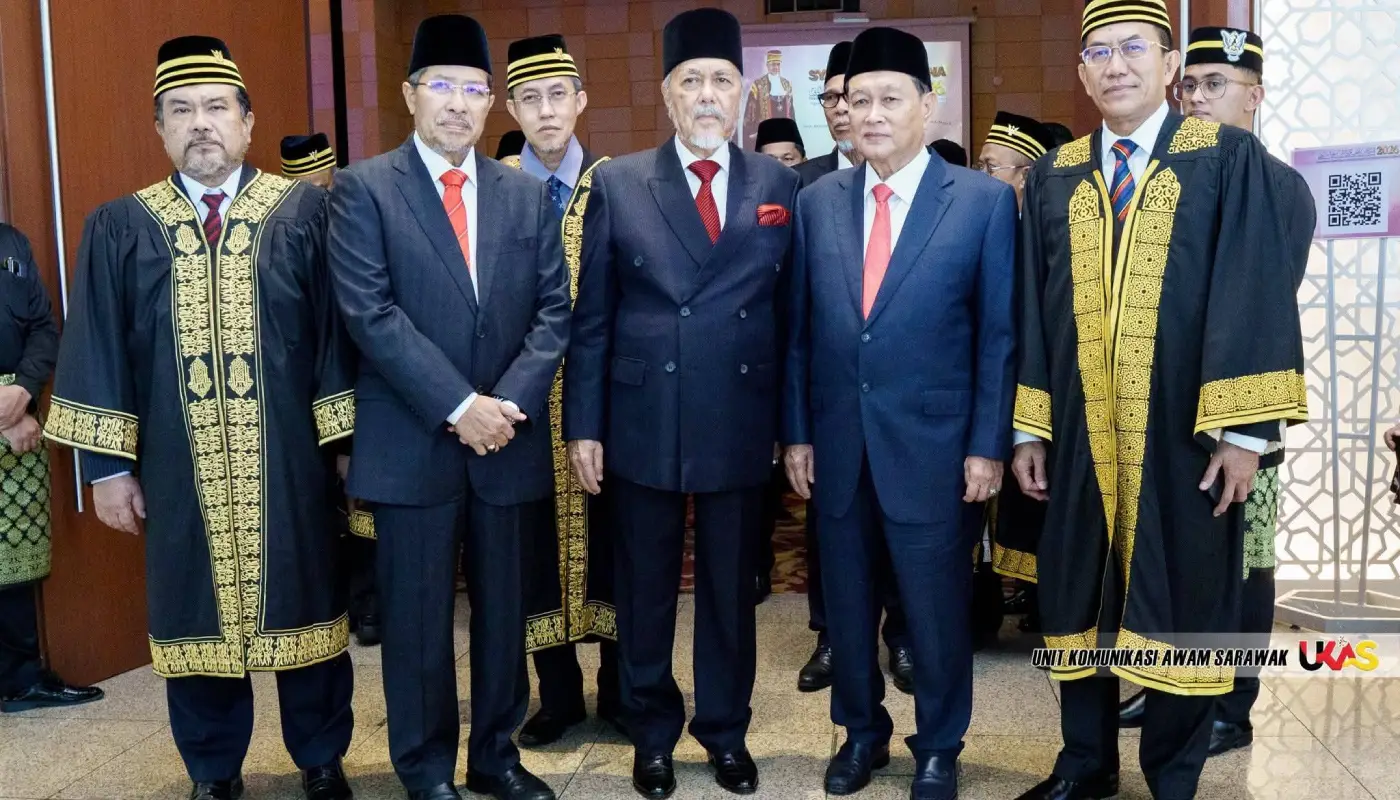
KUCHING – Sarawak’s Native Court remains an enigma to the rest of Malaysia, altogether different from the other courts in terms of jurisdiction and power.

Speaking at the Opening of the Legal Year of the Sarawak Shariah Courts Conference (OSLYS) 2026, Tan Sri Datuk Amar Mohamad Asfia Awang Nassar, Speaker of Dewan Undangan Negeri told streetlawyers about native court’s unique function. This, he said, is unlike the Shariah Court, which is directly sanctioned under the Federal Constitution.
“The Native Court has powers over adat and native customary land, but is not placed in the same hierarchy of law or jurisdiction as the Shariah Court,” he said.
The Shariah Court, functioning within constitutional law, is held in the same standing as the Civil Court. It has this constitutional support which makes it more secure than the Native Court, which is constrained to deal only with native usages and customs.
Ethnic groups have in turn requested that their traditional courts should be accorded the same level as the Shariah judiciary. But Tan Sri Datuk Amar Mohamad Asfia made it clear that those aims are legally impossible. He explained that the Constitution of Malaysia does not allow the creation of a court with all similar powers as the Syariah Court.
“Accordingly, Islamic law, local customary laws or other personal laws do not have the same authority conferred either by the Yang di-Pertuan Agong or by the Federal Constitution,” he said.
The area of jurisdiction for the Native Court is that of native customary land rights, marriage, inheritance and violation of traditional customs. It’s an important indigenous community building resource in Sarawak for Iban, Bidayuh and Melanau culture practices conservation and transmission.
Options on restructuring and upgrading the Native Court system have also been broached at recent Sarawak government talks. In 2023 a study has been completed on how to enhance that role, including new legislation and amendments to existing legislation. The objective is to bring the institution up to date while ensuring that it stays relevant, although it appears evident that constitutional barriers would mean that it may never be on par with the Shariah Court.
The addition of the distinction between these courts is a manifestation that Malaysia has three different legal systems which are the civil (which includes 14 uniform acts), Shariah and native laws to live together but within separate spheres. The enduring relevance of the Native Court will be seen in its protection of native law, although their powers are not commensurate with other legal organs.
To bolster this explanation, Tan Sri Datuk Amar Mohamad Asfia said he wanted to make sure the public has a better understanding of how the courts’ hierarchy in Sarawak works. His comments serve to emphasise that the role of the Native Court must be appreciated, but in so doing it should also operate within the constitutional regime which instructs its boundaries.
