



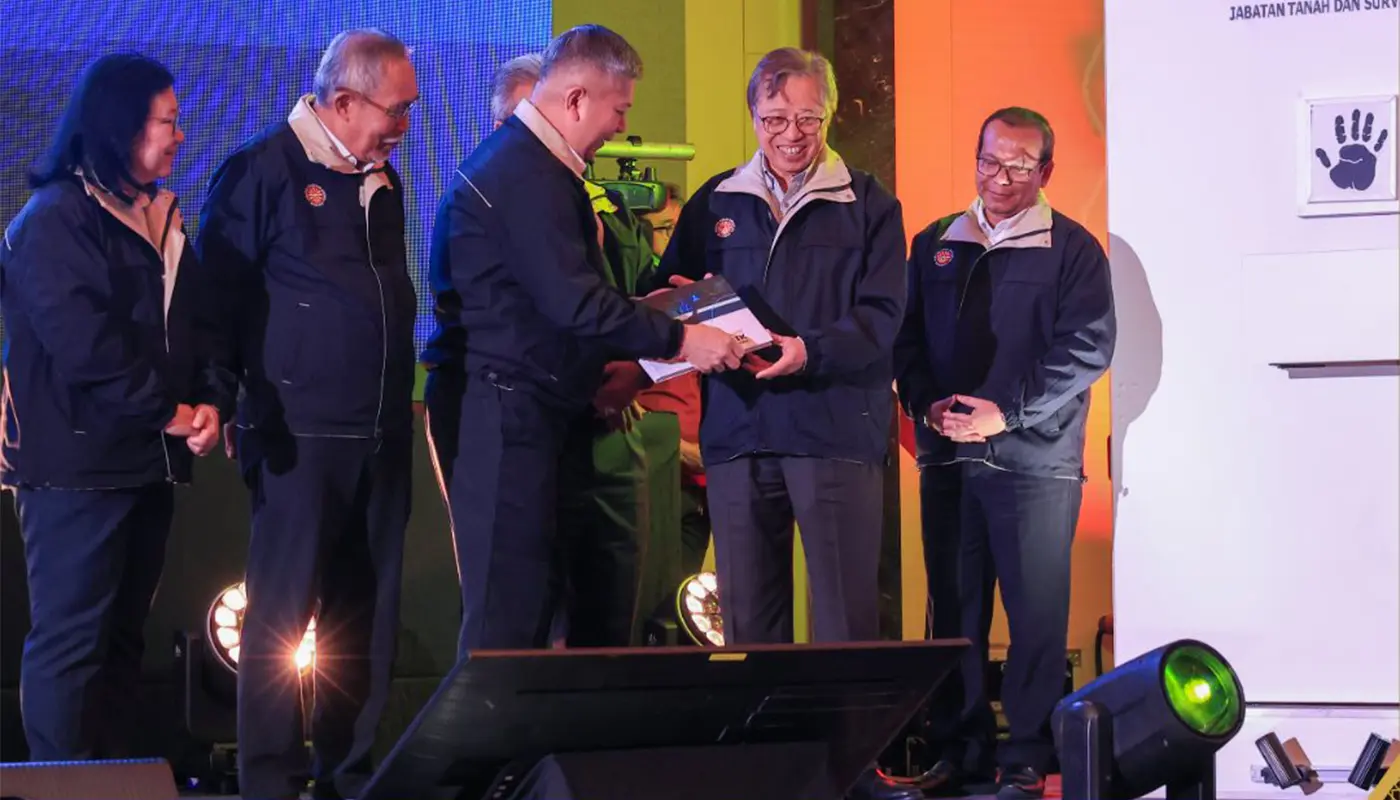
BINTULU – Sarawak is planning to develop nanosatellites of the cubesat type to improve on land surveying and future development planning in the state. The Premier of Sarawak, Abang Johari Openg, said that a nano satellite would be constructed by one local university while another would build its own.

The Premier said at the Summit 2026 Landing Ceremony that nano satellite technology is a more economical and effective option than conventional satellites, as it will allow Sarawak to receive geospatial data directly from low-Earth orbit.
He pointed out the “staggering” difference in cost, pointing out that conventional expensive satellites made in Europe can run from €300 billion (euro) to €500 billion apiece, while nanosatellites, including cubesats, can be had for as little as €500,000 to €700,000.
This cost, he added, makes it affordable for Sarawak to manufacture its own satellites to assist mapping and data storage operations.
Collecting data from low orbit will be essential to enhance economic and spatial planning, the Premier highlighted. He stressed the significance of land management, infrastructure building and sustainable development.
“Data from low orbit will make land survey work speedier, more accurate and more integrated for a clearer picture of the physical condition of Sarawak’s land,” he said.
He commended the progress of the Sarawak Land and Survey Department (JTS) in digital technology adoption and emphasised the necessity of fusion between the land information system for the state with nanosatellite.
The project is part of Sarawak’s overall 2030 development plan, which applies satellite data to modern farming, high value-added sectors, and the digital economy, as well as urban and rural planning.
He also said Sarawak intends to be a leader in ASEAN in small satellites, with avenues for collaboration among researchers, academia and the private sector.
In the JTS Strategic Plan 2026–2030 that has just been published, projects in the framework of space technology are also envisaged to facilitate mapping, data analysis and ensuring a more advanced information system.
The ceremony also marked the opening of the Sarawak Premier Lab at UTM as a symbol of collaboration between the state and academic institutions in geospatial, remote sensing and space technology.
The others were Deputy Minister (Town Planning, Land Administration and Environment) Datuk Len Talif Salleh, Sarawak Deputy Secretary to the Government (Administration); Datu Felicia Tan Ya Hua, Ministry of Natural Resources and Urban Development permanent secretary; Datu Abdullah Julaihi, divisional superintendent resident here; Datu Nyurak Keti, Sarawak Land and Survey Department director; Datu Awang Zamhari Awang Mahmood; as well as other government officials.
The statement by the Premier reflects Sarawak’s aspiration to utilise forefront technology for sustainable development, establishing the state as a regional frontrunner in space-based technology advancement.
