



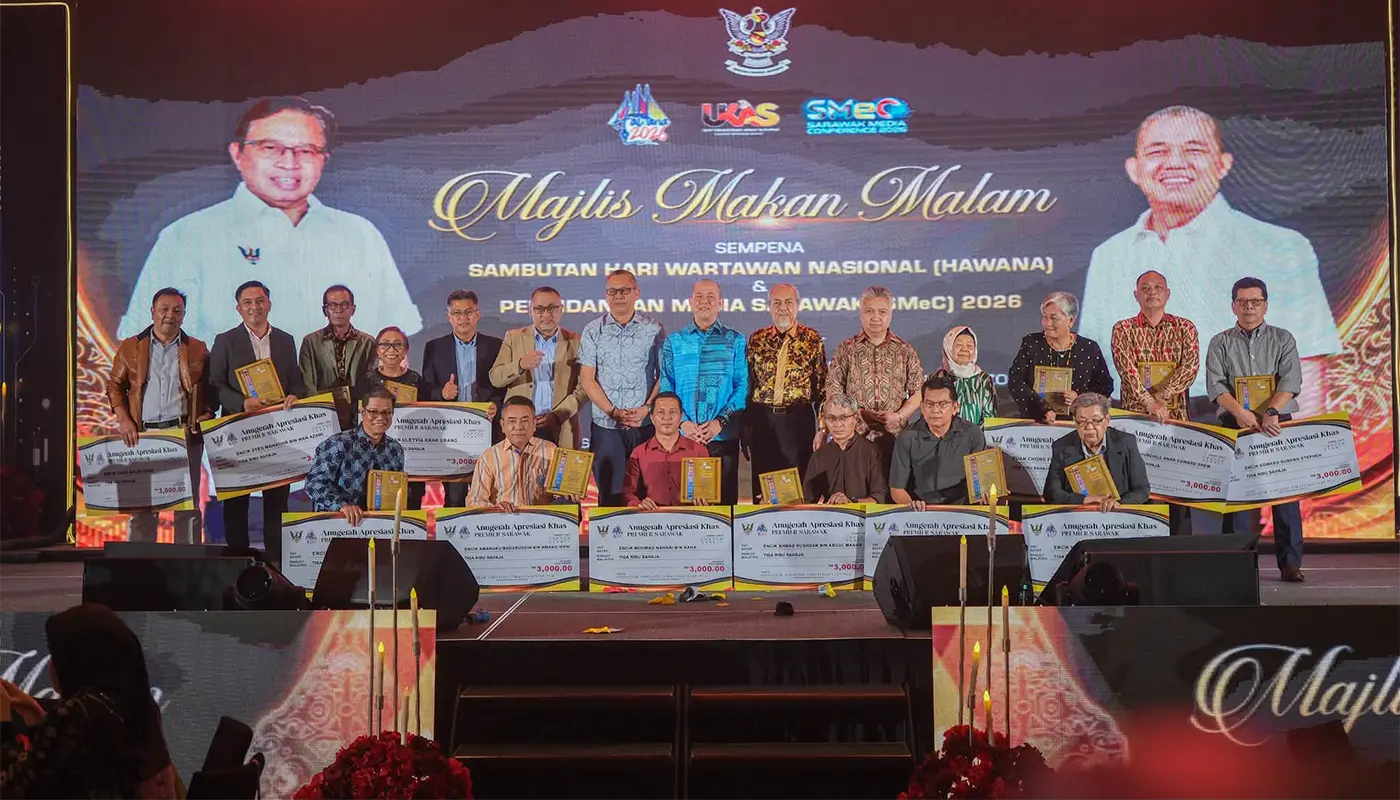
KUCHING – The Sarawak National Journalists’ Day (HAWANA) 2026 Dinner and the Sarawak Media Conference (SMeC) 2026 were officiated on Thursday evening by Deputy Prime Minister and Minister of Energy Transition and Water Transformation, Datuk Seri Fadillah Yusof, who represented the Premier of Sarawak, Datuk Patinggi Tan Sri Abang Johari Tun Openg.

The event brought together media practitioners from across the state and country, highlighting the crucial role journalists play in shaping public understanding, strengthening national unity and safeguarding the integrity of information in an increasingly complex digital landscape.
Fadillah expressed deep appreciation for the dedication shown by media personnel, noting that their work extends far beyond reporting daily events.
He emphasised that journalists are strategic partners in nation-building, helping to cultivate a society that is informed, analytical and resilient.
He reminded attendees that the media’s contribution is essential in ensuring that communities remain connected and well-informed, especially in a diverse state such as Sarawak.
The theme of HAWANA 2026, “Media with Integrity, Core Credibility”, was described as timely and relevant.
Fadillah noted that the modern communication environment, shaped by artificial intelligence, social media and rapid information flows, demands a higher standard of accuracy and responsibility.
He stressed that the challenge for journalists today is not merely speed, but truthfulness and trustworthiness.
“The challenge for the media is no longer just to be the first to report a news item, but to be the most accurate, most honest and most trustworthy,” he said.
He also highlighted the growing risks posed by misinformation, manipulated content and AI-generated visuals that can mimic reality.
These developments, he said, require journalists to strengthen verification processes and uphold ethical standards to prevent falsehoods from spreading unchecked.
Fadillah warned that speculation and unverified claims can quickly fill information gaps, undermining public confidence and social stability.
Balancing media freedom with responsibility was another key point raised. Fadillah emphasised that defending truth does not equate to suppressing differing views.
Instead, he called for public discourse grounded in facts, respect and accountability. He reiterated that media freedom must coexist with the duty to uphold justice, balance and the public interest.
The Deputy Prime Minister also outlined the government’s ongoing efforts to strengthen Malaysia’s media ecosystem.
He referenced the establishment of the Malaysian Media Council and legislative frameworks such as the Online Safety Act 2025 and the Communications and Multimedia Act 1998, which aim to enhance accountability and protect the nation’s digital environment.
These measures, he said, reflect the government’s commitment to ensuring a safe and credible information space.
Fadillah stressed that during crises, transparent and fact-based communication is vital to maintaining public trust.
He called for stronger collaboration between public relations teams, civil servants and journalists to ensure that verified information reaches the public swiftly and accurately.
Sarawak’s unique cultural diversity was highlighted as a strength in the media landscape. Fadillah noted that the media serves as a bridge connecting communities, amplifying local voices and promoting inclusive development.
He acknowledged the media’s role in helping the public understand major government initiatives, including infrastructure expansion, the energy transition agenda, digital transformation and efforts to improve overall well-being.
As Minister of Energy Transition and Water Transformation, Fadillah underscored the importance of accurate reporting in areas such as climate change, energy security and water management.
He said that clear and integrity-based communication is essential to ensure that government policies are evaluated based on facts rather than perceptions.
He encouraged media organisations to continue investing in human capital development, particularly in digital journalism, data analytics, cybersecurity, fact-checking and the ethical use of AI.
At the same time, he stressed the importance of safeguarding the welfare of media practitioners to ensure the profession remains sustainable and competitive.
Fadillah concluded by reaffirming that responsible journalism strengthens national unity and acts as a defence against misinformation.
He called for continued cooperation between the media, government and communication professionals to build trust, accelerate the delivery of verified information and contribute to Malaysia’s unity and progress.
