



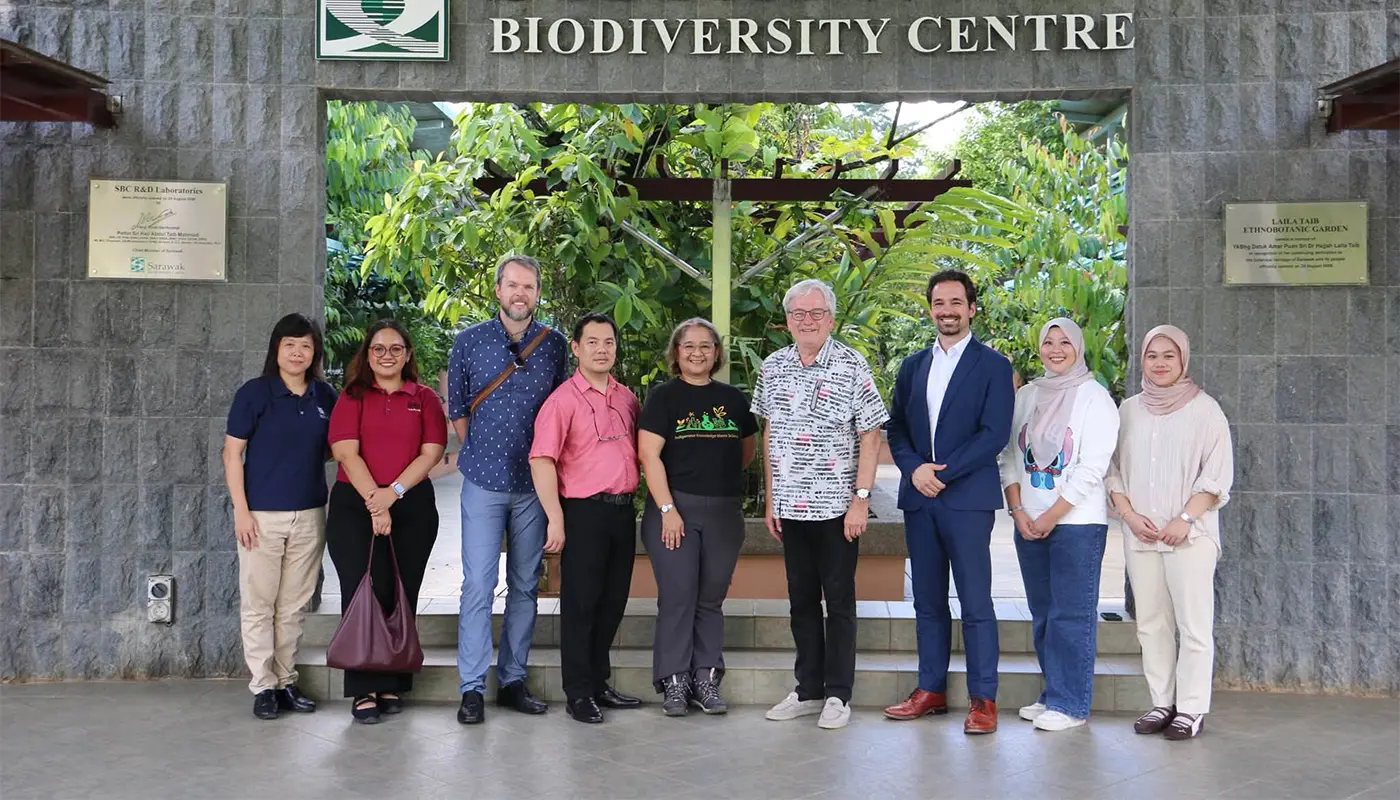
KUCHING – A significant step towards positioning Sarawak as a global hub for scientific diplomacy was taken on 17 July 2026, when the Sarawak Biodiversity Centre and BioVerde Technologies welcomed a high-profile delegation from the International Network for Governmental Science Advice.

This strategic visit serves as a vital precursor to the 6th International Conference on Science Advice to Governments, which is slated to take place in Kuching in November 2027.
The visiting contingent featured several distinguished figures in the global science policy arena. Leading the group was Professor Rémi Quirion, serving as the President of the network.
He was accompanied by Charles Morissette, an advisor to the organisation, and Grant Douglas Mills, who acts as a programme officer. Representing the regional chapter was Professor Dr Tan Wee Hoe, the Chair of INGSA-Asia.
Facilitating the delegation’s itinerary was Serena Sa-or, a Senior Business Development Executive from Business Events Sarawak, underscoring the state’s coordinated effort to host world-class intellectual gatherings.
Established in 2014, the International Network for Governmental Science Advice operates as a premier global platform dedicated to policy exchange and capacity building.
It brings together policy practitioners, academic researchers, and business leaders to enhance the integration of robust scientific evidence into public policy decisions across all tiers of government.
By fostering this collaboration, the network aims to ensure that legislative and administrative frameworks are grounded in empirical data rather than conjecture. The upcoming 2027 conference is anticipated to be a landmark event for the region.
Organisers project that the gathering will attract approximately 400 delegates, encompassing policymakers, eminent scientists, youth representatives, and community advocates from more than 70 nations.
The agenda will centre on critical themes such as scientific diplomacy, the refinement of policy frameworks, and the urgent pursuit of global sustainability.
For Sarawak, hosting this conference presents a unique opportunity to showcase its rich biological heritage and progressive environmental policies.
As a recognised biodiversity hotspot, the state stands to benefit immensely from the cross-pollination of ideas between international experts and local stakeholders.
The dialogue generated during the conference is expected to inform more resilient strategies for natural resource management and climate adaptation.
The involvement of the Sarawak Biodiversity Centre and its subsidiary, BioVerde Technologies, highlights the state’s commitment to translating scientific research into tangible socio-economic benefits.
These institutions have been instrumental in driving initiatives that balance ecological conservation with sustainable economic development, making them ideal hosts for a network focused on evidence-based governance.
Integrating scientific advice into governmental decision-making is increasingly recognised as a necessity in an era defined by complex, transnational challenges.
From managing public health crises to mitigating the impacts of environmental degradation, policymakers require access to timely, accurate, and actionable scientific insights.
The existing global framework provides the necessary architecture to deliver these insights effectively to those who need them most.
Furthermore, the active participation of Business Events Sarawak reflects a broader strategy to elevate the state’s profile within the global meetings, incentives, conferences, and exhibitions sector.
Securing the rights to host this major international conference not only boosts local tourism and hospitality industries but also positions Kuching as a city capable of facilitating high-level international discourse.
Local academics and students will also stand to gain from the influx of global expertise. The conference will likely feature satellite events, workshops, and networking opportunities designed to inspire the next generation of Sarawakian scientists and policy analysts.
By exposing local talent to international best practices, the event will help cultivate a more robust domestic ecosystem for scientific innovation.
As preparations for the 2027 conference accelerate, this initial delegation visit marks a promising beginning.
It demonstrates a shared commitment between international scientific bodies and Sarawakian institutions to foster a future where governance is consistently informed by rigorous, forward-thinking scientific advice.
The successful execution of this event will undoubtedly leave a lasting legacy on the state’s developmental trajectory.
