



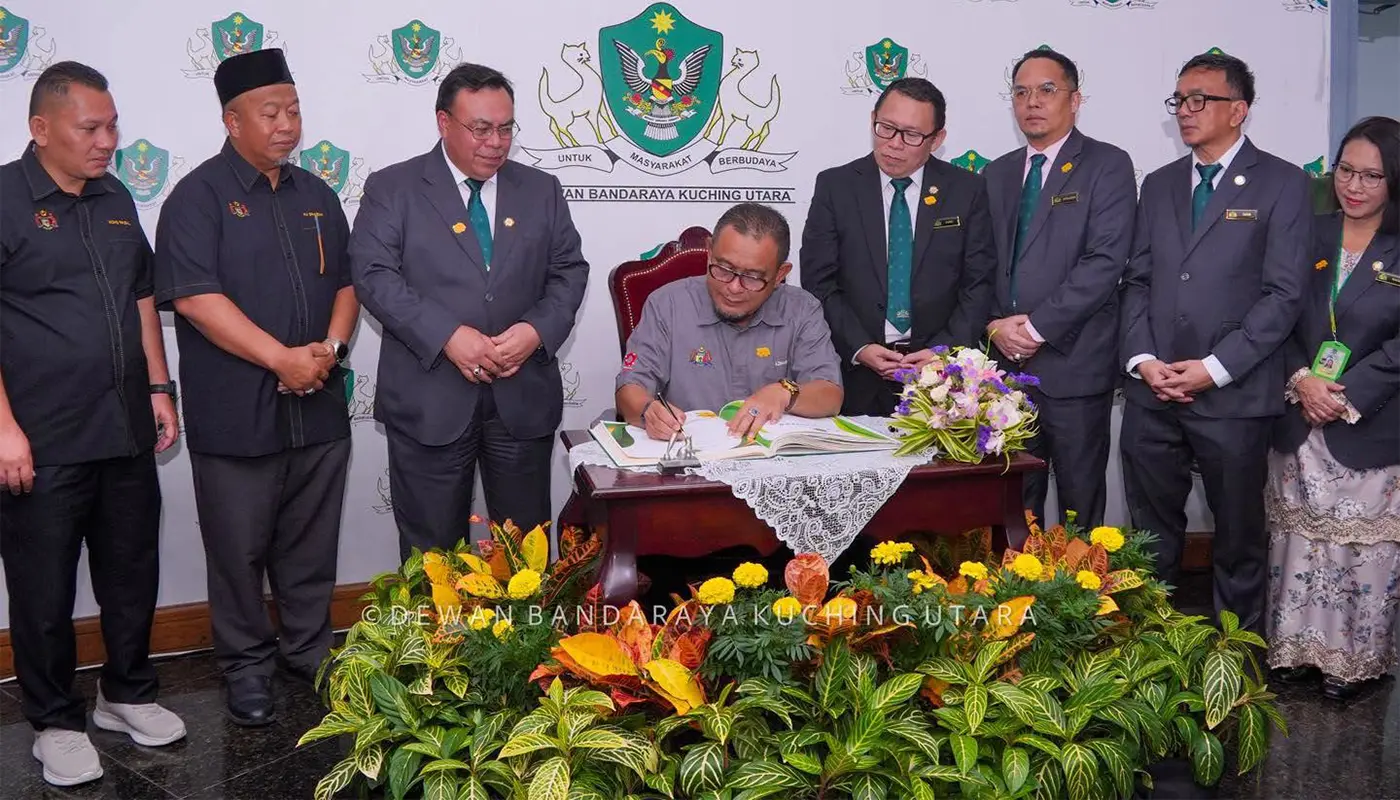
KUCHING – A high-level delegation from the Hang Tuah Jaya Municipal Council (MPHTJ) visited the Kuching North City Hall (DBKU) on Saturday, 25 July 2026, marking a significant step towards strengthening inter-state local government cooperation.

The visit was led by Yang Berhormat Datuk Wira Azhar bin Arshad, the State Secretary of Melaka, who was accompanied by council members and senior officials from the MPHTJ administration.
The primary objective of the courtesy call was to foster stronger bilateral relations between the two local authorities.
By engaging in direct dialogue, both parties aimed to explore avenues for collaboration that could enhance governance standards and improve service delivery for their respective communities.
Such exchanges are increasingly viewed as vital for the modernisation of local councils across Malaysia. During the session, YB Datuk Wira Azhar met with Yang Berbahagia Dato Haji Hilmy bin Haji Othman, the Mayor of Kuching North.
The discussion served as a strategic platform to address various issues pertinent to local government management.
Topics ranged from urban development strategies to community-centric initiatives, reflecting a shared commitment to improving the quality of life for residents in both jurisdictions.
The meeting provided a valuable opportunity for the exchange of best practices. Officials from both sides shared insights on effective governance models, innovative service delivery mechanisms, and sustainable urban planning techniques.
This cross-pollination of ideas is expected to yield tangible benefits, allowing each council to adopt successful strategies implemented by the other.
Sustainable urban development was a key focus of the dialogue. As cities grow, the challenge of balancing infrastructure expansion with environmental preservation becomes more pressing.
Both DBKU and MPHTJ expressed interest in learning from each other’s experiences in managing green spaces, waste management systems, and traffic congestion solutions.
Also present at the meeting were Yang Berusaha Encik Ramzi bin Abdillah, the Director of DBKU, along with the deputy directors and senior management staff of the city hall.
The MPHTJ delegation included its own management team, ensuring that technical and administrative perspectives were well-represented in the discussions.
The presence of such high-ranking officials underscores the importance placed on this partnership. It signals a move towards more proactive engagement between local authorities, not just within Sarawak but also with counterparts in other states.
This broader network of cooperation can lead to more robust policy frameworks and improved resource sharing.
Community benefit remains at the heart of these collaborative efforts. By improving governance efficiency and adopting innovative urban solutions, both councils aim to create more liveable environments for their citizens.
Initiatives discussed may include public transport improvements, digital service integration, and enhanced public amenities.
The visit also highlighted the role of local governments in driving economic and social progress. Effective administration can attract investment, boost tourism, and create jobs, all of which contribute to the overall well-being of the region.
Strengthening ties with other successful councils like DBKU provides MPHTJ with valuable benchmarks for performance and growth.
Feedback from the participants indicated a positive outlook for future collaborations. Both sides expressed willingness to maintain regular contact and explore specific joint projects.
This could range from staff exchange programmes to joint training sessions focused on leadership and technical skills. The event concluded with a mutual agreement to keep communication channels open.
Such ongoing dialogue ensures that the momentum generated during the visit is sustained, leading to long-term partnerships that benefit both administrations. It sets a precedent for other local councils to follow suit in seeking external expertise and collaboration.
As Sarawak continues to develop its urban centres, lessons learned from other states become increasingly relevant.
The MPHTJ’s initiative to visit DBKU demonstrates a forward-thinking approach to local governance. It reflects a desire to stay abreast of national trends and adopt global best practices in city management.
This interaction serves as a reminder that local governments do not operate in isolation. By building bridges with peers, they can overcome common challenges more effectively.
The synergy created through such visits can lead to innovative solutions that might not have been discovered through internal review alone.
Looking ahead, the outcomes of this meeting will likely influence policy decisions in both Kuching and Melaka. The shared knowledge and strengthened relationships provide a solid foundation for future projects.
Residents in both areas can expect to see improvements stemming from this renewed focus on cooperative governance and urban excellence.
