



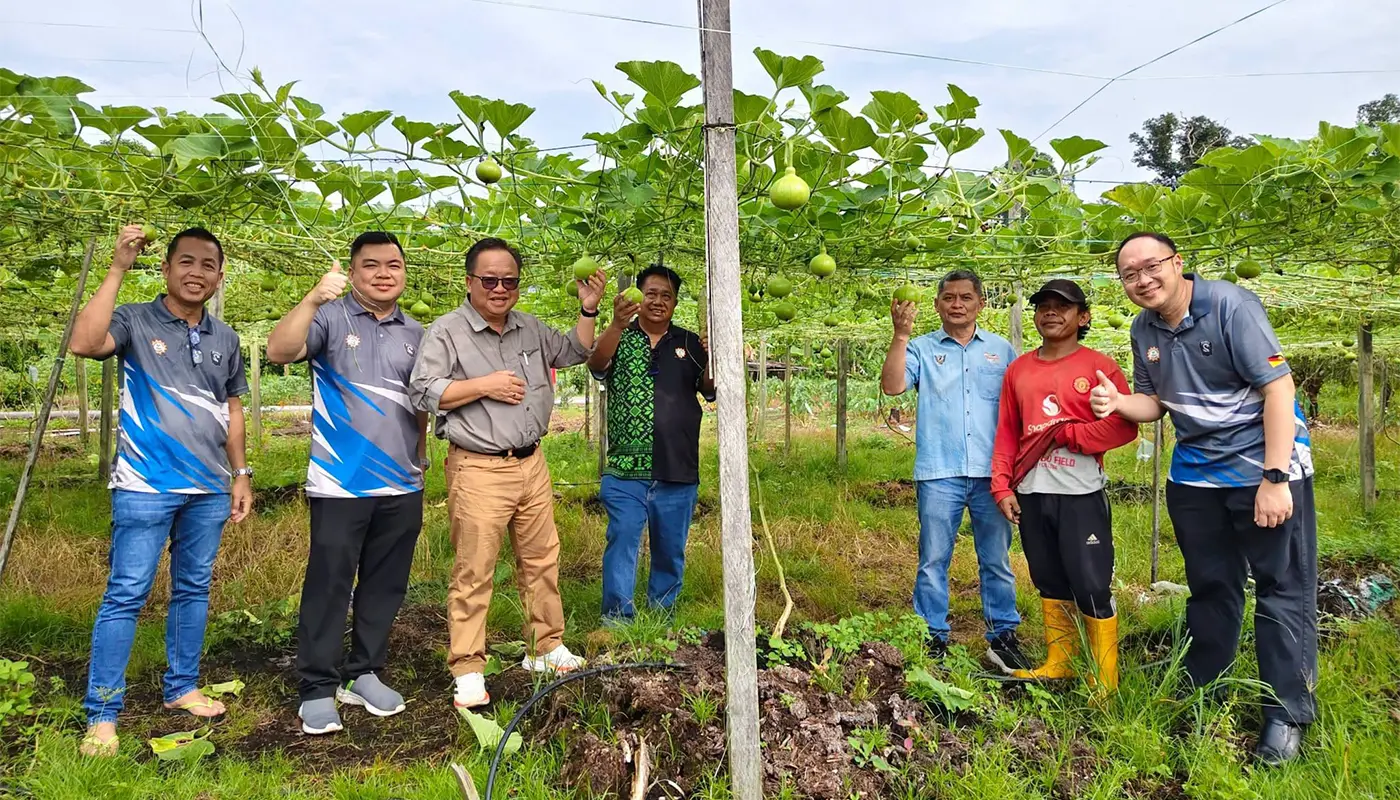
SIBU – Senior government officials from the Sarawak state administration undertook a significant field inspection on Sunday, focusing on agricultural initiatives designed to bolster local food production.

The high-level delegation aimed to assess progress in both vegetable cultivation and advanced rice farming techniques within the Sibu division.
Leading the working visit was the Director of Sarawak Agriculture, Dominic Anak Chunggat. He was accompanied by Datu Sirai Daha, who serves as the Permanent Secretary for the Ministry of Food Industry, Commodities and Regional Development Sarawak, commonly known as M-FICORD.
Their itinerary included stops at key agricultural sites that represent different facets of the state’s strategy to enhance self-sufficiency in food supplies.
The first stop for the delegation was Sungai Bidut, where they examined ongoing vegetable crop activities. This segment of the visit provided an opportunity for direct engagement with local farmers.
The officials listened to concerns raised by the growers regarding operational challenges and discussed potential solutions to improve productivity. Such dialogue is considered crucial for aligning government support with the practical needs of the agricultural community.
Following the review of vegetable farming, the group proceeded to Rumah Unjah in the Sungai Melangan area. Here, they inspected a seven-acre rice demonstration plot that has become a focal point for modernising traditional paddy farming in the region.
The project is managed by Borneo Agritech, under the leadership of Mr Bayang Ringkat, in close collaboration with Tuai Rumah Unjah, the local longhouse headman.
This particular demonstration site is notable for its integration of cutting-edge agricultural technologies. The farm employs sophisticated water management systems to optimise irrigation efficiency.
Additionally, it utilises drone technology for monitoring crop health and applying treatments with precision. The use of high-potential rice varieties ensures that yields are maximised, while Internet of Things (IoT) sensors provide real-time data on soil and environmental conditions.
These technological interventions are not merely experimental but serve as a benchmark for the broader development of the Sarawak rice industry.
The state government has set ambitious targets for strengthening food security by 2030, and projects like the one in Sungai Melangan are viewed as essential stepping stones towards achieving this goal.
By demonstrating the viability of smart farming techniques, the initiative aims to encourage wider adoption among local farmers.
Several other key personnel from the Sarawak Agriculture Department were present during the inspections. Mr Andrew Iling, the Sibu Division Agriculture Officer, joined the delegation to provide regional insights.
He was accompanied by Agricultural Officer Mr Jee Wei Ren and Mr Jenattan Sambang Anak Ai, who serves as the Assistant Agricultural Officer and Sibu Agriculture District Manager.
Staff members from the Sibu Division of the Sarawak Agriculture Department also attended, underscoring the departmental commitment to supporting these agricultural advancements.
The visit highlights the state’s continued emphasis on transforming its agricultural sector through innovation and collaboration.
By combining traditional knowledge with modern technology, Sarawak aims to reduce its reliance on imported food items and ensure a stable supply for its population.
The engagement between senior policymakers and ground-level operators reflects a holistic approach to agricultural development.
Observers note that such high-profile visits often accelerate the implementation of support measures and facilitate quicker resolution of logistical issues faced by farmers.
The focus on both vegetable and rice production indicates a diversified strategy to address various aspects of food security.
As the state moves closer to the 2030 deadline, the success of pilot projects like those in Sibu will likely influence policy decisions and resource allocation across the region.
The collaboration between private entities like Borneo Agritech and public institutions demonstrates a growing trend of public-private partnerships in Sarawak’s agricultural landscape.
This model allows for the sharing of expertise and resources, potentially leading to more sustainable and profitable farming practices.
The outcomes of these demonstrations will be closely watched by stakeholders throughout the state as they seek to replicate similar successes in their own communities.
