



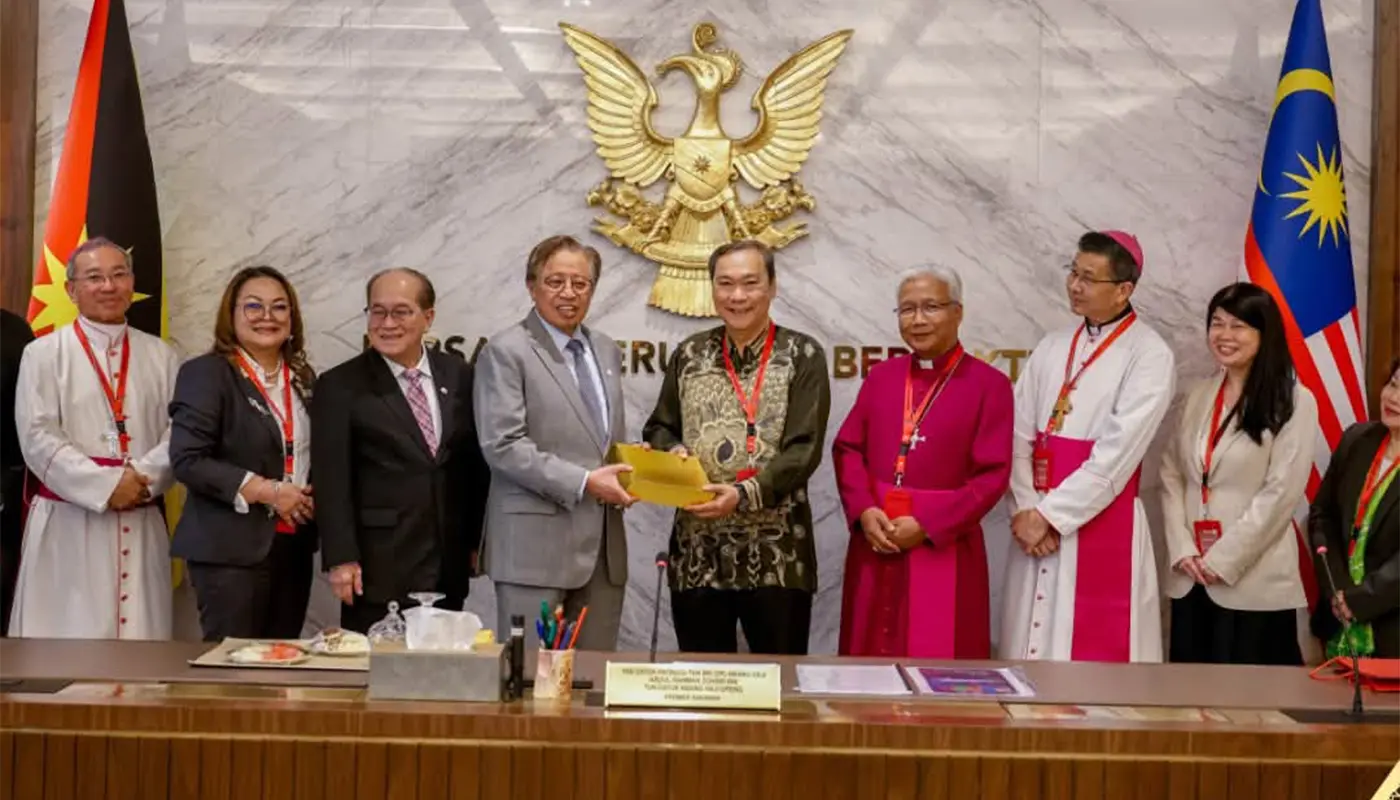
KUCHING – The distinctive approach to social cohesion in Sarawak has garnered significant acclaim from national religious leaders. During a courtesy call on 28 July 2026, delegates from the Christian Federation of Malaysia (CFM) met with the Sarawak Premier, Datuk Patinggi Tan Sri (Dr) Abang Haji Abdul Rahman Zohari bin Tun Datuk Abang Haji Openg, at the Satria Pertiwi Complex in Petra Jaya.

The engagement served as a testament to the enduring rapport between the state administration and Christian communities across the nation.
It provided a platform for meaningful dialogue concerning Sarawak’s developmental trajectory, the preservation of religious harmony, and various issues of shared concern.
The meeting was characterised by a spirit of mutual respect and constructive exchange, reflecting the deep-rooted ties that bind the government and faith-based organisations in the region.
Leading the delegation was the CFM Chairman, Rev. Dr. Eu Hong Seng. He described the discussions as both cordial and productive, highlighting the positive atmosphere that pervaded the session.
A central theme of the conversation was Sarawak’s successful model of multi-racial and multi-religious coexistence. The delegates noted how the state has managed to maintain peace and stability amidst diversity, serving as a benchmark for other regions.
Particular attention was drawn to the role of the Unit for Other Religions (UNIFOR). The CFM leaders commended the unit’s efforts in supporting non-Islamic religious practices and fostering an environment of mutual respect among different faith communities.
They viewed UNIFOR as a vital mechanism in ensuring that all religious groups feel valued and protected under the state’s governance framework.
The delegation also expressed appreciation for the Premier’s progressive vision and steadfast leadership. They acknowledged that these qualities have been instrumental in driving Sarawak’s socio-economic advancement.
As one of the country’s leading economies, Sarawak’s success was attributed not only to resource management but also to the social stability that allows businesses and communities to thrive without the friction of communal discord.
Beyond state-specific matters, the two sides exchanged perspectives on broader national developments. They discussed the potential for Sarawak to continue playing a pivotal role in promoting unity and stability at the federal level.
The consensus was that the state’s experience in managing diversity offers valuable lessons for the nation as a whole, contributing to overall progress and national harmony.
The visit coincided with the CFM’s Executive Committee meeting in Kuching, allowing the leaders to witness firsthand the culture of inclusiveness and acceptance that defines Sarawakian society.
The delegates praised the local ethos, noting how it facilitates seamless interaction among people of different backgrounds. This environment of tolerance was highlighted as a key strength of the state’s social fabric.
Several high-ranking church officials accompanied the Chairman, underscoring the significance of the visit. Among those present were the CFM Vice Chairman, Archbishop Julian Leow Beng Kim, and Bishop Datuk Danald Jute.
Also in attendance were the Assistant Honorary Treasurer, Archbishop Dato Simon Poh, and the Executive Secretary, Rev Andy Chi Cheng Khee.
Representatives from the Catholic Bishops’ Conference of Malaysia, the Council of Churches of Malaysia, and the National Evangelical Christian Fellowship joined other members of the CFM Executive Committee in the dialogue.
The delegation concluded the meeting by reaffirming their hope that Sarawak’s example would continue to inspire greater unity throughout Malaysia.
They emphasised that the principles of mutual respect and harmonious living practiced in Sarawak are essential for the nation’s long-term stability.
By maintaining open lines of communication and fostering interfaith understanding, both the government and religious leaders remain committed to building a cohesive and prosperous society.
This interaction reinforces the narrative that religious harmony is not merely a social ideal in Sarawak but a practical foundation for its continued growth and development.
As the state moves forward, the collaboration between secular authorities and religious bodies remains a cornerstone of its governance strategy.
