



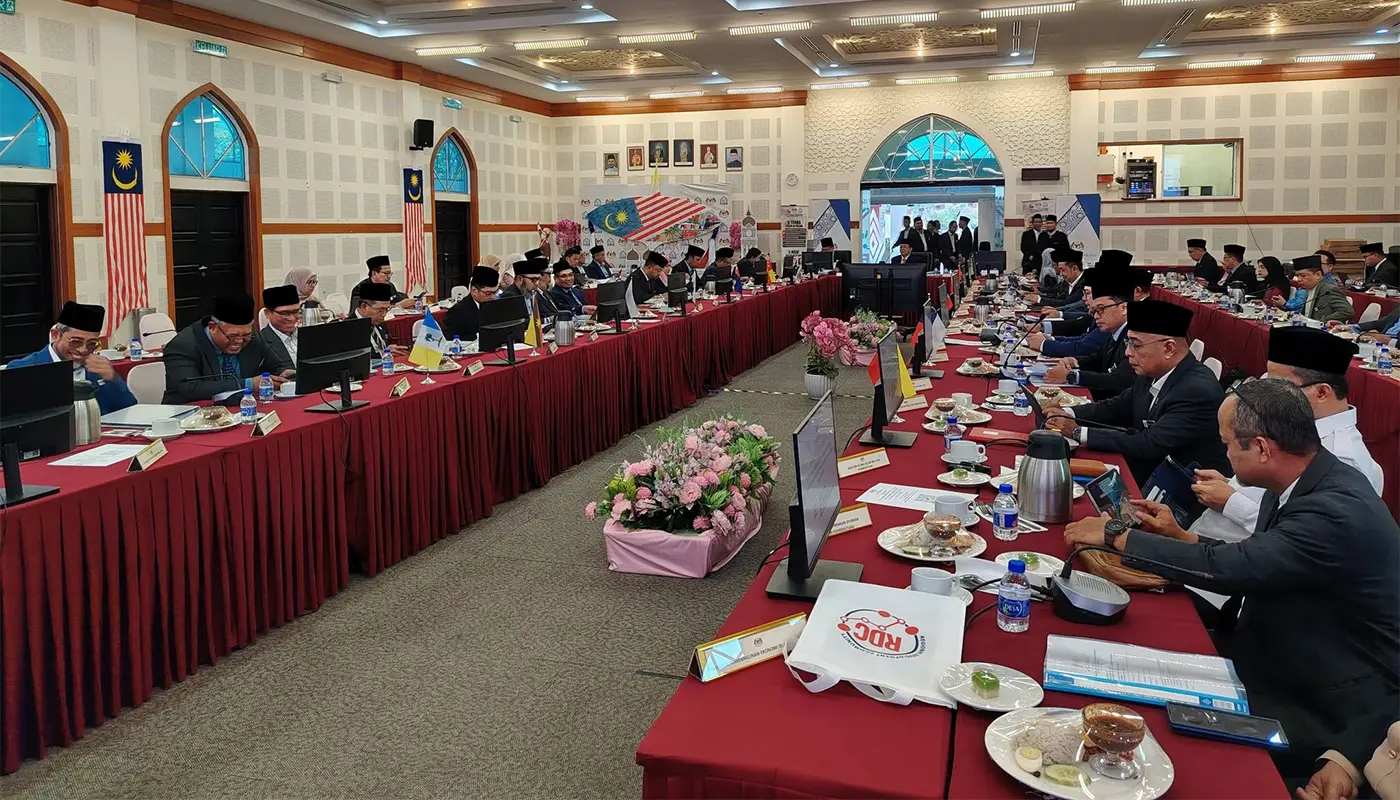
KUCHING – Strengthening administrative ties between federal and state religious authorities took centre stage as senior leaders from across Malaysia convened for a high-level strategic discussion in Selangor.

The Fifth Meeting of Heads of Departments and Islamic Religious Councils, commonly referred to as the MKJ, served as a critical forum for aligning policies and enhancing service delivery for Muslim communities nationwide.
Held on 3 August 2026 at the Datuk Mohd Shahir Hall within the Malaysian Islamic Training Institute (ILIM) in Bandar Baru Bangi, the gathering underscored the ongoing commitment to unified governance in religious affairs.
Representing Sarawak at this significant national assembly was Sahibus Siyadah Ustaz Haji Mual bin Haji Suaud, who serves as the Director of the Sarawak Islamic Religious Department.
His attendance highlights the active role that East Malaysian states play in shaping the broader landscape of Islamic administration in the country.
Participation by key figures from Sarawak ensures that regional perspectives and unique local contexts are adequately represented during federal-level deliberations, preventing a one-size-fits-all approach to religious management.
The session was presided over by the Director General of the Malaysian Islamic Development Department (JAKIM), bringing together department heads and secretaries from state Islamic Religious Councils throughout the federation.
This comprehensive representation facilitates direct communication channels between central leadership and state-level implementers.
Such face-to-face engagement is often more effective than correspondence alone, allowing for nuanced discussions about challenges that may vary significantly between Peninsular Malaysia and the Borneo states.
Central to the agenda was the coordination of Islamic affairs across different tiers of government. Delegates examined various strategies to harmonise programmes and initiatives, aiming to eliminate duplication and enhance overall efficiency.
In an era where public expectations for government services continue to rise, integrating administrative efforts is seen as essential for maintaining relevance and effectiveness.
The meeting provided a structured environment to identify gaps in current systems and propose collaborative solutions that leverage collective resources.
Beyond mere administrative logistics, the MKJ functions as a vital platform for reinforcing relationships between JAKIM and its state counterparts.
Trust and mutual understanding are foundational to successful inter-governmental cooperation, particularly in matters involving religious sensitivity and community welfare.
Regular gatherings of this nature help to cultivate personal rapport among leaders, which can prove invaluable when navigating complex issues or implementing new directives that require broad consensus and buy-in.
Strategic cooperation emerged as another key theme, with participants focusing on how to better coordinate da’wah activities and community outreach.
An integrated approach allows for the sharing of best practices and educational materials, ensuring that messaging remains consistent whilst still being adaptable to local cultural norms.
For Sarawak, this aspect is particularly pertinent given the state’s distinct demographic composition and the need for dakwah methods that resonate with diverse audiences while upholding core theological principles.
The emphasis on improving service delivery to the ummah reflects a broader shift towards outcome-oriented religious administration.
Leaders recognise that institutional credibility depends not only on doctrinal correctness but also on the tangible benefits provided to the community.
Whether through enhanced digital services, improved mosque management, or more responsive counselling support, the ultimate measure of success lies in how well these institutions serve the daily needs of the people they represent.
Discussions also likely touched upon emerging challenges facing Muslim communities in contemporary society, ranging from digital misinformation to socioeconomic pressures.
Addressing these issues requires agile and coordinated responses that no single agency can manage in isolation.
By pooling intelligence and expertise, national and state bodies can develop more robust frameworks for safeguarding community well-being against modern threats.
The outcomes of this fifth meeting are expected to influence policy direction and operational priorities for the coming year.
Action items generated during the session will cascade down to respective departments, guiding budget allocations and programme planning at the state level.
For Sarawak specifically, insights gained from national peers can inform local innovations whilst ensuring alignment with overarching national standards.
Ultimately, forums like the MKJ demonstrate the maturity of Malaysia’s Islamic administrative ecosystem. They reflect a system capable of balancing centralised oversight with regional autonomy, fostering unity without erasing diversity.
As religious institutions continue to evolve, such mechanisms for dialogue and coordination remain indispensable for sustaining effective governance and serving the spiritual and social needs of the nation’s Muslim population.
