



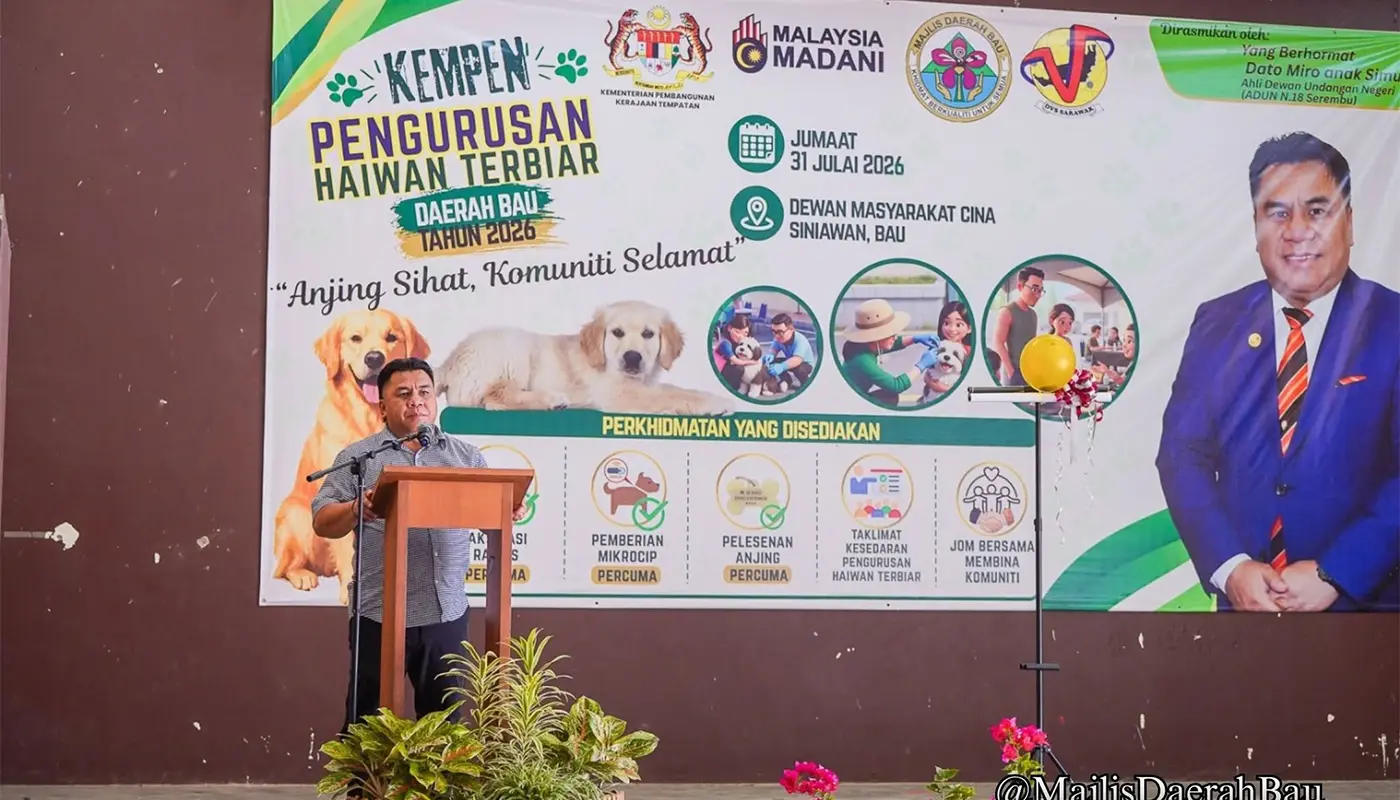
BAU – A concerted effort to address public health safety and animal welfare took centre stage at the Siniawan Chinese Community Hall on 31 July 2026.

The Bau District Council convened a comprehensive campaign dedicated to stray animal management and rabies prevention, drawing together various stakeholders to tackle these persistent local challenges.
This initiative reflects a growing recognition within Sarawak that effective disease control requires not just medical intervention but also sustained community education and behavioural change regarding pet ownership.
By bringing these services directly to residents, authorities aim to bridge the gap between policy implementation and grassroots compliance.
The event was officially launched by Yang Berhormat Dato Miro Anak Simuh, the State Assemblyman for N.18 Serembu, whose presence underscored the political will supporting such public health measures.
Before the formal proceedings commenced, attendees underwent registration, ensuring organisers could track participation levels and demographic reach.
Educational components formed the backbone of the morning agenda, with Dr Amielea Missell, an epidemiology officer from the Bau District Health Office, delivering a critical briefing on rabies control protocols.
Her expertise provided residents with accurate, science-based information necessary to dispel myths and encourage proactive health-seeking behaviours for both humans and animals in the district.
Ceremonial elements were woven throughout the programme to observe national and state traditions whilst fostering a sense of shared civic responsibility.
Participants stood for the national anthem Negaraku and the state song Ibu Pertiwiku, reinforcing the connection between local actions and broader patriotic duties.
Spiritual grounding was provided through prayers recited by Desmond Andrin Anak Aloi, Head of the Ummah, acknowledging the diverse cultural fabric of the Bau community.
Such inclusive practices ensure that public health campaigns resonate across different ethnic and religious groups, making vital messages more accessible and acceptable to the wider population.
Administrative leadership was visibly present, with Encik Ong Chin Ping, Secretary of the Bau District Council, delivering welcoming remarks that set the tone for collaborative engagement.
His address preceded the keynote speech by YB Dato Miro Anak Simuh, who emphasised the collective responsibility required to maintain safe neighbourhoods.
Following these addresses, a symbolic opening gimmick marked the official commencement of campaign activities, transitioning the gathering from ceremonial observance to practical action.
Tokens of appreciation were subsequently presented to key contributors, recognising the often-unseen labour of volunteers and agency staff who make such large-scale events possible.
Practical service delivery distinguished this campaign from purely informational seminars. Exhibition booths offered tangible resources, including complimentary rabies vaccinations, microchipping services, and dog licensing facilitation.
These on-site interventions remove common barriers to compliance such as cost, transportation, or bureaucratic complexity.
When authorities bring services directly to communities rather than expecting residents to navigate distant offices, uptake rates typically improve significantly.
The exhibition also featured educational displays illustrating proper stray animal management techniques, providing visual reinforcement of verbal messages delivered earlier in the programme.
Photographic documentation captured the spirit of collaboration amongst agencies, officials, and citizens, creating visual records that can inspire future participation.
More importantly, these images serve as evidence of government responsiveness to community concerns about public safety and animal welfare.
The Bau District Council has expressed profound gratitude to all participating organisations and individuals whose efforts ensured the campaign’s success.
Their acknowledgement reinforces the value placed on multi-sectoral partnerships in addressing complex socio-health issues that no single entity can resolve alone.
Looking ahead, organisers hope this initiative catalyses lasting shifts in community attitudes towards responsible pet ownership.
The campaign motto, “Healthy Dogs, Safe Communities”, succinctly captures the interdependence between animal health and human security.
Sustainable progress will require continuous education beyond single-day events, alongside consistent enforcement of existing regulations.
As Sarawak continues managing endemic rabies risks, programmes like this one in Bau demonstrate how localised, culturally sensitive approaches can complement statewide strategies.
Ultimately, creating safer environments depends on transforming awareness into habitual responsible behaviour among all residents.
