



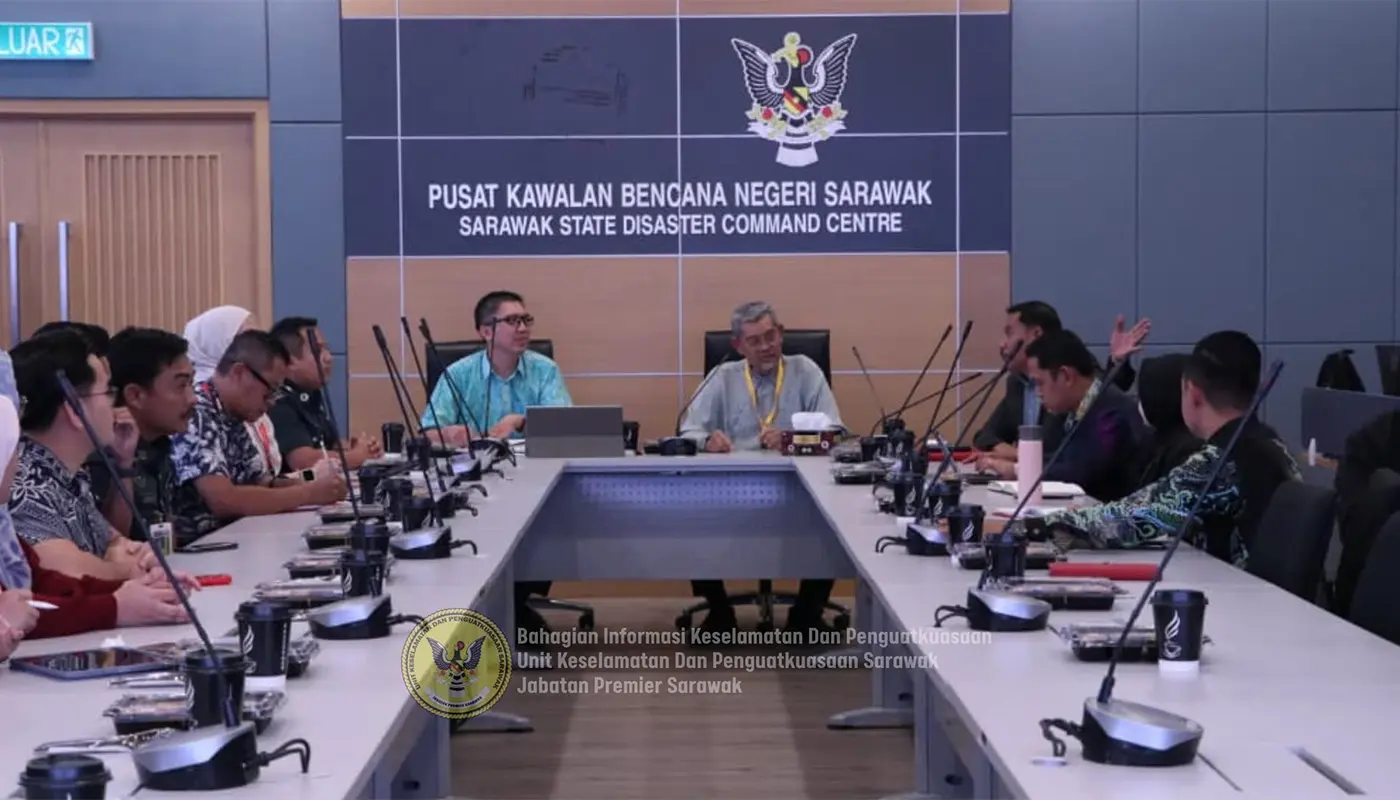
KUCHING – Strategic coordination between state security authorities and airport management has been reinforced through a high-level engagement session focused on aviation emergency readiness. The meeting took place at the State Disaster Control Centre within Wisma Bapa Malaysia on Wednesday afternoon.

Personnel from the Sarawak Security and Enforcement Unit hosted representatives from Malaysia Airports Sdn Bhd Kuching International Airport at 3.00 pm on 6 August 2026. This interaction served to solidify inter-agency cooperation frameworks essential for effective crisis response.
Deputy Director of Safety Abang Ahmad bin Abang Julai chaired the proceedings on behalf of the UKPS Director. His leadership underscored the unit’s prioritisation of collaborative safety mechanisms across critical infrastructure sectors.
The visiting delegation was headed by Senior Airport Manager Ir. Jun Iskandar Murshidi. His presence signalled institutional commitment from MASB towards maintaining robust disaster management protocols at the region’s primary air gateway.
Central to discussions was the upcoming Exercise Buceros Shield 2026, a major air disaster relief simulation. Planning and coordination for this exercise formed the substantive core of the strategic dialogue between both organisations.
Such drills are indispensable for testing integrated response capabilities under realistic pressure conditions. They reveal systemic strengths and vulnerabilities that desk-based planning alone cannot identify effectively.
Benchmarking infrastructure preparedness featured prominently as a key objective of the session. Both parties sought to align their operational standards with best practices in aviation emergency management specific to Sarawak’s context.
Quality enhancement of management systems was another focal point raised during deliberations. Continuous improvement cycles ensure that protocols evolve alongside emerging threats and technological advancements in aviation safety.
The engagement commenced with comprehensive introductions to MASB’s organisational structure and command hierarchies. Understanding counterpart agency architectures facilitates smoother communication during actual emergencies when time is critical.
Detailed briefings on Exercise Buceros Shield 2026 followed the structural overview. Participants examined scenarios, resource allocations, communication protocols, and evaluation metrics planned for the forthcoming drill.
Two-way dialogue characterised the entire session rather than unilateral presentations. Interactive exchanges allowed clarifications, suggestions, and mutual adjustments to enhance exercise design and real-world applicability.
Souvenir exchange concluded the formal proceedings as symbolic affirmation of strengthened partnership. Such gestures reinforce interpersonal relationships that underpin effective institutional collaboration during high-stress situations.
Aviation disasters demand seamless multi-agency coordination due to their complexity and potential casualty scale. No single entity possesses all necessary resources or expertise to manage such incidents independently.
Regular engagement sessions prevent complacency and maintain institutional memory between crises. Familiarity bred through routine interaction translates directly into faster, more coherent responses when disasters strike.
State-level disaster control centres serve as nerve coordinates for unified command during emergencies. Co-locating planning activities within these facilities reinforces their centrality to regional resilience architecture.
Infrastructure benchmarking extends beyond physical assets to encompass procedural and human capital dimensions. True preparedness requires alignment of equipment, training, documentation, and decision-making cultures.
Exercise Buceros Shield 2026 will likely involve multiple stakeholders beyond just UKPS and MASB. Whole-of-government approaches maximise resource mobilisation and demonstrate comprehensive governmental commitment to public safety.
Lessons learned from previous exercises inform continuous refinement of current plans. Institutional learning transforms past experiences into future capabilities through systematic after-action review processes.
Public confidence in aviation safety depends partly on visible preparedness demonstrations. Transparent communication about readiness efforts reassures travellers and residents alike regarding systemic safeguards.
Future engagements may expand scope to include other transport modes or cross-border coordination elements. Integrated regional resilience requires breaking down silos between traditionally separate domains.
Ultimately, these preparatory investments aim to minimise loss of life and property should worst-case scenarios materialise. Professional diligence today prevents catastrophic failures tomorrow.
